Ratchasimasaurus
"Ratchasima lizard"
- Lived
- 121 to 113 million years ago, Early Cretaceous
- Diet
- Herbivore
- Group
- Ornithopods
- Found in
- Thailand
- Named by
- Shibata et al. 2011
Where its fossils were found
The evidence
Today

115 million years ago
Habitat
Winding rivers crossed a floodplain in what is now Thailand. The Khok Kruat Formation also contains Siamodon, Sirindhorna and Siamraptor.
Field notes
About Ratchasimasaurus
What it was like
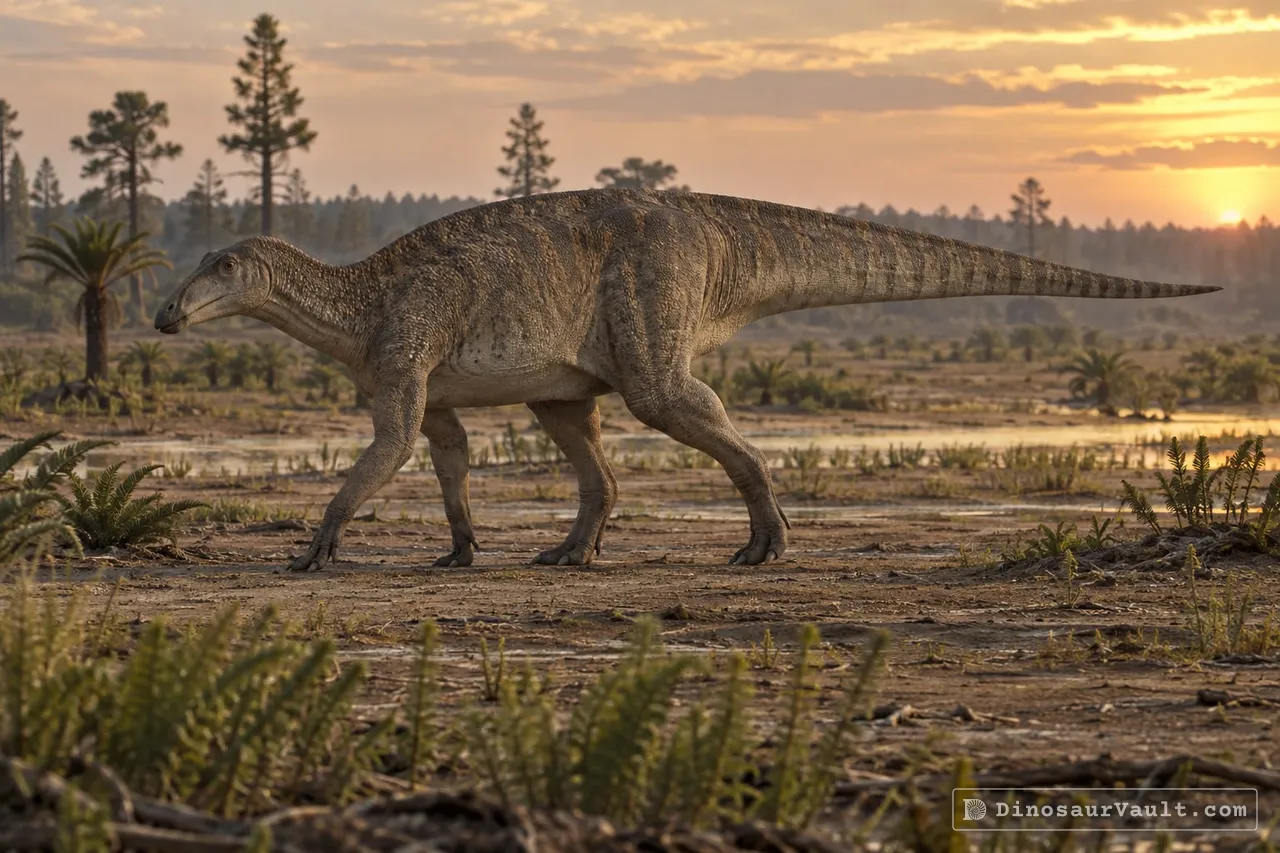
Ratchasimasaurus was a plant eater related to Iguanodon. It is known from a lower jaw bone.
Its world
It lived in the Early Cretaceous in what is now Thailand. Its bones come from the Khok Kruat Formation, where it shared the land with the plant eaters Siamodon and Sirindhorna and the predator Siamraptor.
How it was found
Shibata and colleagues named it in 2011. It is named after the province where it was found.
Field gallery
More views of Ratchasimasaurus
Scenes reconstructed from the available fossil evidence.
1 of 3
Lived alongside
Found in the same rock formations


A rock formation can hold fossils laid down millions of years apart, so not every animal here met Ratchasimasaurus.
The evidence
The science behind Ratchasimasaurus
Which parts of the picture come from its own bones, and which come from its relatives.
From its own fossils
- It is known from a single toothless lower jaw bone, long and low, with a row of empty tooth sockets.
- A shelf separates the tooth row from the tall process where jaw muscles attached, and that process leans backward.
- Its jaw is longer and shallower than the jaw of Sirindhorna from the same rocks. Jaws in this group grow longer with age, so it is unlikely to be a young Sirindhorna.
Borrowed from relatives
- Its upper skull is unknown, so restorations borrow a broad toothless beak and a low skull roof from Eolambia, a North American relative.
- The neck, body, limbs and tail also follow Eolambia, because Ratchasimasaurus is known only from its jaw.
Still unknown
- Whether its jaw features are distinctive enough to define a genus. Some experts see them as unique, while others find them in many related plant eaters.
- Whether it is the same animal as Siamodon from the same rocks. The two are known from different bones, so they cannot be compared.
- Its age at death, its complete skull and body, and its skin.
Discovery timeline
- 2011Named itSHIBATA, JINTASAKUL & AZUMA
- 2015Close relativeShibata et al.
- 2019Same rocksChokchaloemwong et al.
- 2022Family treePoole
Key papers
The research behind what we know of Ratchasimasaurus
Named it
Named Ratchasimasaurus from a long, low lower jaw combining features seen in early iguanodontians and more advanced relatives.
A New Iguanodontian Dinosaur from the Lower Cretaceous Khok Kruat Formation, Nakhon Ratchasima in Northeastern Thailand. Acta Geologica Sinica - English Edition 85: 969-976
Read the paper : A New Iguanodontian Dinosaur from the Lower Cretaceous Khok Kruat Formation, Nakhon Ratchasima in Northeastern Thailand (opens in a new tab)Close relative
Described Sirindhorna skulls from the same formation and identified jaw differences separating it from Ratchasimasaurus and Siamodon.
A New Basal Hadrosauroid Dinosaur from the Lower Cretaceous Khok Kruat Formation in Nakhon Ratchasima Province, Northeastern Thailand. PLOS ONE 10: e0145904
Read the paper : A New Basal Hadrosauroid Dinosaur from the Lower Cretaceous Khok Kruat Formation in Nakhon Ratchasima Province, Northeastern Thailand (opens in a new tab)Same rocks
Described the predator Siamraptor from the same formation and explained how its fossil sites formed beside winding rivers.
A new carcharodontosaurian theropod (Dinosauria: Saurischia) from the Lower Cretaceous of Thailand. PLOS ONE 14: e0222489
Read the paper : A new carcharodontosaurian theropod (Dinosauria: Saurischia) from the Lower Cretaceous of Thailand (opens in a new tab)Family tree
Judged the jaw features of Ratchasimasaurus to be widespread among iguanodonts and left it out of a large family tree of the group.
Phylogeny of iguanodontian dinosaurs and the evolution of quadrupedality. Palaeontologia Electronica
Read the paper : Phylogeny of iguanodontian dinosaurs and the evolution of quadrupedality (opens in a new tab)
Close relatives
Other members of Hadrosauroidea


Sources: Wikidata