Claosaurus
KLAY-oh-SORE-us
"broken lizard"
Type species Claosaurus agilis
- Lived
- 90 to 72 million years ago, Late Cretaceous
- Diet
- Herbivore
- Group
- Ornithopods
- Found in
- United States
- Named by
- Marsh 1890
Where its fossils were found
The evidence
Today

80 million years ago
Habitat
Claosaurus lived on land beside the Western Interior Seaway, and its body probably drifted offshore before burial in marine chalk. Niobrarasaurus also comes from the Niobrara rocks of Kansas.
Field notes
About Claosaurus
What it was like
Claosaurus was an early relative of the duck-billed dinosaurs. A partial skeleton preserves bones from the backbone, limbs and hips, but only small pieces of its skull. The complete shape of its snout is unknown.
Its world
It lived in the Late Cretaceous in North America. Its first skeleton was found in the Niobrara chalk of Kansas, which formed on the floor of a shallow sea. Its body probably floated out to sea after death, like that of the armored Niobrarasaurus from the same rocks.
How it was found
Marsh named Claosaurus in 1890. The type species is Claosaurus agilis. The name refers to the jumbled, broken way its bones were found.
Field gallery
More views of Claosaurus
Scenes reconstructed from the available fossil evidence.
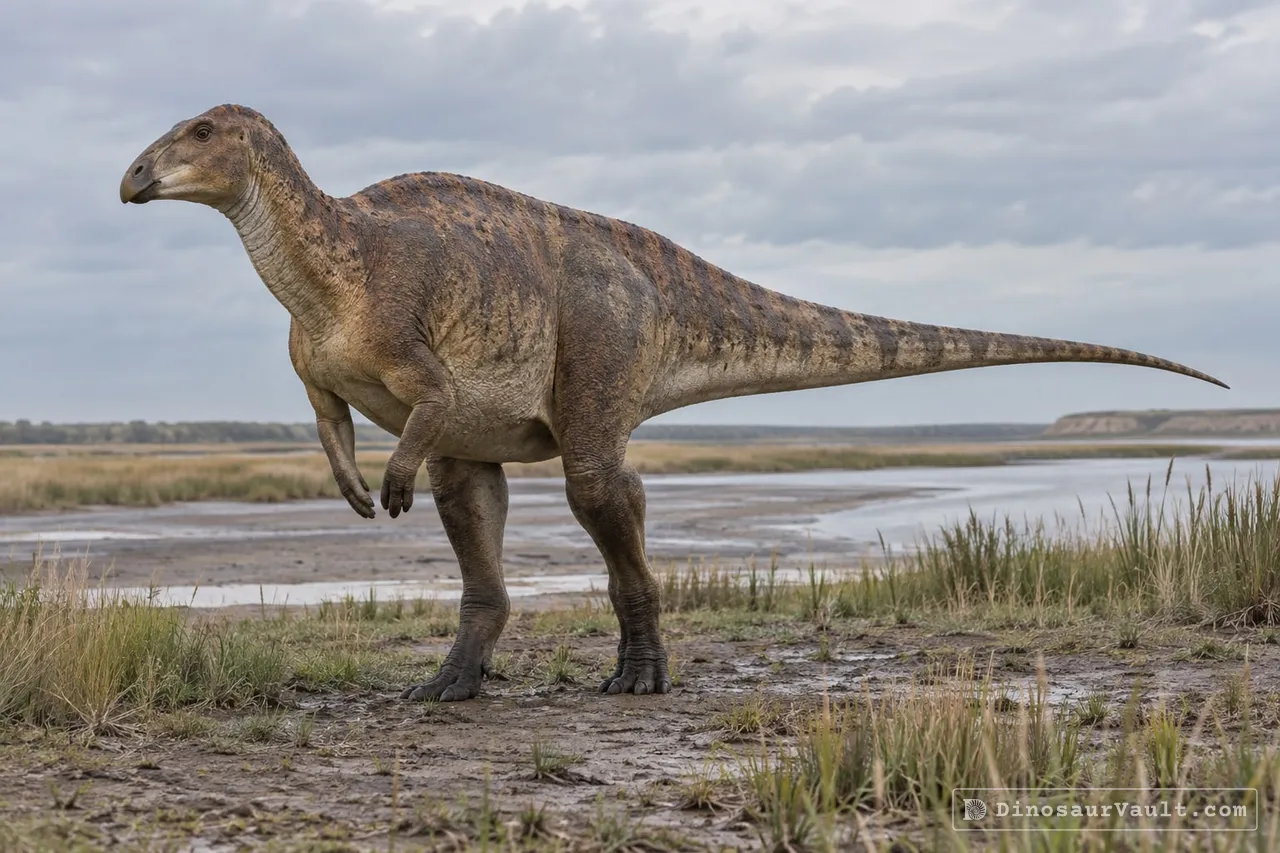
1 of 2
Lived alongside
Found in the same rock formations

A rock formation can hold fossils laid down millions of years apart, so not every animal here met Claosaurus.
The evidence
The science behind Claosaurus
Which parts of the picture come from its own bones, and which come from its relatives.
From its own fossils
- A single partial skeleton preserves vertebrae from the neck to the tail, breastbone plates, a shoulder blade, both upper arm bones, parts of the forearms, the hips, the thigh bones and parts of the shins and feet.
- Only small pieces of the skull survive: fragments of the upper jaw, part of a bone behind the eye and the top of the lower jaw's rear process.
- The crest on its upper arm bone is relatively short with a broad, curved corner, and its hip bone has a broad upper crest. These arm and hip features distinguish it from other early duckbill relatives.
Borrowed from relatives
- The missing parts of its head, neck, tail, hands and feet are restored by comparison with Gobihadros, an early duckbill relative known from complete skulls and skeletons.
- The tips of its fingers follow Camptosaurus, while its own arm bones set the shape of the forelimbs.
Still unknown
- The complete shape of its snout.
- The shape of its hands.
- Where on land the animal lived before its body reached the sea.
Discovery timeline
- 1890Named itMarsh
- 1995Same rocksCarpenter, Dilkes & Weishampel
- 2011RedescriptionPRIETO-MÁRQUEZ
- 2016Close relativePrieto-Márquez, Erickson & Ebersole
- 2019Close relativeTsogtbaatar et al.
Key papers
The research behind what we know of Claosaurus
Named it
Separated Claosaurus from Hadrosaurus after recognizing differences in its hip bones.
Additional characters of the Ceratopsidae, with notice of new Cretaceous dinosaurs. American Journal of Science s3-39: 418-426
Read the paper : Additional characters of the Ceratopsidae, with notice of new Cretaceous dinosaurs (opens in a new tab)Same rocks
Reviewed Claosaurus and the armored dinosaurs from the same marine chalk, recognizing Claosaurus as a distinct early duckbill relative.
The Dinosaurs of the Niobrara Chalk Formation (Upper Cretaceous, Kansas). Journal of Vertebrate Paleontology 15: 275-297
Read the paper : The Dinosaurs of the Niobrara Chalk Formation (Upper Cretaceous, Kansas) (opens in a new tab)Redescription
Identified a combination of hip-bone features that distinguishes Claosaurus from other duckbill relatives.
Revised diagnoses of Hadrosaurus foulkii Leidy, 1858 (the type genus and species of Hadrosauridae Cope, 1869) and Claosaurus agilis Marsh, 1872 (Dinosauria: Ornithopoda) from the Late Cretaceous of North America. Zootaxa 2765
Read the paper : Revised diagnoses of Hadrosaurus foulkii Leidy, 1858 (the type genus and species of Hadrosauridae Cope, 1869) and Claosaurus agilis Marsh, 1872 (Dinosauria: Ornithopoda) from the Late Cretaceous of North America (opens in a new tab)Close relative
Described Eotrachodon and compared it with the single Claosaurus skeleton, listing its surviving bones and its distinctive upper arm and hip features.
Anatomy and osteohistology of the basal hadrosaurid dinosaurEotrachodonfrom the uppermost Santonian (Cretaceous) of southern Appalachia. PeerJ 4: e1872
Read the paper : Anatomy and osteohistology of the basal hadrosaurid dinosaurEotrachodonfrom the uppermost Santonian (Cretaceous) of southern Appalachia (opens in a new tab)Close relative
Named Gobihadros, an early duckbill relative known from a complete skull and articulated skeletons.
A new hadrosauroid (Dinosauria: Ornithopoda) from the Late Cretaceous Baynshire Formation of the Gobi Desert (Mongolia). PLOS ONE 14: e0208480
Read the paper : A new hadrosauroid (Dinosauria: Ornithopoda) from the Late Cretaceous Baynshire Formation of the Gobi Desert (Mongolia) (opens in a new tab)
Close relatives
Other members of Hadrosauroidea


Sources: Wikidata