Qianjiangsaurus
"Qianjiang lizard"
Type species Qianjiangsaurus changshengi
- Lived
- 101 to 66 million years ago, Late Cretaceous
- Diet
- Herbivore
- Group
- Ornithopods
- Found in
- China
- Named by
- Dai et al. 2025
Where its fossils were found
The evidence
Today

80 million years ago
Habitat
The Zhengyang Formation records rivers and lakes in a basin enclosed by mountains, with conditions becoming drier over time. Other inhabitants included titanosaurs, dromaeosaurs and tyrannosaur relatives.
Field notes
About Qianjiangsaurus
What it was like
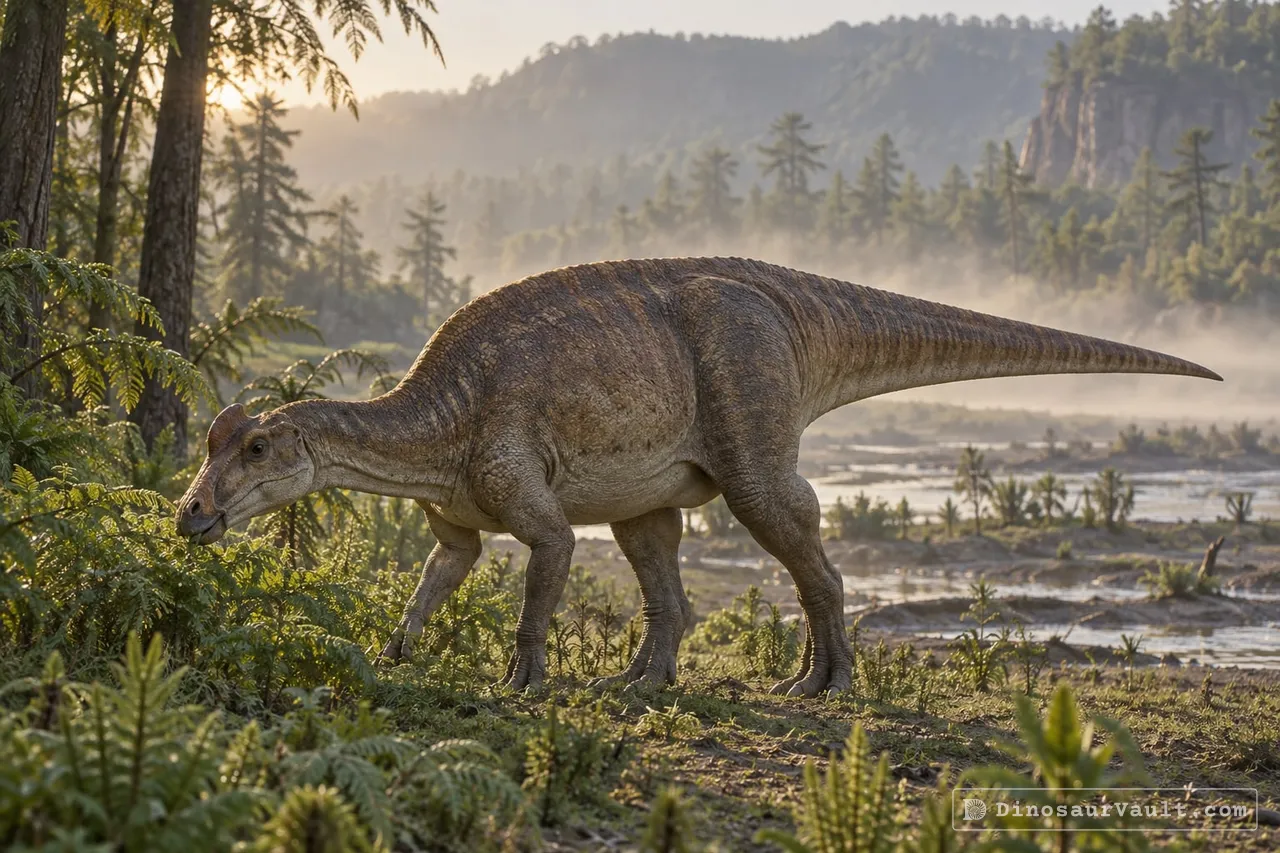
Qianjiangsaurus was a plant eater, an early relative of the duck-billed dinosaurs. It is known from part of a skeleton and a lower jaw, and later from part of a skull.
Its world
It lived in the Late Cretaceous in what is now central China. Its bones come from the Zhengyang Formation.
How it was found
Dai and colleagues named Qianjiangsaurus in 2025, from a single find.
Field gallery
More views of Qianjiangsaurus
Scenes reconstructed from the available fossil evidence.
1 of 3
The evidence
The science behind Qianjiangsaurus
Which parts of the picture come from its own bones, and which come from its relatives.
From its own fossils
- The original find preserves part of the lower jaw, backbone, tail, hips and hind legs.
- A later skull has a low, helmet-shaped hollow crest formed by the nasal bones.
- Scans of the crest reveal paired extra chambers above the main nasal airway.
Borrowed from relatives
- The missing forelimbs are restored by comparison with other early duckbill relatives such as Gobihadros.
- Corythosaurus has a hollow crest too, but Qianjiangsaurus evolved its crest independently.
Still unknown
- Its skin texture and color.
- The sounds it made.
- How its crest changed as it grew.
Discovery timeline
- 2025Named itDai et al.
- 2026SkullMa et al.
- 2026Its worldDai et al.
Key papers
The research behind what we know of Qianjiangsaurus
Named it
Described a partial skeleton and lower jaw, placing Qianjiangsaurus close to the duckbill family and linking dinosaur faunas across Asia.
A new late-diverging non-hadrosaurid hadrosauroid (Dinosauria: Ornithopoda) from southwest China: Support for interchange of dinosaur faunas across East Asia during the Late Cretaceous. Cretaceous Research 166: 105995
Read the paper : A new late-diverging non-hadrosaurid hadrosauroid (Dinosauria: Ornithopoda) from southwest China: Support for interchange of dinosaur faunas across East Asia during the Late Cretaceous (opens in a new tab)Skull
Described a hollow nasal crest whose internal chambers may have amplified low-pitched calls, evolving separately from the crests of later duckbills.
First Report of a Hollow Cranial Crest in an Early-Diverging Duck-Billed Dinosaur, with Implications for Convergent Evolution of Acoustic Signaling. Biology 15: 615
Read the paper : First Report of a Hollow Cranial Crest in an Early-Diverging Duck-Billed Dinosaur, with Implications for Convergent Evolution of Acoustic Signaling (opens in a new tab)Its world
Traced river, lake and debris-flow deposits in the Zhengyang Formation and a shift from humid to dry conditions.
Stratigraphy, sedimentology, and palaeoenvironment of dinosaur-bearing Upper Cretaceous Zhengyang Formation in Zhengyang Basin, Chongqing, Southwest China. Palaeoworld 35: 201158
Read the paper : Stratigraphy, sedimentology, and palaeoenvironment of dinosaur-bearing Upper Cretaceous Zhengyang Formation in Zhengyang Basin, Chongqing, Southwest China (opens in a new tab)
Close relatives
Other members of Hadrosauroidea


Sources: Wikidata