Fukuisaurus
"Fukui lizard"
Type species Fukuisaurus tetoriensis
- Lived
- 121 to 113 million years ago, Early Cretaceous
- Diet
- Herbivore
- Length
- about 4.7 m (15 ft)
- Group
- Ornithopods
- Found in
- Japan
- Named by
- Kobayashi and Azuma 2003
Size comparison
To scale


Scale in metersOutline: typical ornithopod shape
Where its fossils were found
The evidence
Today

115 million years ago
Habitat
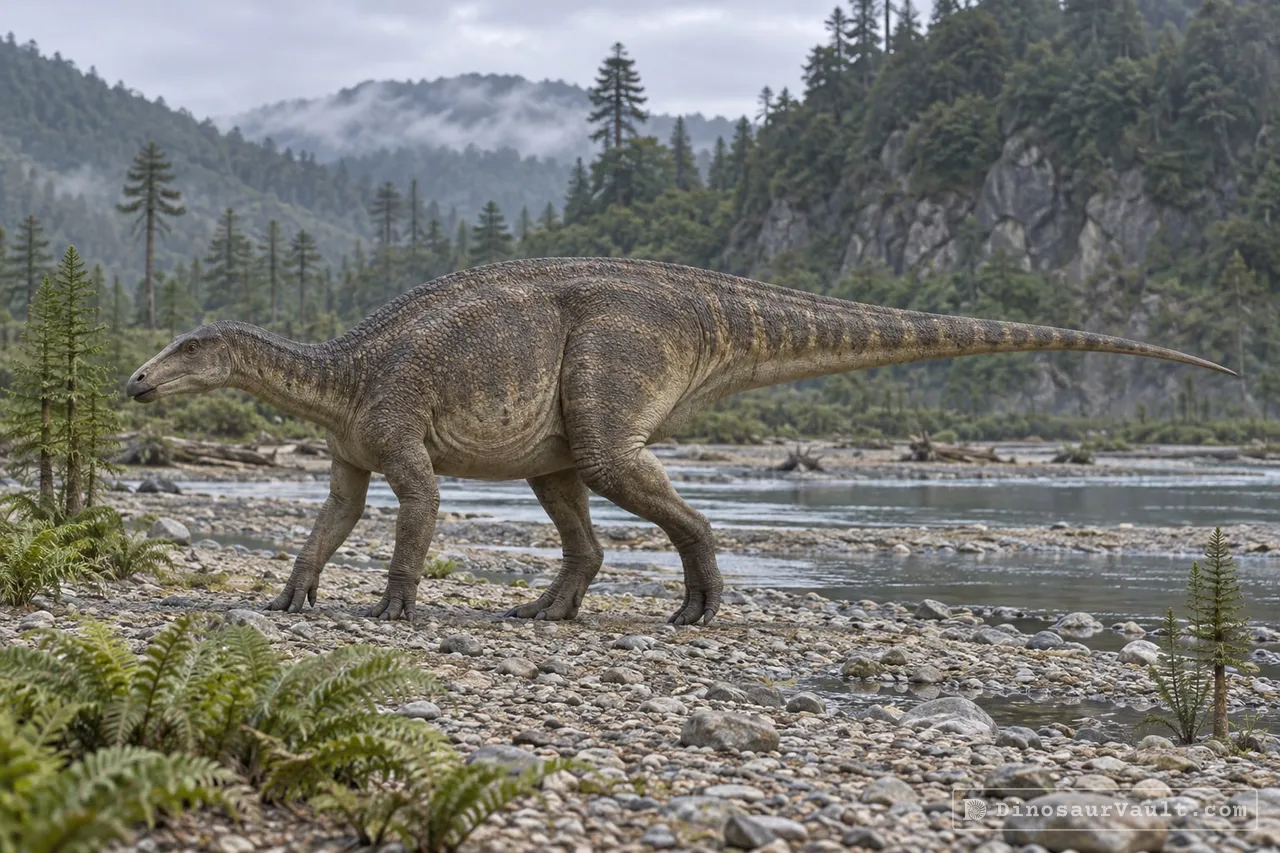
Rivers and lakes crossed a warm landscape with ferns and conifers. Fukuiraptor, Fukuititan and Koshisaurus also come from the Kitadani Formation.
Field notes
About Fukuisaurus
What it was like
Fukuisaurus was a plant eater about 4.7 meters (15 feet) long, an early relative of the duckbills. Its skull was solid, and scientists think it could not flex its upper jaw the way some other iguanodonts could.
Its world
It lived in the Early Cretaceous, in what is now Japan. It comes from the Kitadani Formation, where it shared the land with the predators Fukuiraptor and Fukuivenator and the sauropod Fukuititan.
How it was found
Kobayashi and Azuma named Fukuisaurus in 2003. The type species is Fukuisaurus tetoriensis.
Field gallery
More views of Fukuisaurus
Scenes reconstructed from the available fossil evidence.
1 of 3
Lived alongside
Found in the same rock formations


A rock formation can hold fossils laid down millions of years apart, so not every animal here met Fukuisaurus.
The evidence
The science behind Fukuisaurus
Which parts of the picture come from its own bones, and which come from its relatives.
From its own fossils
- Skull bones and teeth show a narrow snout and a deep lower jaw.
- The tooth-bearing upper jaw fitted tightly against a bone in the roof of the mouth, suggesting it could not flex sideways while chewing.
Borrowed from relatives
- Missing parts of the body can be restored by comparison with Iguanodon and Ouranosaurus, which share features of its skull.
Still unknown
- Its skin texture and color.
- Exactly which plants it ate.
- How its body changed as it grew.
Discovery timeline
- 2003Named itKobayashi & Azuma
- 2013Its worldLegrand et al.
- 2015Same rocksSHIBATA & AZUMA
Key papers
The research behind what we know of Fukuisaurus
Named it
Described skull bones and teeth of a plant eater with an unusually firm connection between its upper jaw and the roof of its mouth.
A new iguanodontian (Dinosauria: Ornithopoda) from the Lower Cretaceous Kitadani Formation of Fukui Prefecture, Japan. Journal of Vertebrate Paleontology 23: 166-175
Read the paper : A new iguanodontian (Dinosauria: Ornithopoda) from the Lower Cretaceous Kitadani Formation of Fukui Prefecture, Japan (opens in a new tab)Its world
Fossil spores and pollen reveal vegetation around rivers and lakes in a warm, moderately humid climate.
Lower Cretaceous (Upper Barremian-Lower Aptian?) Palynoflora from the Kitadani Formation (Tetori Group, Inner Zone of Central Japan). Paleontological Research 17: 201-229
Read the paper : Lower Cretaceous (Upper Barremian-Lower Aptian?) Palynoflora from the Kitadani Formation (Tetori Group, Inner Zone of Central Japan) (opens in a new tab)Same rocks
Named Koshisaurus from the same formation and found differences in its jaws and teeth that distinguish it from Fukuisaurus.
New basal hadrosauroid (Dinosauria: Ornithopoda) from the Lower Cretaceous Kitadani Formation, Fukui, central Japan. Zootaxa 3914
Read the paper : New basal hadrosauroid (Dinosauria: Ornithopoda) from the Lower Cretaceous Kitadani Formation, Fukui, central Japan (opens in a new tab)
Close relatives
Other members of Hadrosauroidea


Sources: Wikidata