Koshisaurus
"Koshi lizard"
Type species Koshisaurus katsuyama
- Lived
- 121 to 113 million years ago, Early Cretaceous
- Diet
- Herbivore
- Group
- Ornithopods
- Found in
- Japan
- Named by
- Shibata and Azuma 2015
Where its fossils were found
The evidence
Today

115 million years ago
Habitat
Rivers crossed its landscape in the Kitadani Formation of Japan. Other dinosaurs from these rocks include Fukuisaurus, Fukuiraptor and Fukuititan.
Field notes
About Koshisaurus
What it was like
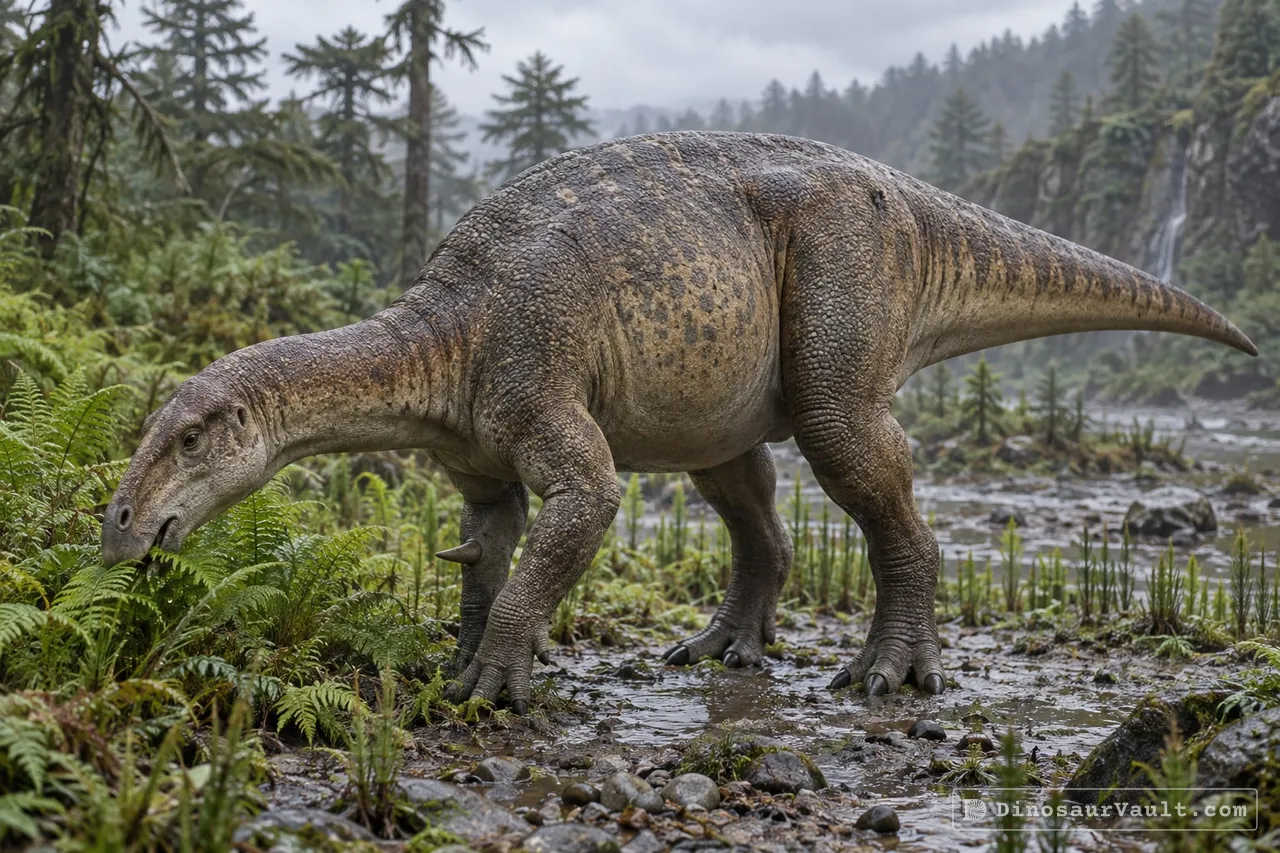
Koshisaurus was a plant eater, an early relative of the duck-billed dinosaurs, known from part of an upper jaw with teeth.
Its world
It lived in the Early Cretaceous in what is now Japan. Its fossil comes from the Kitadani Formation, where it shared the land with another early hadrosaur relative, Fukuisaurus, the hunter Fukuiraptor and the long-necked Fukuititan.
How it was found
Shibata and Azuma named Koshisaurus in 2015, from a single find. Its name comes from an old name for the region.
Field gallery
More views of Koshisaurus
Scenes reconstructed from the available fossil evidence.
Lived alongside
Found in the same rock formations


A rock formation can hold fossils laid down millions of years apart, so not every animal here met Koshisaurus.
The evidence
The science behind Koshisaurus
Which parts of the picture come from its own bones, and which come from its relatives.
From its own fossils
- An upper jaw preserves teeth with a strong main ridge and at least three smaller ridges on their inner surfaces.
- The described bones also include neck and back vertebrae, part of the pelvis and a thigh bone.
- A hollow in front of the eye helps distinguish its upper jaw from that of Fukuisaurus.
Borrowed from relatives
- Probactrosaurus provides broader comparisons for the missing head and body regions; Iguanodon provides comparisons for the missing hands and feet.
Still unknown
- Its full adult size, body proportions and complete skull shape.
- Its exact place in the family tree: the naming study put it near the base of the duck-bill line, and one later analysis put it just outside the wider group.
- Its skin covering and color.
Discovery timeline
- 2003Same rocksKobayashi & Azuma
- 2015Named itSHIBATA & AZUMA
- 2016Same rocksAzuma et al.
- 2019Family treeTsogtbaatar et al.
Key papers
The research behind what we know of Koshisaurus
Same rocks
Described Fukuisaurus from the same river deposits, providing a comparison for the jaw and teeth of Koshisaurus.
A new iguanodontian (Dinosauria: Ornithopoda) from the Lower Cretaceous Kitadani Formation of Fukui Prefecture, Japan. Journal of Vertebrate Paleontology 23: 166-175
Read the paper : A new iguanodontian (Dinosauria: Ornithopoda) from the Lower Cretaceous Kitadani Formation of Fukui Prefecture, Japan (opens in a new tab)Named it
Distinguished Koshisaurus from Fukuisaurus using the jaw, teeth and other bones, and placed it near the base of the duck-bill family tree.
New basal hadrosauroid (Dinosauria: Ornithopoda) from the Lower Cretaceous Kitadani Formation, Fukui, central Japan. Zootaxa 3914
Read the paper : New basal hadrosauroid (Dinosauria: Ornithopoda) from the Lower Cretaceous Kitadani Formation, Fukui, central Japan (opens in a new tab)Same rocks
Described Fukuivenator, another dinosaur from the same quarry, with an unusual mixture of theropod features.
A bizarre theropod from the Early Cretaceous of Japan highlighting mosaic evolution among coelurosaurians. Scientific Reports 6
Read the paper : A bizarre theropod from the Early Cretaceous of Japan highlighting mosaic evolution among coelurosaurians (opens in a new tab)Family tree
One later analysis, described as preliminary, placed Koshisaurus outside the wider duck-bill group, farther from the true duckbills than its naming study did.
A new hadrosauroid (Dinosauria: Ornithopoda) from the Late Cretaceous Baynshire Formation of the Gobi Desert (Mongolia). PLOS ONE 14: e0208480
Read the paper : A new hadrosauroid (Dinosauria: Ornithopoda) from the Late Cretaceous Baynshire Formation of the Gobi Desert (Mongolia) (opens in a new tab)
Close relatives
Other members of Hadrosauroidea


Sources: Wikidata