Tyrannomimus
"tyrant mimic"
Type species Tyrannomimus fukuiensis
- Lived
- 121 to 113 million years ago, Early Cretaceous
- Diet
- Omnivore
- Group
- Theropods, Deinocheiridae
- Found in
- Japan
- Named by
- Hattori et al. 2023
Where its fossils were found
The evidence
Today

115 million years ago
Habitat
Rivers and floodplains in the Kitadani Formation of Japan. Neighbors included Fukuiraptor, Fukuisaurus and Fukuititan.
Field notes
About Tyrannomimus
What it was like
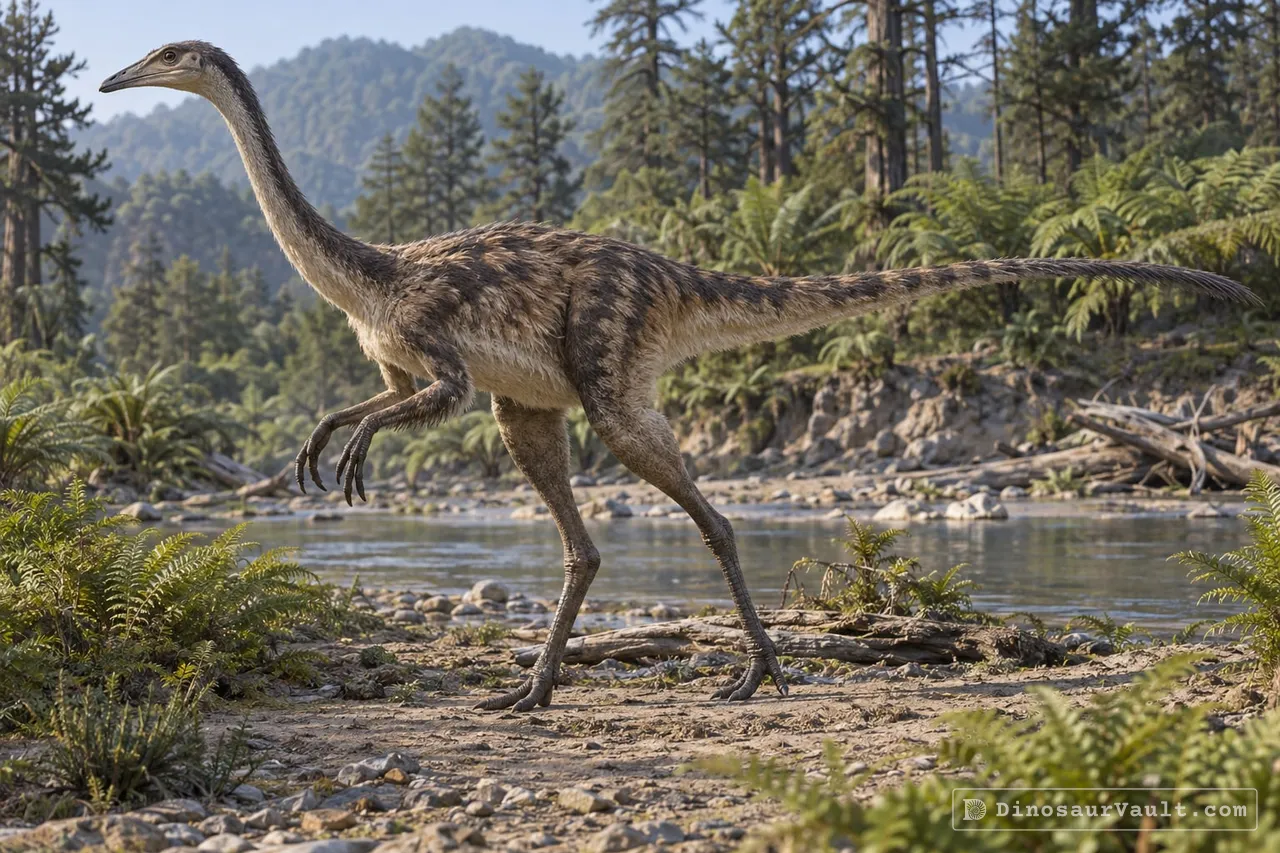
Tyrannomimus was an early ostrich-like dinosaur, a relative of Deinocheirus and Garudimimus. Some features of its skeleton look like those of tyrannosaurs, which gave it its name. It probably had long legs for running.
Its world
It lived in the Early Cretaceous in what is now Japan. Its bones come from the Kitadani Formation, a rich site shared with the predator Fukuiraptor, the plant eaters Fukuisaurus and Koshisaurus, and the sauropod Fukuititan.
How it was found
Hattori and colleagues named it in 2023 from one find. The type species is Tyrannomimus fukuiensis.
Field gallery
More views of Tyrannomimus
Scenes reconstructed from the available fossil evidence.
1 of 3
Lived alongside
Found in the same rock formations


A rock formation can hold fossils laid down millions of years apart, so not every animal here met Tyrannomimus.
The evidence
The science behind Tyrannomimus
Which parts of the picture come from its own bones, and which come from its relatives.
From its own fossils
- The original partial skeleton preserves the back of the skull, vertebrae and pieces of the hip.
- Finger bones assigned to Tyrannomimus are long and slender, with only gently curved claws.
- A separate partial hindlimb preserves a bone from the small inner toe and flat-bottomed toe claws.
Borrowed from relatives
- Garudimimus provides a guide to the missing snout, neck and body.
- Feathers preserved in Ornithomimus suggest that Tyrannomimus probably had a coat of fine filaments.
Still unknown
- The shape of its jaws and whether they carried teeth.
- Its feather pattern and color.
- The complete arrangement of its fingers and toes.
Discovery timeline
- 2005Close relativeKobayashi & Barsbold
- 2012SkinZelenitsky et al.
- 2023Named itHattori et al.
Key papers
The research behind what we know of Tyrannomimus
Close relative
Described the skull and skeleton of Garudimimus, a useful comparison for the missing parts of Tyrannomimus.
Reexamination of a primitive ornithomimosaur, Garudimimus brevipes Barsbold, 1981 (Dinosauria: Theropoda), from the Late Cretaceous of Mongolia. Canadian Journal of Earth Sciences 42: 1501-1521
Read the paper : Reexamination of a primitive ornithomimosaur, Garudimimus brevipes Barsbold, 1981 (Dinosauria: Theropoda), from the Late Cretaceous of Mongolia (opens in a new tab)Skin
Found filamentous feathers in Ornithomimus at different growth stages and winglike structures on the arms of adults.
Feathered Non-Avian Dinosaurs from North America Provide Insight into Wing Origins. Science 338: 510-514
Read the paper : Feathered Non-Avian Dinosaurs from North America Provide Insight into Wing Origins (opens in a new tab)Named it
Described bones from several individuals and identified Tyrannomimus as an early member of the family that includes Deinocheirus.
New theropod dinosaur from the Lower Cretaceous of Japan provides critical implications for the early evolution of ornithomimosaurs. Scientific Reports 13
Read the paper : New theropod dinosaur from the Lower Cretaceous of Japan provides critical implications for the early evolution of ornithomimosaurs (opens in a new tab)
Close relatives
Other members of Deinocheiridae


Sources: Wikidata