Masiakasaurus
"vicious lizard"
- Lived
- 72 to 66 million years ago, Late Cretaceous
- Diet
- Carnivore
- Length
- about 2 m (7 ft)
- Group
- Theropods, Noasauridae
- Found in
- Madagascar
- Named by
- Sampson et al. 2001
Size comparison
To scale

Scale in metersOutline: typical theropod shape
Where its fossils were found
The evidence
Today

70 million years ago
Habitat
A river plain in Madagascar with strong wet and dry seasons. Other dinosaurs in the Maevarano Formation included Majungasaurus, Rapetosaurus and Rahonavis.
Field notes
About Masiakasaurus
What it was like
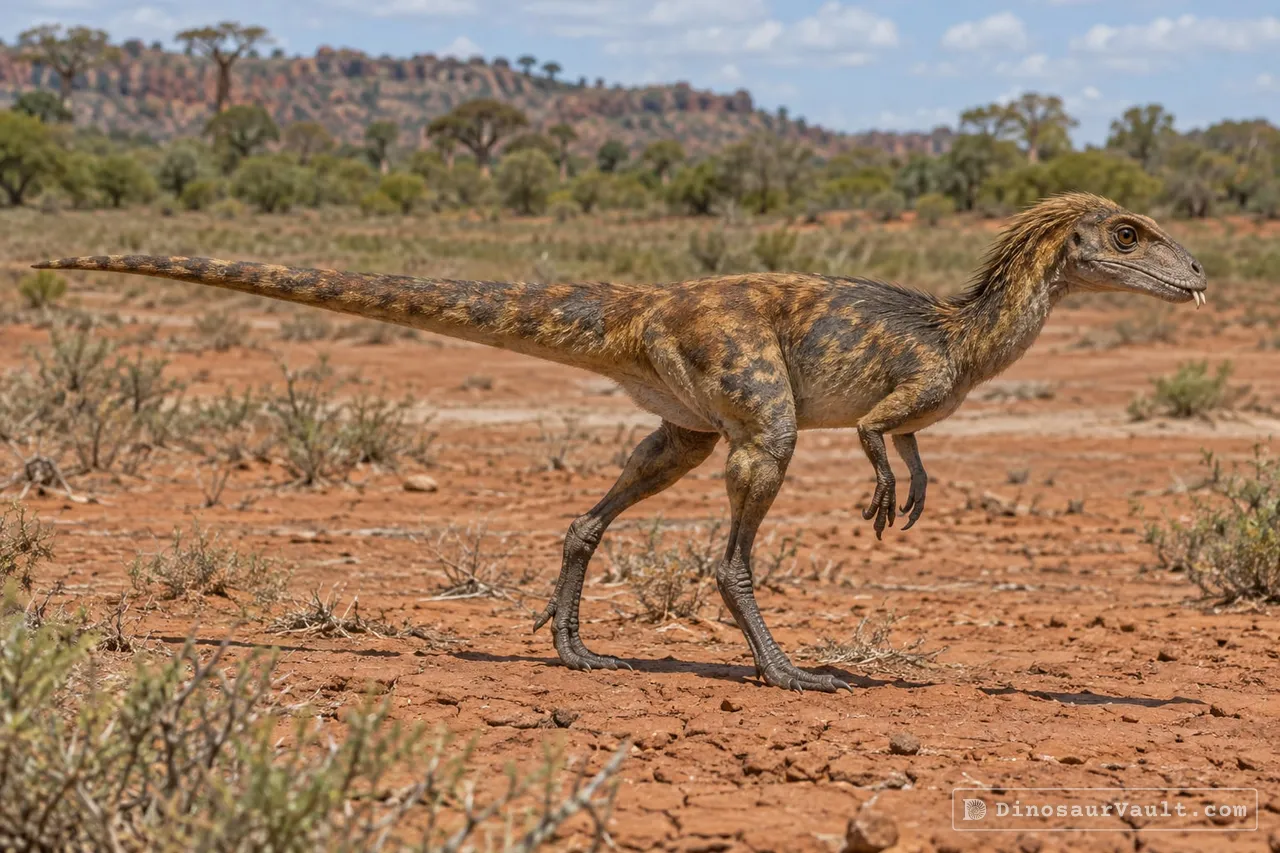
Masiakasaurus was a small two-legged meat eater about 2 meters (7 feet) long. Its front teeth stuck forward from its lower jaw, almost straight out, unlike those of any other dinosaur.
Those odd teeth may have helped it snatch small prey such as fish, lizards or insects. It had long legs and short arms.
Its world
It lived about 72 to 66 million years ago, at the end of the Cretaceous, in what is now Madagascar. Its fossils come from the Maevarano Formation.
It shared that land with the much bigger abelisaurid Majungasaurus, the titanosaur Rapetosaurus and the small feathered hunter Rahonavis.
How it was found
Sampson and colleagues named Masiakasaurus in 2001. About 29 finds are known, so much of its skeleton is well understood.
Field gallery
More views of Masiakasaurus
Scenes reconstructed from the available fossil evidence.
1 of 3
Lived alongside
Found in the same rock formations


A rock formation can hold fossils laid down millions of years apart, so not every animal here met Masiakasaurus.
The evidence
The science behind Masiakasaurus
Which parts of the picture come from its own bones, and which come from its relatives.
From its own fossils
- Its front teeth project forward, while teeth farther back have curved crowns with cutting edges.
- New skull bones reveal a long, low head rather than the short, deep skull of Majungasaurus.
- Many individuals preserve much of the backbone, hind limbs and parts of the arms.
Borrowed from relatives
- Most of its outline comes from its own bones; gaps are filled by comparison with other noasaurids such as Noasaurus.
Still unknown
- Which small animals it most often ate.
- Its skin colors and covering.
- The complete shape of the top and rear of its skull.
Discovery timeline
- 2001Named itSampson, Carrano & Forster
- 2011Full descriptionCarrano, Loewen & Sertich
- 2013Growing upLee & O’Connor
Key papers
The research behind what we know of Masiakasaurus
Named it
Named a small predatory dinosaur with forward-pointing front teeth and a different tooth shape farther back in the jaw.
A bizarre predatory dinosaur from the Late Cretaceous of Madagascar. Nature 409: 504-506
Read the paper : A bizarre predatory dinosaur from the Late Cretaceous of Madagascar (opens in a new tab)Full description
New bones revealed a long, low skull, forward-pointing upper teeth and much more of the limbs and backbone.
New materials of Masiakasaurus knopfleri Sampson, Carrano, and Forster, 2001, and implications for the morphology of the Noasauridae (Theropoda:Ceratosauria). Smithsonian Contributions to Paleobiology: 1-53
Read the paper : New materials of Masiakasaurus knopfleri Sampson, Carrano, and Forster, 2001, and implications for the morphology of the Noasauridae (Theropoda:Ceratosauria) (opens in a new tab)Growing up
Microscopic growth lines showed that Masiakasaurus grew relatively slowly and reached adulthood at a small size.
Bone histology confirms determinate growth and small body size in the noasaurid theropodMasiakasaurus knopfleri. Journal of Vertebrate Paleontology 33: 865-876
Read the paper : Bone histology confirms determinate growth and small body size in the noasaurid theropodMasiakasaurus knopfleri (opens in a new tab)
Close relatives
Other members of Noasauridae


Sources: Wikidata