Outline: a typical theropod
Vespersaurus
"western lizard"
Type species Vespersaurus paranaensis
- Lived
- 121 to 72 million years ago, Early Cretaceous to Late Cretaceous
- Diet
- Carnivore
- Group
- Theropods, Noasauridae
- Found in
- Brazil
- Named by
- Langer et al. 2019
Where its fossils were found
The evidence
Today

95 million years ago
Field notes
About Vespersaurus
What it was like
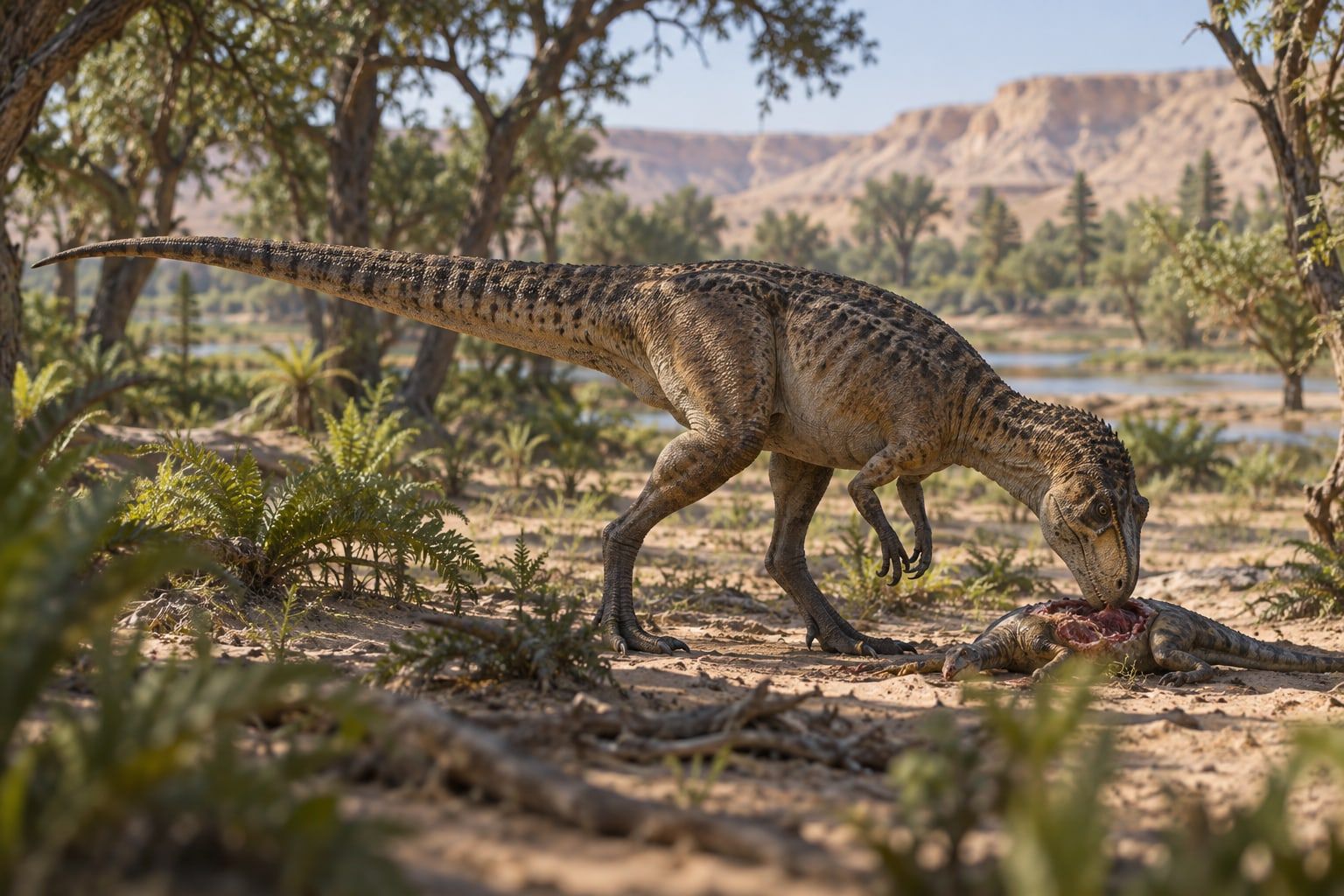
Vespersaurus was a small, slender predator from the noasaurid family. Its feet were unusual: it seems to have walked mainly on its middle toe, with the other toes held off the ground. That made it a lightweight runner, well suited to loose sand.
Its world
It lived in the Cretaceous in what is now Brazil. Its bones come from the Goio-Erê Formation, a desert of sand dunes where the toothless Berthasaura also lived.
How it was found
Langer and colleagues named it in 2019. The type species is Vespersaurus paranaensis.
Lived alongside
Found in the same rock formations
Close relatives
Other members of Noasauridae
Sources: WikidataNamed in: M. C. Langer, N. Martins, and P. C. Manzig, G. S. Ferreira, J. C. Marsola, E. Fortes, R. Lima, L. C. F. Sant’ana, L. S. Vidal, R. H. Lorençato, M. D. Ezcurra. 2019. A new desert-dwelling dinosaur (Theropoda, Noasaurinae) from the Cretaceous of south Brazil. Scientific Reports 9(9379)