Rapetosaurus
- Lived
- 101 to 66 million years ago, Late Cretaceous
- Diet
- Herbivore
- Length
- about 15 m (49 ft)
- Group
- Sauropods
- Found in
- Madagascar
- Named by
- Curry Rogers and Forster 2001
Size comparison
To scale
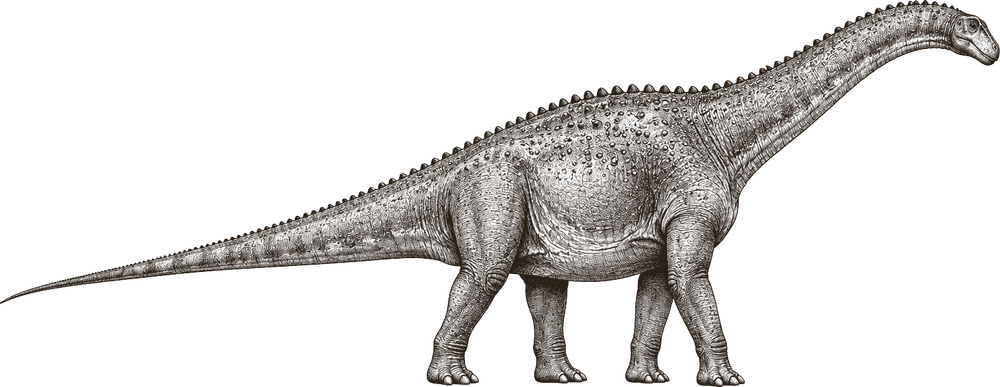


Scale in meters
Where its fossils were found
The evidence
Today

80 million years ago
Habitat
It lived on a seasonal river plain in Madagascar that experienced severe droughts. Regional neighbors included Majungasaurus, Masiakasaurus and Rahonavis.
Field notes
About Rapetosaurus
What it was like
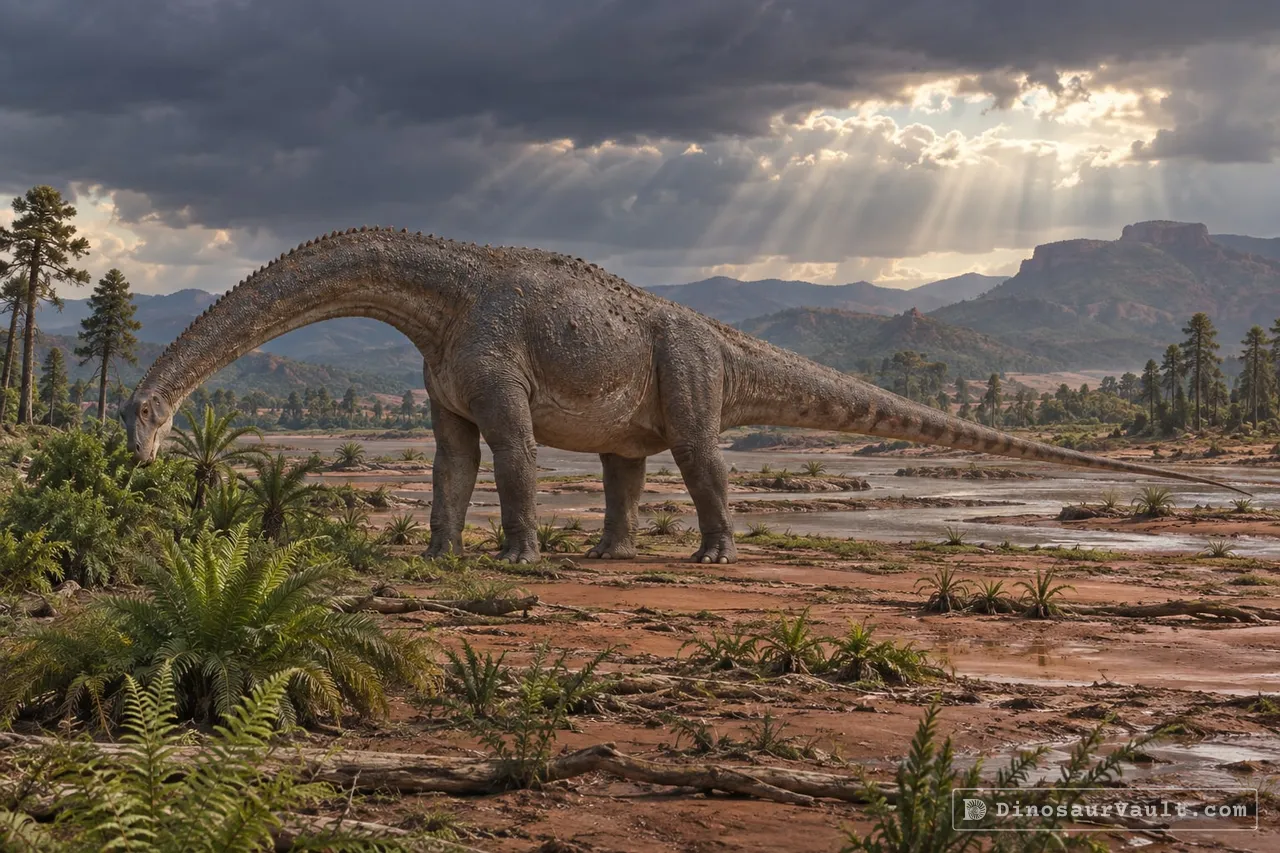
Rapetosaurus was a long-necked, plant-eating titanosaur, walking on four thick, column-like legs like other sauropods. It is unusually well known for a titanosaur because several skulls have been found, a rare thing for this group since sauropod skulls are lightly built and easily lost before fossilization. Its head was small compared to its body, with peg-like teeth suited to stripping leaves from plants. Its exact adult size remains uncertain, as is common for sauropods known mostly from partial skeletons.
Its world
Rapetosaurus lived from about 101 to 66 million years ago, during the Late Cretaceous, in what is now Madagascar. Its fossils come from the Maevarano Formation, where it shared its world with the predator Majungasaurus, the small theropod Masiakasaurus, the bird-like Rahonavis, and the fellow titanosaur Vahiny.
How it was found
Curry Rogers and Forster named Rapetosaurus in 2001. Five fossil finds are known today, including skull material that has made Rapetosaurus one of the best studied titanosaurs, helping fill in gaps in what is known about how these giant sauropods' heads were built. Before this, many titanosaurs around the world were known only from scattered bones, so a well preserved skeleton like this was especially valuable to paleontologists studying this diverse group of sauropods.
Field gallery
More views of Rapetosaurus
Scenes reconstructed from the available fossil evidence.
1 of 7
Lived alongside
Found in the same rock formations


A rock formation can hold fossils laid down millions of years apart, so not every animal here met Rapetosaurus.
The evidence
The science behind Rapetosaurus
Which parts of the picture come from its own bones, and which come from its relatives.
From its own fossils
- Skulls and skeletons show a small head with peg-like teeth, a long neck and sturdy limbs.
- A tiny youngster had limb proportions much like those of larger Rapetosaurus.
- Bony plates from its skin include a large plate with a hollow interior.
Borrowed from relatives
- Much of the skeleton is known directly, including skulls and the bones of young animals.
- Scaly skin between the bony plates is inferred from other titanosaurs, including Saltasaurus.
Still unknown
- Its exact adult length.
- How the bony plates were arranged across its body.
- Its color and whether adults cared for their young.
Often drawn wrong
- A continuous coat of armor exaggerates the scattered bony plates known from its fossils.
Discovery timeline
- 2001Named itCurry Rogers & Forster
- 2011SkinCurry Rogers et al.
- 2016Growing upCurry Rogers et al.
Key papers
The research behind what we know of Rapetosaurus
Named it
Named a titanosaur from Madagascar with unusually complete skull and skeleton material, helping clarify the anatomy and relationships of titanosaurs.
The last of the dinosaur titans: a new sauropod from Madagascar. Nature 412: 530-534
Read the paper : The last of the dinosaur titans: a new sauropod from Madagascar (opens in a new tab)Skin
Examined bony skin plates from Rapetosaurus and proposed that their hollow interiors may have helped store minerals.
Sauropod dinosaur osteoderms from the Late Cretaceous of Madagascar. Nature Communications 2
Read the paper : Sauropod dinosaur osteoderms from the Late Cretaceous of Madagascar (opens in a new tab)Growing up
A tiny Rapetosaurus had rapidly growing bones and adult-like limb proportions, suggesting that it could move independently soon after hatching.
Precocity in a tiny titanosaur from the Cretaceous of Madagascar. Science 352: 450-453
Read the paper : Precocity in a tiny titanosaur from the Cretaceous of Madagascar (opens in a new tab)
Close relatives
Other members of Saltasauroidea


Sources: Wikidata