Austrocheirus
"southern hand"
Type species Austrocheirus isasii
- Lived
- 84 to 72 million years ago, Late Cretaceous
- Diet
- Carnivore
- Group
- Theropods, Noasauridae
- Found in
- Argentina
- Named by
- Ezcurra et al. 2010
Where its fossils were found
The evidence
Today

80 million years ago
Habitat
Winding rivers crossed a coastal plain with subtropical forest. Dreadnoughtus, Puertasaurus and Orkoraptor are also known from the Cerro Fortaleza Formation.
Field notes
About Austrocheirus
What it was like
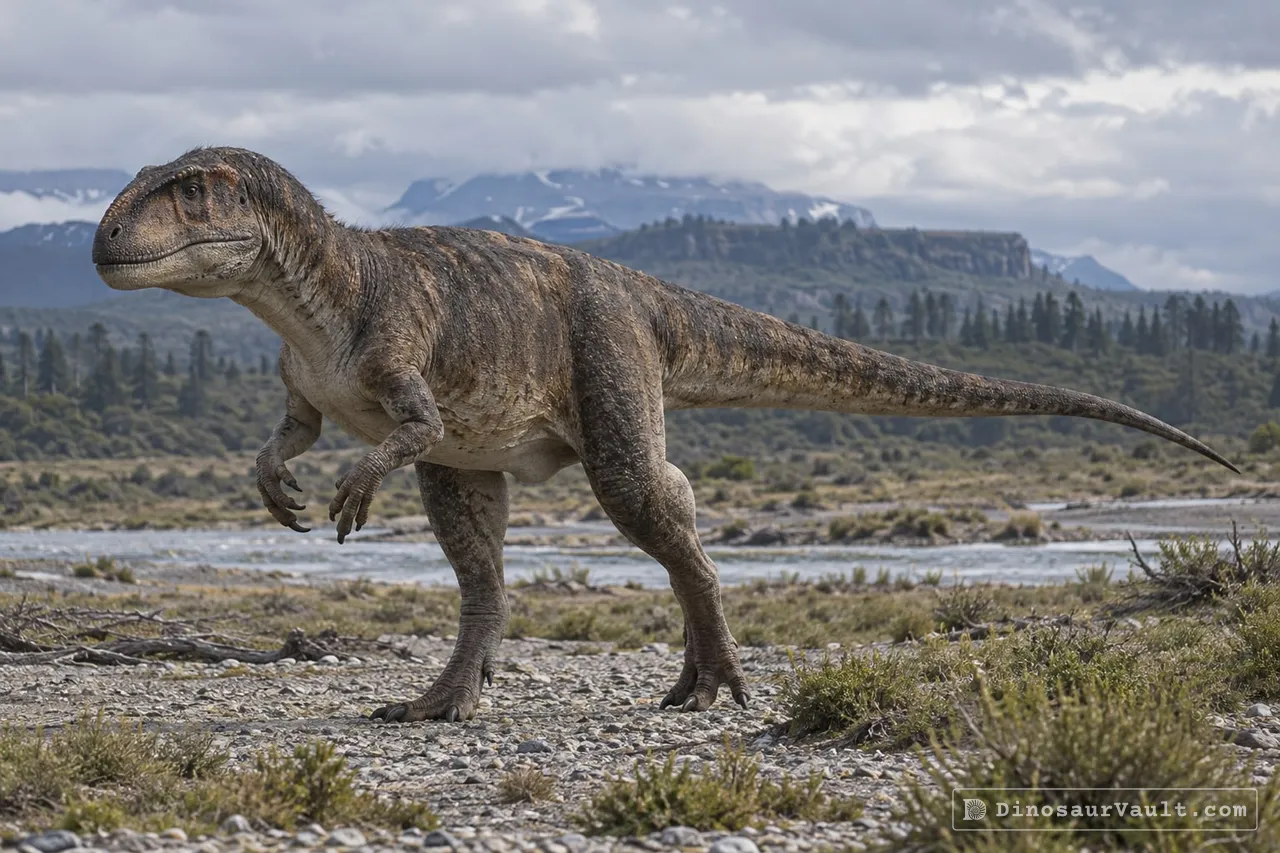
Austrocheirus was a meat eater known from parts of the hand, lower legs and feet. It belongs to the noasaurids, a family of often small, slender hunters, though Austrocheirus was probably larger than most.
Its world
It lived in the Late Cretaceous in what is now southern Argentina. Its bones come from the Cerro Fortaleza Formation, where it shared the land with the giant titanosaurs Dreadnoughtus and Puertasaurus and the megaraptor Orkoraptor.
How it was found
Ezcurra and colleagues named Austrocheirus in 2010, from a single find.
Field gallery
More views of Austrocheirus
Scenes reconstructed from the available fossil evidence.
1 of 3
Lived alongside
Found in the same rock formations


A rock formation can hold fossils laid down millions of years apart, so not every animal here met Austrocheirus.
The evidence
The science behind Austrocheirus
Which parts of the picture come from its own bones, and which come from its relatives.
From its own fossils
- Its partial skeleton includes hand, lower-leg, foot and tail bones.
- The hand had a long, sturdy palm bone and a short, thick finger bone.
- A later description added a partial forearm bone, a hand claw and another foot bone from the original skeleton.
Borrowed from relatives
- Broader theropod comparisons, including Dilophosaurus, help fill in the missing head and body.
Still unknown
- Its exact branch of the theropod family tree.
- The shape of its skull and its complete body proportions.
- The complete arrangement of its fingers and toes.
Discovery timeline
- 2010Named itEZCURRA, AGNOLIN & NOVAS
- 2024Full descriptionAgnolín et al.
- 2024Family treeHendrickx et al.
Key papers
The research behind what we know of Austrocheirus
Named it
Named a theropod with a well-developed hand, contrasting it with the reduced hands of large abelisaurids.
An abelisauroid dinosaur with a non-atrophied manus from the Late Cretaceous Pari Aike Formation of southern Patagonia. Zootaxa 2450
Read the paper : An abelisauroid dinosaur with a non-atrophied manus from the Late Cretaceous Pari Aike Formation of southern Patagonia (opens in a new tab)Full description
Described additional Austrocheirus bones, including a hand claw, while finding its relationships difficult to resolve.
Fossil vertebrates from the Cerro Fortaleza Formation (Upper Cretaceous), Santa Cruz Province, Argentina. Cretaceous Research 154: 105735
Read the paper : Fossil vertebrates from the Cerro Fortaleza Formation (Upper Cretaceous), Santa Cruz Province, Argentina (opens in a new tab)Family tree
Included Austrocheirus in revised theropod analyses and examined its disputed position among noasaurid relatives.
Osteology, relationship, and feeding ecology of the theropod dinosaur Noasaurus leali , from the Late Cretaceous of North-Western Argentina. Zoological Journal of the Linnean Society 202
Read the paper : Osteology, relationship, and feeding ecology of the theropod dinosaur Noasaurus leali , from the Late Cretaceous of North-Western Argentina (opens in a new tab)
Close relatives
Other members of Noasauridae


Sources: Wikidata