Rahonavis
"cloud menace bird"
- Lived
- 72 to 66 million years ago, Late Cretaceous
- Diet
- Carnivore
- Group
- Theropods, Dromaeosauridae
- Found in
- Madagascar
- Named by
- Forster et al. 1998
Where its fossils were found
The evidence
Today

70 million years ago
Habitat
It lived on a river plain in Madagascar with strong wet and dry seasons. The Maevarano Formation also preserves Majungasaurus, Masiakasaurus and Rapetosaurus.
Field notes
About Rahonavis
What it was like
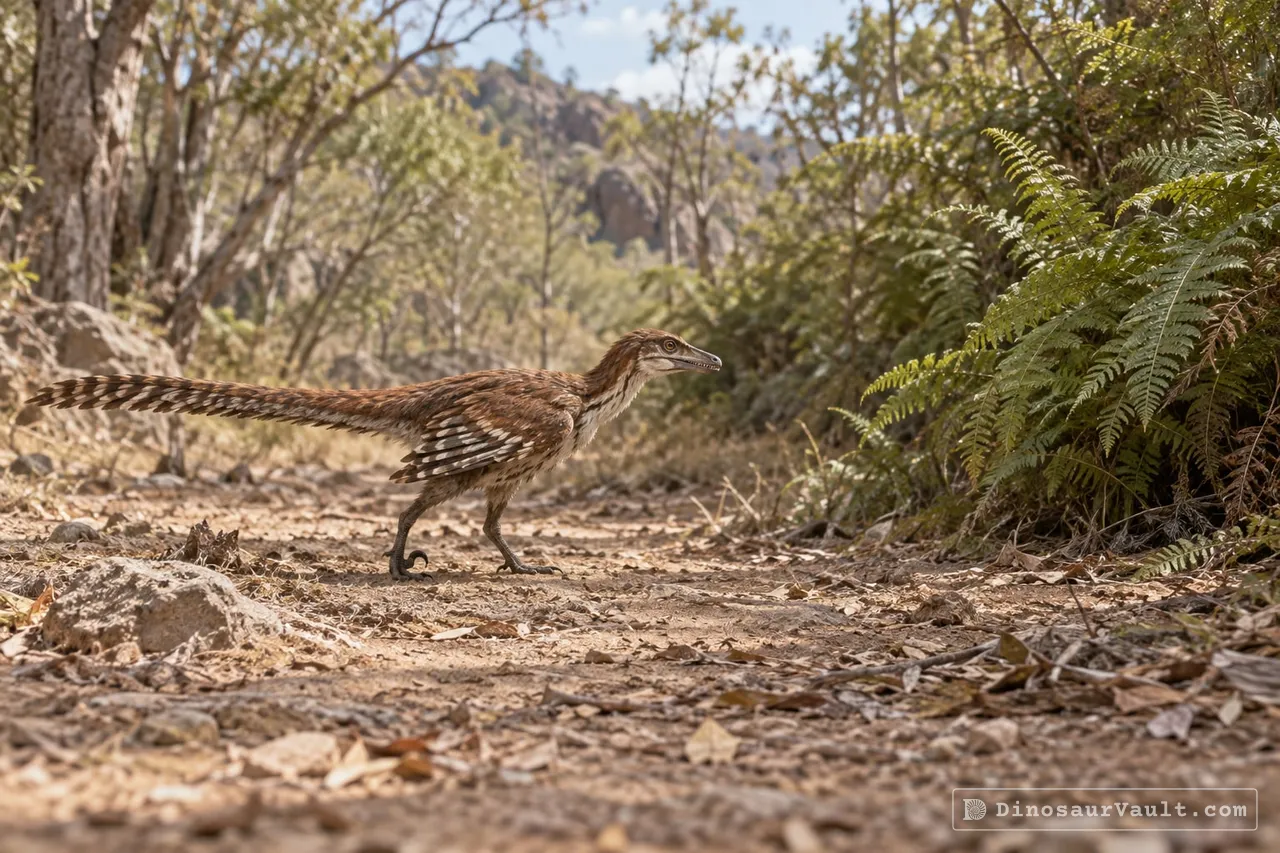
Rahonavis was a small feathered hunter about the size of a raven. It had long arms that were probably wings, and a large sickle claw on each foot, like Velociraptor.
Scientists still argue whether it was an early bird or a raptor-like dinosaur close to birds. It may have been able to fly.
Its world
It lived about 72 to 66 million years ago, at the end of the Cretaceous, in what is now Madagascar. Its bones come from the Maevarano Formation, where it lived with the big hunter Majungasaurus, the small Masiakasaurus and the titanosaur Rapetosaurus.
How it was found
Forster and colleagues named Rahonavis in 1998. Only one partial skeleton is known.
Field gallery
More views of Rahonavis
Scenes reconstructed from the available fossil evidence.
1 of 3
Lived alongside
Found in the same rock formations


A rock formation can hold fossils laid down millions of years apart, so not every animal here met Rahonavis.
The evidence
The science behind Rahonavis
Which parts of the picture come from its own bones, and which come from its relatives.
From its own fossils
- A partial skeleton preserves much of the pelvis and hind legs, together with parts of the backbone and tail.
- The foot has an enlarged sickle claw and a small inner toe turned partly backward.
- A long forearm bone attributed to Rahonavis bears small bumps interpreted as attachment points for wing feathers.
Borrowed from relatives
- The missing upper head is inferred from long-snouted paravians such as Buitreraptor.
- Body feathers are inferred from feathered paravians such as Anchiornis.
- Archaeopteryx and Anchiornis guide the missing outer wing and tail details.
Still unknown
- Whether the wing bones and main skeleton belonged to the same animal.
- Whether it could fly, and whether it was an early bird or a close relative outside birds.
- Its feather colors and complete head shape.
Often drawn wrong
- Bare, scaly arms omit the wing feathers supported by the attributed forearm bone.
Discovery timeline
- 1998Named itForster et al.
- 2017Close relativeGianechini, Makovicky & Apesteguía
- 2020Full descriptionForster et al.
Key papers
The research behind what we know of Rahonavis
Named it
Introduced Rahonavis as a bird-like animal with feather attachment bumps on its forearm and a sickle claw on its foot.
Genus Correction. Science 280: 179-179
Read the paper : Genus Correction (opens in a new tab)Close relative
Described the long skull and small teeth of Buitreraptor, a comparison for the missing head of Rahonavis.
The cranial osteology ofBuitreraptor gonzalezorumMakovicky, ApesteguÍa, and AgnolÍn, 2005 (Theropoda, Dromaeosauridae), from the Late Cretaceous of Patagonia, Argentina. Journal of Vertebrate Paleontology 37: e1255639
Read the paper : The cranial osteology ofBuitreraptor gonzalezorumMakovicky, ApesteguÍa, and AgnolÍn, 2005 (Theropoda, Dromaeosauridae), from the Late Cretaceous of Patagonia, Argentina (opens in a new tab)Full description
Described the bones in detail and examined their association, providing the anatomical basis for comparing Rahonavis with early birds and raptors.
The osteology of the Late Cretaceous paravian Rahonavis ostromi from Madagascar. Palaeontologia Electronica
Read the paper : The osteology of the Late Cretaceous paravian Rahonavis ostromi from Madagascar (opens in a new tab)
Close relatives
Other members of Dromaeosauridae


Sources: Wikidata