Vahiny
"traveler"
- Lived
- 72 to 66 million years ago, Late Cretaceous
- Diet
- Herbivore
- Group
- Sauropods
- Found in
- Madagascar
- Named by
- Curry Rogers and Wilson 2014
Where its fossils were found
The evidence
Today

70 million years ago
Habitat
Shallow rivers crossed floodplains with long dry spells and seasonal rains. Its neighbors included Rapetosaurus, Majungasaurus and Masiakasaurus.
Field notes
About Vahiny
What it was like
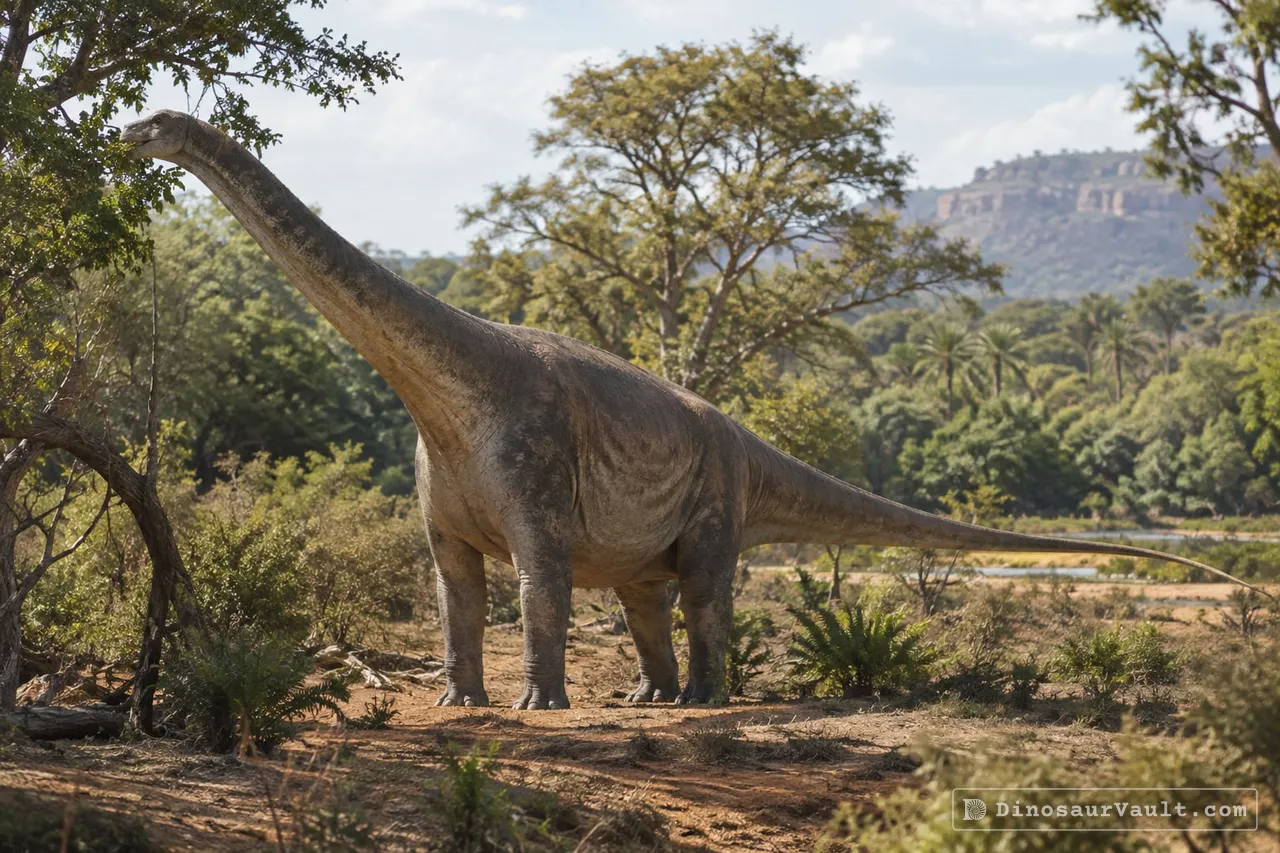
Vahiny was a titanosaur, a long-necked plant eater. It is known from a braincase, which differs from that of the other titanosaur in the same rocks.
Its world
It lived about 72 to 66 million years ago, near the end of the Cretaceous, in what is now Madagascar. It comes from the Maevarano Formation, where it shared the land with the abelisaur Majungasaurus, the titanosaur Rapetosaurus and the small predator Masiakasaurus.
How it was found
Curry Rogers and Wilson named Vahiny in 2014. Its name refers to a visitor from far away, since its closest relatives seem to have lived elsewhere.
Field gallery
More views of Vahiny
Scenes reconstructed from the available fossil evidence.
Lived alongside
Found in the same rock formations


A rock formation can hold fossils laid down millions of years apart, so not every animal here met Vahiny.
The evidence
The science behind Vahiny
Which parts of the picture come from its own bones, and which come from its relatives.
From its own fossils
- A partial braincase preserves the bony casing around the brain and the openings for nerves.
- The shape of the braincase separates Vahiny from Rapetosaurus, the other titanosaur in the same rocks.
Borrowed from relatives
- Its long neck, broad body and weight-bearing legs are restored from better-known titanosaurs such as Rapetosaurus.
- Its braincase shares distinctive grooves and projections with Jainosaurus.
Still unknown
- Its body size and proportions.
- Whether it had bony plates in its skin.
- Its color.
Discovery timeline
- 2007Its worldRogers et al.
- 2011Same rocksCurry Rogers et al.
- 2014Named itRogers & Wilson
Key papers
The research behind what we know of Vahiny
Its world
Reconstructed the Maevarano landscape as river floodplains with a dry climate, seasonal rains and mud flows that buried animals.
PALEOENVIRONMENT AND PALEOECOLOGY OF MAJUNGASAURUS CRENATISSIMUS (THEROPODA: ABELISAURIDAE) FROM THE LATE CRETACEOUS OF MADAGASCAR. Journal of Vertebrate Paleontology 27: 21-31
Read the paper : PALEOENVIRONMENT AND PALEOECOLOGY OF MAJUNGASAURUS CRENATISSIMUS (THEROPODA: ABELISAURIDAE) FROM THE LATE CRETACEOUS OF MADAGASCAR (opens in a new tab)Same rocks
Described bony skin plates belonging to Rapetosaurus, the other titanosaur in Vahiny's environment, and proposed that hollow plates stored minerals.
Sauropod dinosaur osteoderms from the Late Cretaceous of Madagascar. Nature Communications 2
Read the paper : Sauropod dinosaur osteoderms from the Late Cretaceous of Madagascar (opens in a new tab)Named it
Named a titanosaur from a distinctive braincase, described a juvenile skull bone and compared it with Jainosaurus and Rapetosaurus.
Vahiny depereti, gen. et sp. nov., a new titanosaur (Dinosauria, Sauropoda) from the Upper Cretaceous Maevarano Formation, Madagascar. Journal of Vertebrate Paleontology 34: 606-617
Read the paper : Vahiny depereti, gen. et sp. nov., a new titanosaur (Dinosauria, Sauropoda) from the Upper Cretaceous Maevarano Formation, Madagascar (opens in a new tab)
Close relatives
Other members of Lithostrotia


Sources: Wikidata