Cariocecus
Type species Cariocecus bocagei
- Lived
- 126 to 121 million years ago, Early Cretaceous
- Diet
- Herbivore
- Group
- Ornithopods
- Found in
- Portugal
- Named by
- Bertozzo et al. 2025
Where its fossils were found
The evidence
Today

125 million years ago
Habitat
It lived near coastal lagoons in Portugal, where fresh water mixed with some seawater. Iberospinus lived in the same region, along with crocodile relatives, turtles and pterosaurs.
Field notes
About Cariocecus
What it was like
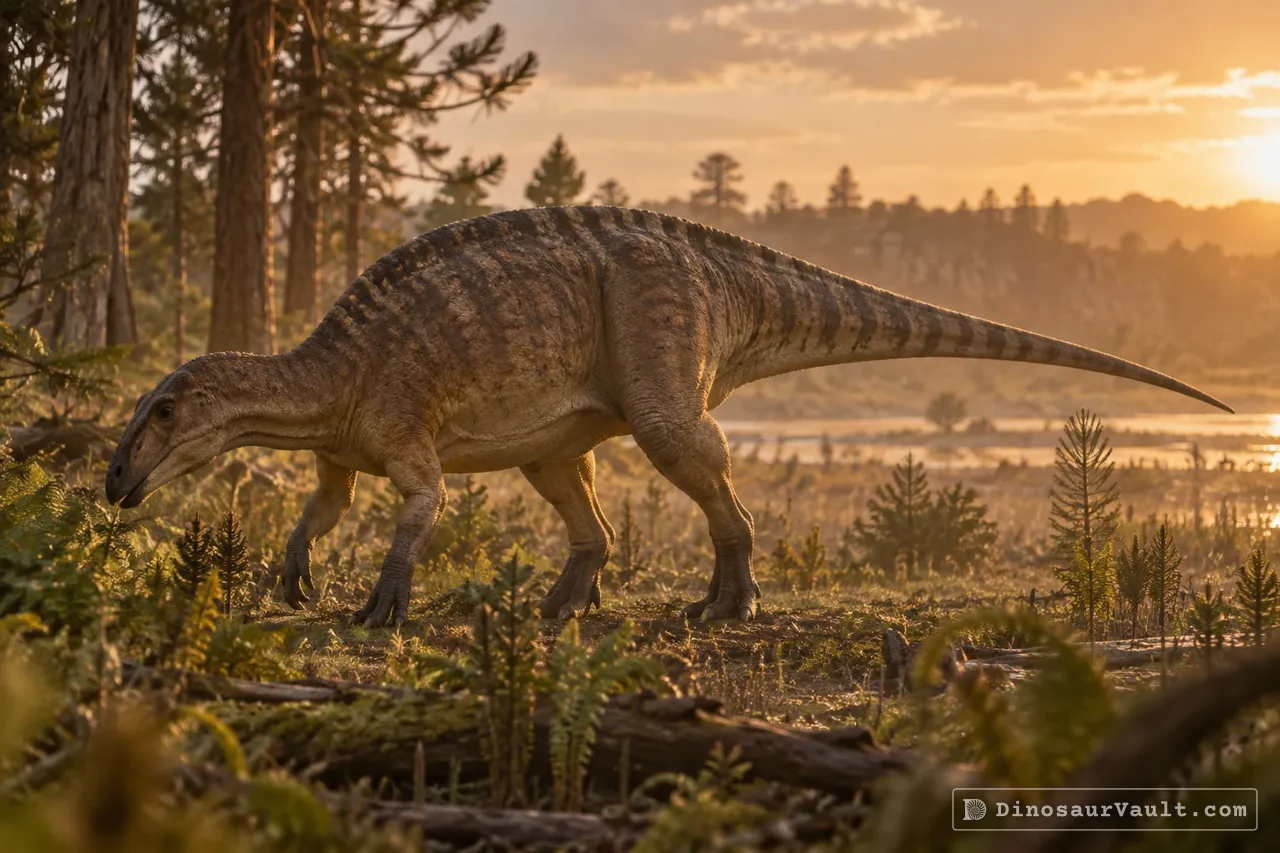
Cariocecus was a plant eater related to Iguanodon. It is known from a skull.
Its world
It lived in the Early Cretaceous in what is now Portugal. Its bones come from the Papo Seco Formation, where the spinosaur Iberospinus also lived.
How it was found
Bertozzo and colleagues named it in 2025. The type species is Cariocecus bocagei.
Field gallery
More views of Cariocecus
Scenes reconstructed from the available fossil evidence.
Lived alongside
Found in the same rock formations


A rock formation can hold fossils laid down millions of years apart, so not every animal here met Cariocecus.
The evidence
The science behind Cariocecus
Which parts of the picture come from its own bones, and which come from its relatives.
From its own fossils
- A partial skull preserves much of its right side, part of the roof and a nearly complete braincase floor.
- The upper jaw and cheek bone are fused into a single piece, and a bone at the back of the skull has three lobes.
- A bone above the eye is preserved, and scans reveal the spaces for the brain and inner ear.
Borrowed from relatives
- A fleshy membrane above the eye is inferred by comparison with living animals.
Still unknown
- Its body length and limb proportions.
- Its skin texture and color.
- Whether it had a fleshy brow membrane above its eye, and what that membrane looked like.
Discovery timeline
- 2022Same rocksMateus & Estraviz-López
- 2024Family treeLockwood, Martill & Maidment
- 2025Named itBertozzo et al.
Key papers
The research behind what we know of Cariocecus
Same rocks
Named Iberospinus from the Papo Seco Formation and described the coastal setting where its bones were buried.
A new theropod dinosaur from the early cretaceous (Barremian) of Cabo Espichel, Portugal: Implications for spinosaurid evolution. PLOS ONE 17: e0262614
Read the paper : A new theropod dinosaur from the early cretaceous (Barremian) of Cabo Espichel, Portugal: Implications for spinosaurid evolution (opens in a new tab)Family tree
Described a nearly complete Comptonatus skeleton with distinctive features in its skull, teeth, shoulder and pelvis.
Comptonatus chasei , a new iguanodontian dinosaur from the Lower Cretaceous Wessex Formation of the Isle of Wight, southern England. Journal of Systematic Palaeontology 22
Read the paper : Comptonatus chasei , a new iguanodontian dinosaur from the Lower Cretaceous Wessex Formation of the Isle of Wight, southern England (opens in a new tab)Named it
Described the skull's fused jaw and cheek bone, reconstructed the brain cavity and inner ear, and placed Cariocecus among early duckbill relatives.
Cariocecus bocagei , a new basal hadrosauroid from the Lower Cretaceous of Portugal. Journal of Systematic Palaeontology 23
Read the paper : Cariocecus bocagei , a new basal hadrosauroid from the Lower Cretaceous of Portugal (opens in a new tab)
Close relatives
Other members of Hadrosauroidea


Sources: Wikidata