Erectopus
"upright foot"
Type species Erectopus superbus
- Lived
- 126 to 101 million years ago, Early Cretaceous
- Diet
- Carnivore
- Group
- Theropods, Metriacanthosauridae
- Found in
- France and Portugal
- Named by
- Huene 1923
Where its fossils were found
The evidence
Today

115 million years ago
Habitat
Its European surroundings included coastal rivers and lagoons, as recorded in the Papo Seco rocks. Other dinosaurs from its world include Iguanodon, Mantellisaurus and Baryonyx.
Field notes
About Erectopus
What it was like
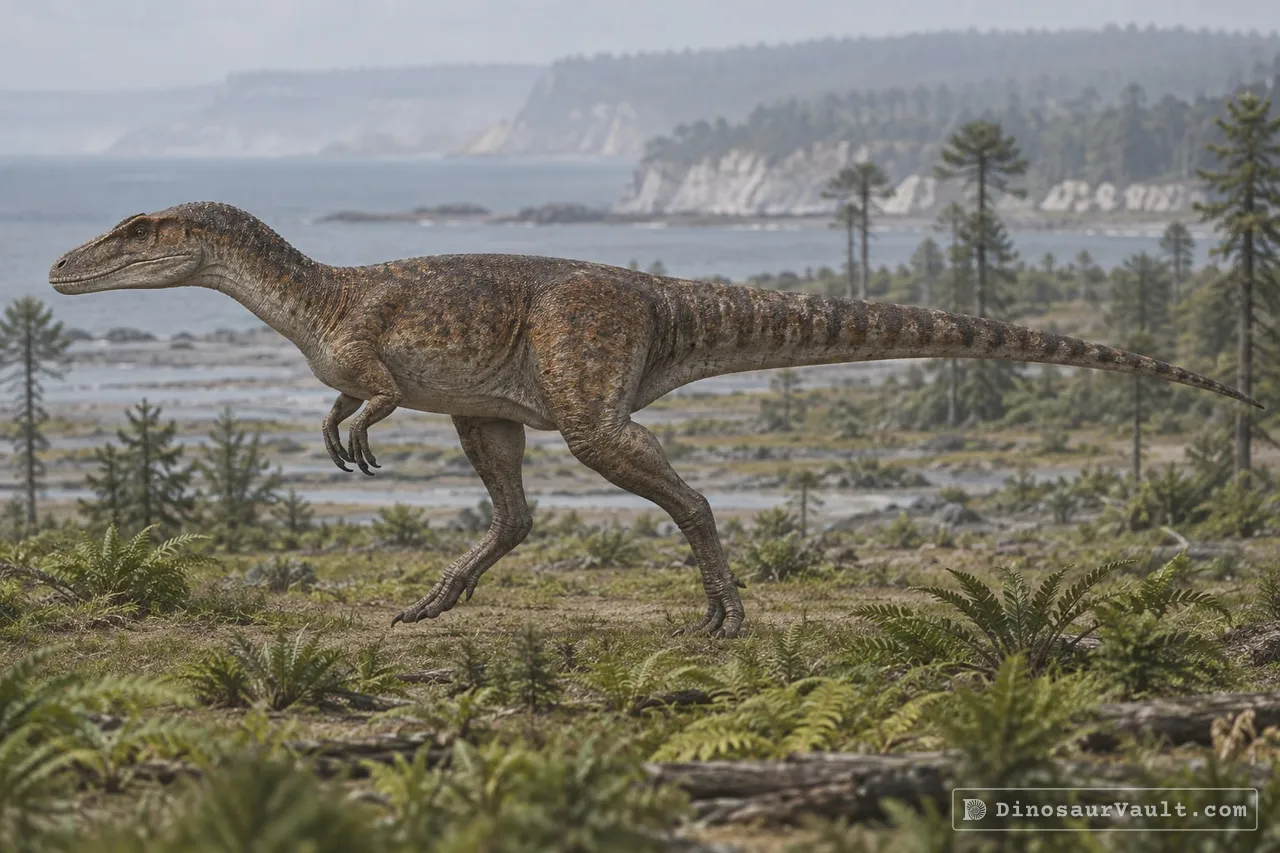
Erectopus was a medium-sized meat eater known from scattered bones, including parts of the leg and foot. It was a relative of Sinraptor and Yangchuanosaurus.
Its world
It lived in the Early Cretaceous in what is now France, with finds also reported from Portugal. In that land it shared its world with the plant eaters Iguanodon and Mantellisaurus and the fish-eating Baryonyx.
How it was found
Its bones were first described as a species of Megalosaurus. Huene gave them their own genus in 1923. The original bones were later lost, and scientists now study casts and drawings.
Field gallery
More views of Erectopus
Scenes reconstructed from the available fossil evidence.
1 of 3
Lived alongside
Found in the same rock formations


A rock formation can hold fossils laid down millions of years apart, so not every animal here met Erectopus.
The evidence
The science behind Erectopus
Which parts of the picture come from its own bones, and which come from its relatives.
From its own fossils
- Part of the upper jaw, an incomplete hand, and bones from the thigh, shin, ankle and foot.
- The shape of the jaw and leg joints links it to the allosauroids, the group that includes Allosaurus.
Borrowed from relatives
- The missing parts of the face are restored using Sinraptor as a comparison.
- Acrocanthosaurus provides a broader comparison for the missing parts of the hands, feet and tail.
Still unknown
- Its complete skull shape and any head ornaments.
- Whether it belonged to the same family as Sinraptor.
- Its skin covering and color.
Discovery timeline
- 1923Named itVON HUENE
- 2012Family treeCarrano, Benson & Sampson
- 2020Close relativeHendrickx et al.
Key papers
The research behind what we know of Erectopus
Named it
Gave bones previously assigned to Megalosaurus their own genus, Erectopus.
Carnivorous Saurischia in Europe Since the Triassic. Geological Society of America Bulletin 34: 449-458
Read the paper : Carnivorous Saurischia in Europe Since the Triassic (opens in a new tab)Family tree
Compared the jaw and limb bones and placed Erectopus among allosauroids, possibly in the family of Sinraptor.
The phylogeny of Tetanurae (Dinosauria: Theropoda). Journal of Systematic Palaeontology 10: 211-300
Read the paper : The phylogeny of Tetanurae (Dinosauria: Theropoda) (opens in a new tab)Close relative
Described the jaws and teeth of Sinraptor, a possible relative used to help restore the missing face of Erectopus.
Dental anatomy of the apex predator Sinraptor dongi (Theropoda: Allosauroidea) from the Late Jurassic of China. Canadian Journal of Earth Sciences 57: 1127-1147
Read the paper : Dental anatomy of the apex predator Sinraptor dongi (Theropoda: Allosauroidea) from the Late Jurassic of China (opens in a new tab)
Close relatives
Other members of Metriacanthosauridae


Sources: Wikidata