Iberospinus
"Iberian spine"
- Lived
- 126 to 121 million years ago, Early Cretaceous
- Diet
- Carnivore
- Group
- Theropods, Spinosauridae
- Found in
- Portugal
- Named by
- Mateus and Estraviz-López 2022
Where its fossils were found
The evidence
Today

125 million years ago
Habitat
Its home in Portugal included coastal lagoons fed by fresh water, with some seawater entering from the coast. Plant eaters recorded in the region include Iguanodon and Mantellisaurus.
Field notes
About Iberospinus
What it was like
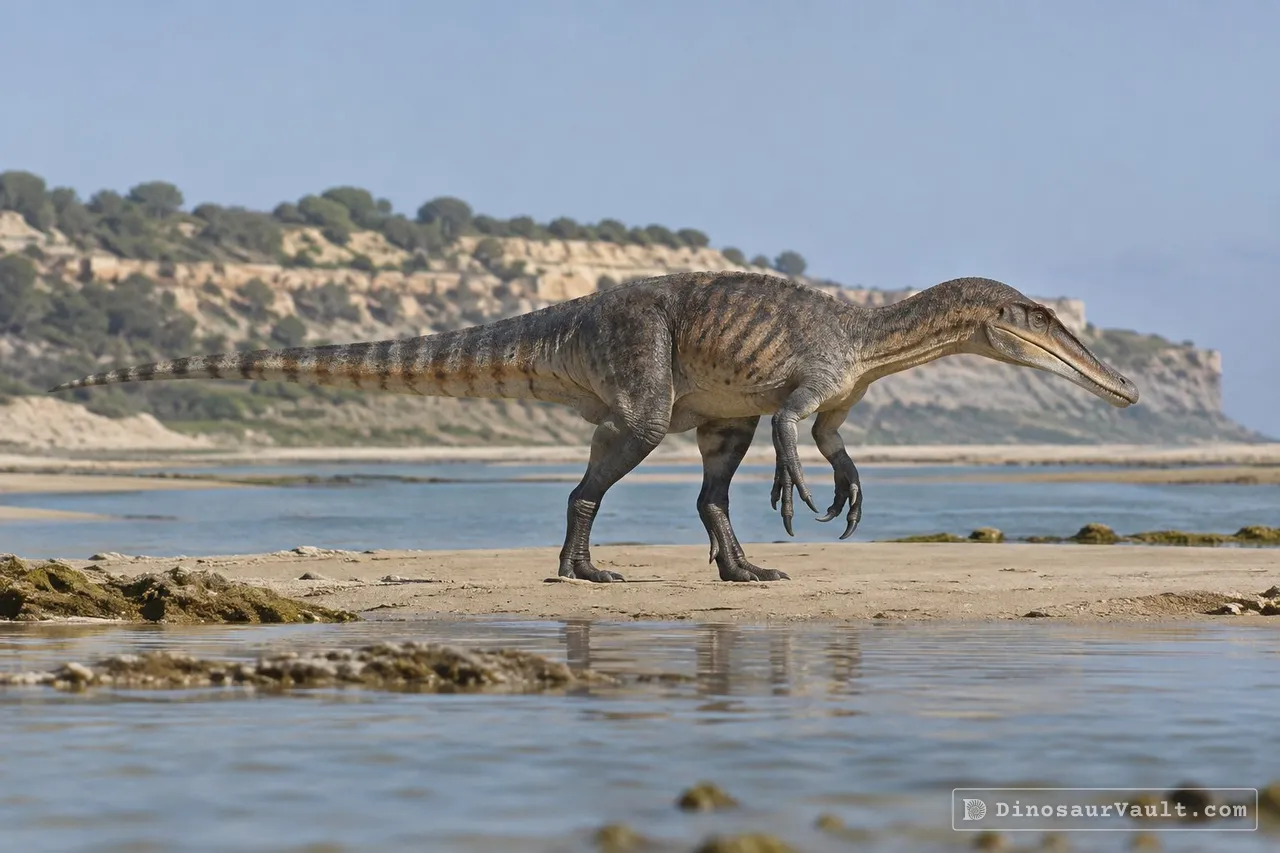
Iberospinus was a spinosaur, a predator with a long, narrow snout that probably caught fish as well as other prey. It is known from a partial skeleton, including parts of the lower jaw, ribs, backbone and limbs.
Its world
It lived in the Early Cretaceous in what is now Portugal. Its bones come from the Papo Seco Formation, laid down near the coast.
How it was found
Mateus and Estraviz-López named Iberospinus in 2022. Some of its bones were found years earlier and first thought to belong to Baryonyx. It is one of several spinosaurs known from Spain and Portugal.
Field gallery
More views of Iberospinus
Scenes reconstructed from the available fossil evidence.
1 of 3
Lived alongside
Found in the same rock formations


A rock formation can hold fossils laid down millions of years apart, so not every animal here met Iberospinus.
The evidence
The science behind Iberospinus
Which parts of the picture come from its own bones, and which come from its relatives.
From its own fossils
- A partial skeleton preserves a lower jaw with teeth, ribs, backbone, shoulder and hip bones, and parts of the ankle and foot.
- The lower edge of the preserved jaw is straight, unlike the upward curve in Baryonyx.
- A broad foot claw has a relatively straight lower edge.
Borrowed from relatives
- The missing upper snout and much of the body are restored by comparison with Baryonyx.
- Strong arms with inward-facing palms follow other spinosaurs and large theropods.
Still unknown
- The height and shape of any sail on its back.
- The complete outline of its tail and the arrangement of its foot claws.
- Its skin covering and color.
Often drawn wrong
- Copying the upturned lower jaw of Baryonyx misses its straight jaw edge.
- A tall sail and deep paddle tail copy specialized features of Spinosaurus.
Discovery timeline
- 2011Full descriptionMateus et al.
- 2013Close relativeCuff & Rayfield
- 2022Named itMateus & Estraviz-López
Key papers
The research behind what we know of Iberospinus
Full description
First described bones later named Iberospinus, assigning them to Baryonyx and comparing their teeth and skeleton with other spinosaurs.
A new specimen of the theropod dinosaur Baryonyx from the early Cretaceous of Portugal and taxonomic validity of Suchosaurus. Zootaxa 2827: 54-68
Read the paper : A new specimen of the theropod dinosaur Baryonyx from the early Cretaceous of Portugal and taxonomic validity of Suchosaurus (opens in a new tab)Close relative
Compared spinosaur snouts with crocodilian snouts, providing a detailed Baryonyx comparison for the missing upper jaws of Iberospinus.
Feeding Mechanics in Spinosaurid Theropods and Extant Crocodilians. PLoS ONE 8: e65295
Read the paper : Feeding Mechanics in Spinosaurid Theropods and Extant Crocodilians (opens in a new tab)Named it
Named Iberospinus from a partial skeleton previously assigned to Baryonyx, identifying distinctive features in its jaw, backbone and other bones.
A new theropod dinosaur from the early cretaceous (Barremian) of Cabo Espichel, Portugal: Implications for spinosaurid evolution. PLOS ONE 17: e0262614
Read the paper : A new theropod dinosaur from the early cretaceous (Barremian) of Cabo Espichel, Portugal: Implications for spinosaurid evolution (opens in a new tab)
Close relatives
Other members of Spinosauridae


Sources: Wikidata