Puertasaurus
- Lived
- 84 to 72 million years ago, Late Cretaceous
- Diet
- Herbivore
- Length
- about 30 m (98 ft)
- Group
- Sauropods
- Found in
- Argentina
- Named by
- Novas et al. 2005
Size comparison
To scale


Scale in metersOutline: typical sauropod shape
Where its fossils were found
The evidence
Today

80 million years ago
Habitat
A river plain in southern Argentina, with conifers and cycads recorded in the sandstone around its bones. Other dinosaurs from the Cerro Fortaleza Formation include Dreadnoughtus and Talenkauen.
Field notes
About Puertasaurus
What it was like
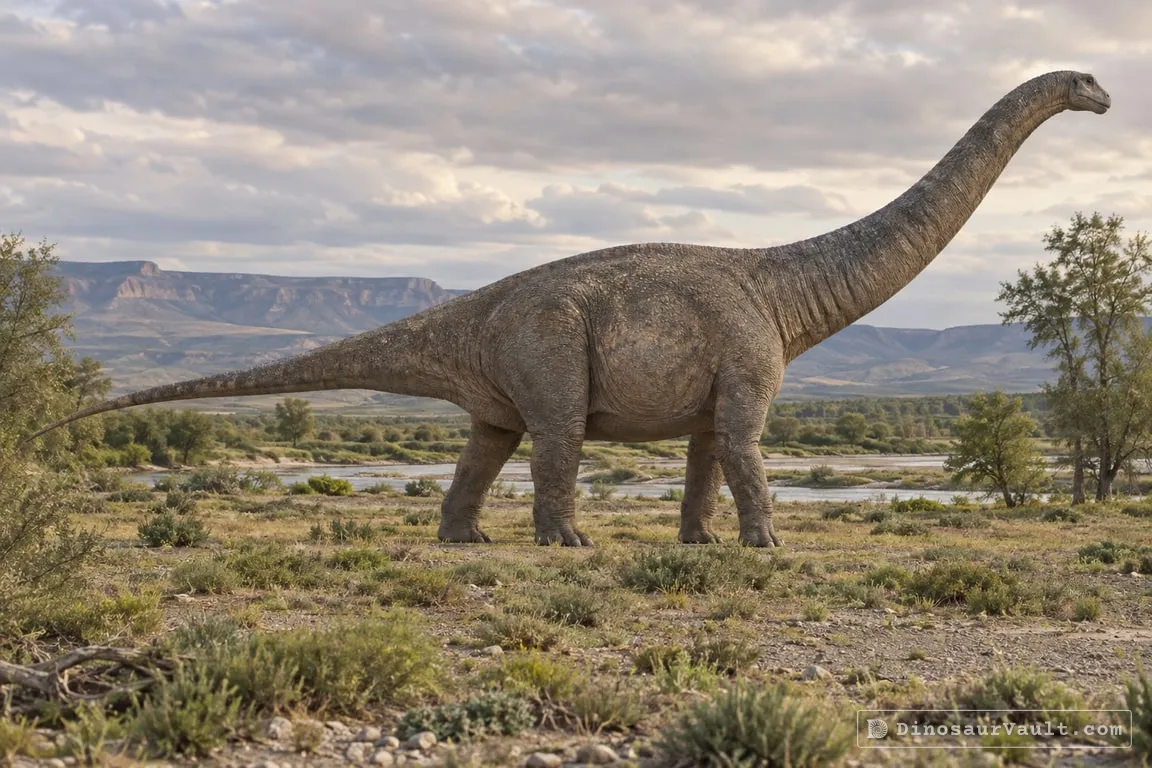
Puertasaurus was a titanosaur, one of the biggest long-necked plant eaters. It is known from only a few huge backbones, so its size is a rough estimate, around 30 meters (98 feet) long.
One of its back bones is extremely wide, which suggests a very broad, deep chest.
Its world
It lived in the Late Cretaceous, about 84 to 72 million years ago, in what is now southern Argentina. Its bones come from the Cerro Fortaleza Formation, the same rocks that held the giant titanosaur Dreadnoughtus and the small plant eater Talenkauen.
How it was found
Novas and colleagues named Puertasaurus in 2005. Only one find is known.
Field gallery
More views of Puertasaurus
Scenes reconstructed from the available fossil evidence.
Lived alongside
Found in the same rock formations


A rock formation can hold fossils laid down millions of years apart, so not every animal here met Puertasaurus.
The evidence
The science behind Puertasaurus
Which parts of the picture come from its own bones, and which come from its relatives.
From its own fossils
- A neck vertebra, a back vertebra and a pair of tail vertebrae make up the known skeleton.
- The back vertebra is exceptionally wide but short from front to back, with broad, wing-like projections on either side.
- The neck vertebra has a swollen bony spine and deep attachment areas for strong muscles and ligaments.
Borrowed from relatives
- Most of the body must be restored by comparison with more complete titanosaurs such as Patagotitan and Dreadnoughtus.
Still unknown
- Its exact length and weight, and the shape of its head and the proportions of its legs.
- Its exact place among the titanosaurs. Its few bones make its position in family trees unstable.
- Its skin texture and color.
Discovery timeline
- 2005Named itNovas et al.
- 2014Same rocksLacovara et al.
- 2017Family treeCarballido et al.
Key papers
The research behind what we know of Puertasaurus
Named it
Named Puertasaurus from enormous neck, back and tail vertebrae, including an unusually broad back bone.
Giant titanosaur (Dinosauria, Sauropoda) from the Late Cretaceous of Patagonia. Revista del Museo Argentino de Ciencias Naturales 7: 31-36
Read the paper : Giant titanosaur (Dinosauria, Sauropoda) from the Late Cretaceous of Patagonia (opens in a new tab)Same rocks
Described Dreadnoughtus, a giant titanosaur from the same formation with much more of its skeleton preserved.
A Gigantic, Exceptionally Complete Titanosaurian Sauropod Dinosaur from Southern Patagonia, Argentina. Scientific Reports 4
Read the paper : A Gigantic, Exceptionally Complete Titanosaurian Sauropod Dinosaur from Southern Patagonia, Argentina (opens in a new tab)Family tree
Compared Puertasaurus with Patagotitan, telling them apart by their backbones, and placed it among a group of exceptionally large titanosaurs.
A new giant titanosaur sheds light on body mass evolution among sauropod dinosaurs. Proceedings of the Royal Society B: Biological Sciences 284: 20171219
Read the paper : A new giant titanosaur sheds light on body mass evolution among sauropod dinosaurs (opens in a new tab)
Close relatives
Other members of Colossosauria


Sources: Wikidata