Dreadnoughtus
DRED-naw-tus
"fears nothing"
Type species Dreadnoughtus schrani
- Lived
- 84 to 72 million years ago, Late Cretaceous
- Diet
- Herbivore
- Length
- about 26 m (85 ft)
- Group
- Sauropods
- Found in
- Argentina
- Named by
- Lacovara et al. 2014
Size comparison
To scale
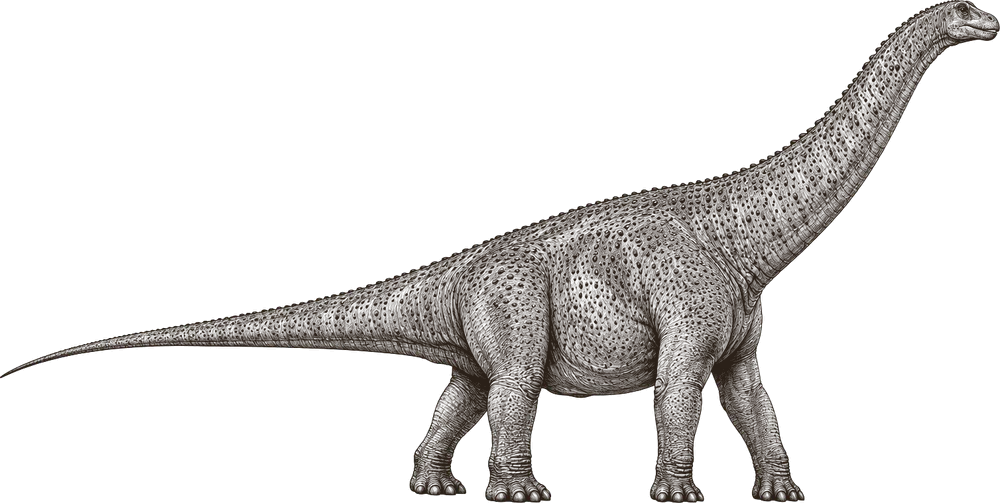


Scale in meters
Where its fossils were found
The evidence
Today

80 million years ago
Habitat
A river floodplain where overflowing water spread sand and mud across the low ground. Other dinosaurs from the Cerro Fortaleza Formation include Puertasaurus, Orkoraptor and Talenkauen.
Field notes
About Dreadnoughtus
What it was like
Dreadnoughtus was an enormous, long-necked plant eater and one of the largest land animals known from reasonably complete fossils. It stretched about 26 meters (85 feet) from nose to tail, and the type specimen may not even have finished growing when it died.
Dreadnoughtus is known from an unusually complete skeleton for such a giant animal, giving scientists a clearer picture of a titanosaur's proportions and growth than is possible for most other giant sauropods.
Its world
Dreadnoughtus lived from about 84 to 72 million years ago, in the Late Cretaceous, in what is now Argentina. Its bones come from the Cerro Fortaleza Formation.
It shared its floodplain habitat with the even larger sauropod Puertasaurus, the predator Orkoraptor, and smaller plant eaters such as Talenkauen and Austrocheirus.
How it was found
Lacovara and colleagues named Dreadnoughtus in 2014, giving the type species the name Dreadnoughtus schrani. Only one fossil find is known, but the bones recovered make it one of the most completely known giant titanosaurs. Its name means fears nothing, chosen because a fully grown adult of its size would have had little to fear from predators. It is considered a relative of other titanosaurs, including Argentinosaurus and Patagotitan.
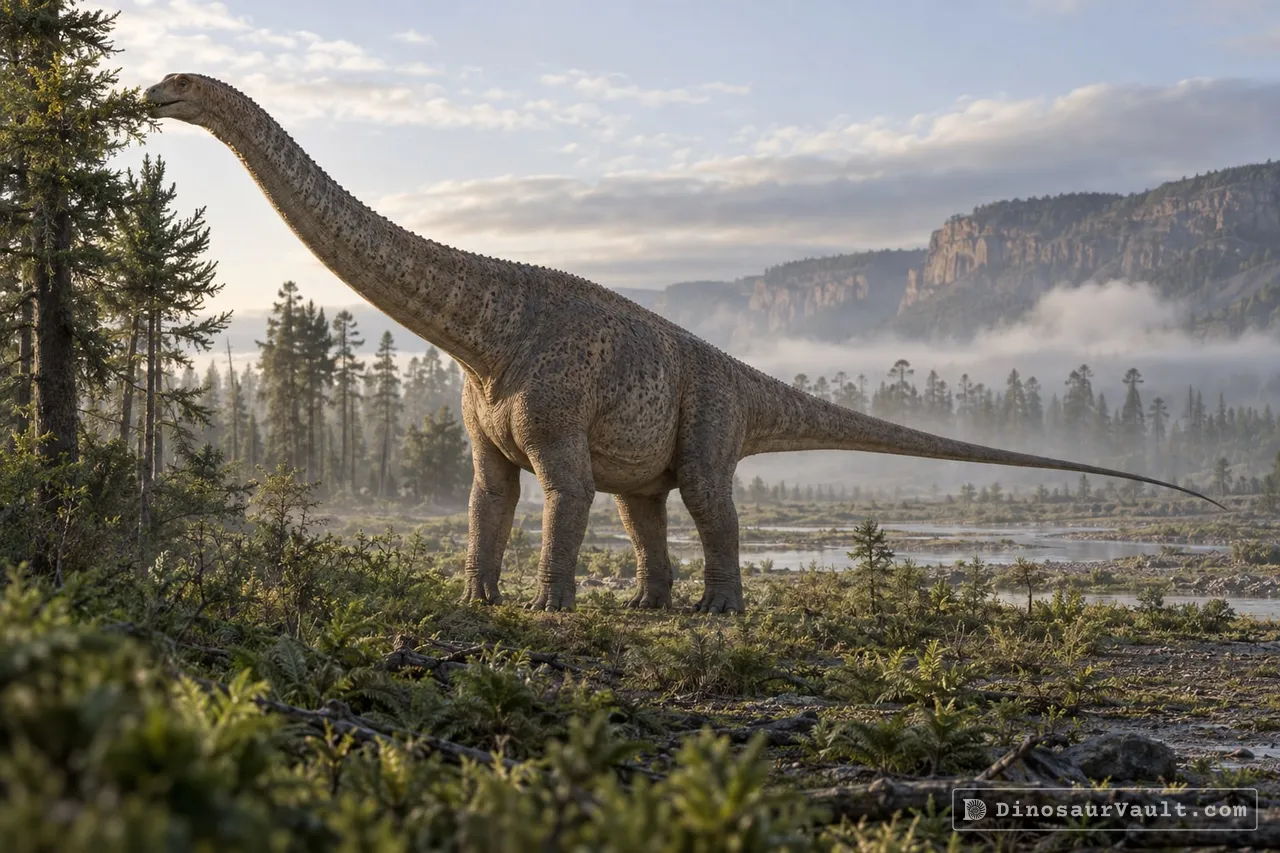
Field gallery
More views of Dreadnoughtus
Scenes reconstructed from the available fossil evidence.
1 of 7
Lived alongside
Found in the same rock formations


A rock formation can hold fossils laid down millions of years apart, so not every animal here met Dreadnoughtus.
The evidence
The science behind Dreadnoughtus
Which parts of the picture come from its own bones, and which come from its relatives.
From its own fossils
- Two partial skeletons preserve much of the shoulders, hips, limbs and tail of this giant titanosaur.
- Thick limb bones and a broad pelvis supported a heavy body.
- The largest known skeleton belonged to an animal that was still growing.
Borrowed from relatives
- The head and missing neck bones are restored by comparison with other titanosaurs, such as Patagotitan.
- Compact, upright forefeet and scaly skin follow other titanosaurs.
Still unknown
- How large a fully grown Dreadnoughtus could become.
- What hatchlings looked like.
- Its color and whether it lived in groups.
Often drawn wrong
- Its forefeet should be compact columns, rather than elephant feet with rows of toenails.
- A covering of large spikes or armor plates has no support in its known fossils.
Discovery timeline
- 2014Named itLacovara et al.
- 2015Full descriptionBates et al.
- 2016Full descriptionUllmann & Lacovara
Key papers
The research behind what we know of Dreadnoughtus
Named it
Named a giant titanosaur from partial skeletons in Argentina and found that the larger individual was still growing.
A Gigantic, Exceptionally Complete Titanosaurian Sauropod Dinosaur from Southern Patagonia, Argentina. Scientific Reports 4
Read the paper : A Gigantic, Exceptionally Complete Titanosaurian Sauropod Dinosaur from Southern Patagonia, Argentina (opens in a new tab)Full description
Used a digital skeleton to estimate body volume, proposing a lower weight than the original estimate based on limb bones.
Downsizing a giant: re-evaluating Dreadnoughtus body mass. Biology Letters 11
Read the paper : Downsizing a giant: re-evaluating Dreadnoughtus body mass (opens in a new tab)Full description
Described the shoulders, pelvis and limb bones in detail, identifying distinctive features and comparing them with other titanosaurs.
Appendicular osteology ofDreadnoughtus schrani, a giant titanosaurian (Sauropoda, Titanosauria) from the Upper Cretaceous of Patagonia, Argentina. Journal of Vertebrate Paleontology 36: e1225303
Read the paper : Appendicular osteology ofDreadnoughtus schrani, a giant titanosaurian (Sauropoda, Titanosauria) from the Upper Cretaceous of Patagonia, Argentina (opens in a new tab)
Close relatives
Other members of Eutitanosauria


Sources: Wikidata