Talenkauen
"small skull"
- Lived
- 84 to 72 million years ago, Late Cretaceous
- Diet
- Herbivore
- Group
- Ornithopods
- Found in
- Argentina
- Named by
- Novas et al. 2004
Where its fossils were found
The evidence
Today

80 million years ago
Habitat
Its Argentine landscape probably included wooded lowlands and river channels, with flowering plants and conifers. Regional neighbors included Dreadnoughtus, Puertasaurus and Orkoraptor.
Field notes
About Talenkauen
What it was like
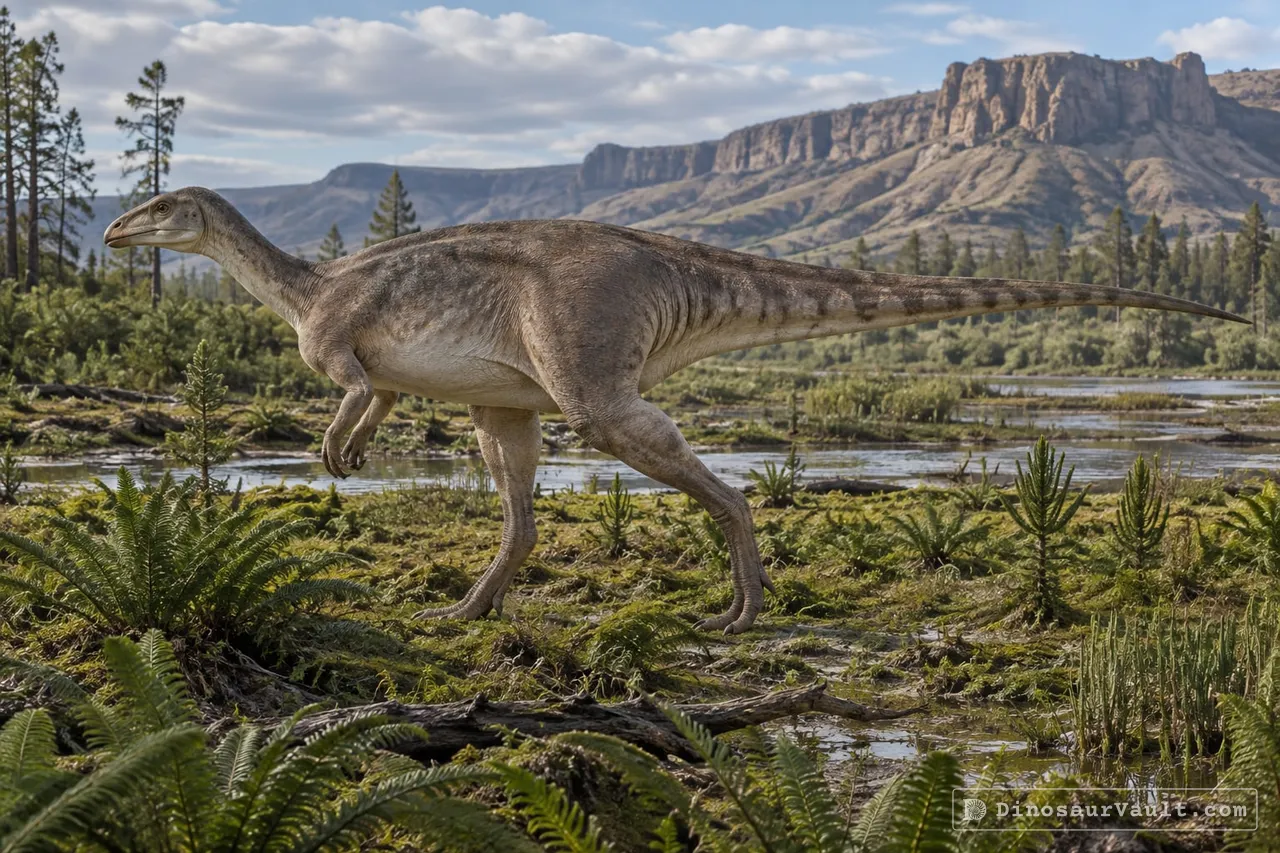
Talenkauen was a medium-sized plant eater that walked on two legs. It had a small head and a long neck for an ornithopod. Thin plates of bone along the sides of its ribs are a feature of its group, the elasmarians.
Its world
It lived in the Late Cretaceous, in what is now Argentina. It comes from the Cerro Fortaleza Formation, where it shared the land with the giant titanosaurs Dreadnoughtus and Puertasaurus and the predator Orkoraptor.
How it was found
Novas and colleagues named Talenkauen in 2004, from a partial skeleton missing most of its skull.
Field gallery
More views of Talenkauen
Scenes reconstructed from the available fossil evidence.
Lived alongside
Found in the same rock formations


A rock formation can hold fossils laid down millions of years apart, so not every animal here met Talenkauen.
The evidence
The science behind Talenkauen
Which parts of the picture come from its own bones, and which come from its relatives.
From its own fossils
- An associated skeleton preserves parts of the jaws, backbone, limbs and feet.
- Long neck vertebrae gave it a proportionally longer neck than most ornithopods.
- Thin, rounded bony plates lay along the sides of the rib cage.
Borrowed from relatives
- Much of the body is known from its own bones.
- Thescelosaurus provides a comparison for missing parts around the eyes, the hands and the tail.
Still unknown
- What the plates beside its ribs did.
- Its complete hand anatomy and skin covering.
- Its precise age and rock unit.
Often drawn wrong
- The plates beside its ribs were inside the body, rather than an outer coat of armor.
- Its neck should be longer than the short neck often given to small ornithopods.
Discovery timeline
- 2004Named itNovas, Cambiaso & Ambrosio
- 2014Close relativeBoyd
- 2019Full descriptionRozadilla, Agnolín & Novas
Key papers
The research behind what we know of Talenkauen
Named it
Named a plant eater with a small skull and unusual bony plates beside its ribs.
A new basal iguanodontian (Dinosauria, Ornithischia) from the Upper Cretaceous of Patagonia. Ameghiniana 41: 75-82
No link available
Close relative
Described a well-preserved Thescelosaurus skull, a comparison for missing bones around the eyes of Talenkauen.
The cranial anatomy of the neornithischian dinosaur Thescelosaurus neglectus. PeerJ 2: e669
Read the paper : The cranial anatomy of the neornithischian dinosaur Thescelosaurus neglectus (opens in a new tab)Full description
Described the skeleton in detail and showed that its long neck was a feature shared with other elasmarians.
Osteology of the Patagonian ornithopod Talenkauen santacrucensis (Dinosauria, Ornithischia). Journal of Systematic Palaeontology 17: 2043-2089
Read the paper : Osteology of the Patagonian ornithopod Talenkauen santacrucensis (Dinosauria, Ornithischia) (opens in a new tab)
Close relatives
Other members of Elasmaria


Sources: Wikidata