Orkoraptor
- Lived
- 84 to 72 million years ago, Late Cretaceous
- Diet
- Carnivore
- Group
- Theropods, Megaraptoridae
- Found in
- Argentina
- Named by
- Novas et al. 2008
Where its fossils were found
The evidence
Today

80 million years ago
Habitat
It lived on river floodplains in southern Argentina. Other dinosaurs from the Cerro Fortaleza Formation include Puertasaurus, Dreadnoughtus and Talenkauen.
Field notes
About Orkoraptor
What it was like
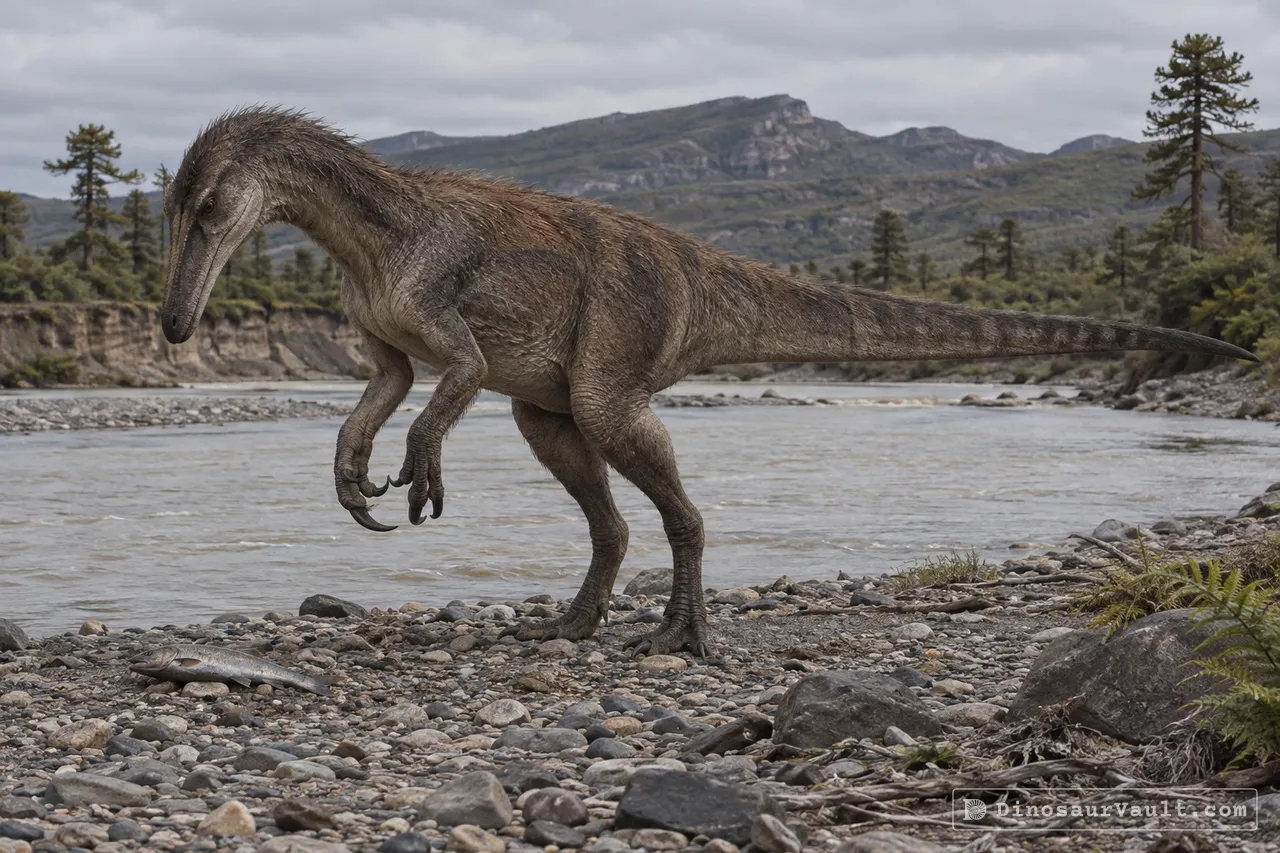
Orkoraptor was a medium-sized meat eater known only from scattered pieces: bits of the skull, some teeth, tail bones and part of a shin bone. Its teeth were unusual, with shapes more like those of much smaller hunters.
Its world
It lived about 84 to 72 million years ago, in the Late Cretaceous, in what is now southern Argentina. Its bones come from the Cerro Fortaleza Formation, where giant titanosaurs such as Dreadnoughtus and Puertasaurus lived. It is one of the most southerly meat-eating dinosaurs known from South America.
How it was found
Novas and colleagues named Orkoraptor in 2008. At first they placed it among the small, bird-like coelurosaurs, but later studies grouped it with the megaraptors, big-clawed hunters such as Megaraptor and Aerosteon.
Field gallery
More views of Orkoraptor
Scenes reconstructed from the available fossil evidence.
1 of 3
Lived alongside
Found in the same rock formations


A rock formation can hold fossils laid down millions of years apart, so not every animal here met Orkoraptor.
The evidence
The science behind Orkoraptor
Which parts of the picture come from its own bones, and which come from its relatives.
From its own fossils
- The type specimen includes pieces of the skull, a fragment that is probably from the lower jaw, teeth, part of the first neck vertebra, tail vertebrae, ribs and part of a shin bone.
- Its teeth have narrow grooves on their inner surfaces and lack serrations along the front edge.
- The bone behind the eye is broad with little surface texture, and the preserved tail vertebrae have small openings in their sides.
Borrowed from relatives
- The missing arms and hands are restored by comparison with Megaraptor and Australovenator, relatives with large hand claws.
- Much of the body outline follows better-known megaraptors such as Aerosteon.
Still unknown
- The complete shape of its skull and hands, and whether one skull fragment comes from the lower jaw or from the top of the snout.
- Its skin covering and color.
- How it caught and handled prey.
Discovery timeline
- 2008Named itNovas, Ezcurra & Lecuona
- 2009Family treeBenson, Carrano & Brusatte
- 2013Family treeNovas et al.
- 2025Close relativeIbiricu et al.
Key papers
The research behind what we know of Orkoraptor
Named it
Described a large meat eater from skull fragments, unusual teeth, tail vertebrae and a partial shin bone in Argentina.
Orkoraptor burkei nov. gen. et sp., a large theropod from the Maastrichtian Pari Aike Formation, Southern Patagonia, Argentina. Cretaceous Research 29: 468-480
Read the paper : Orkoraptor burkei nov. gen. et sp., a large theropod from the Maastrichtian Pari Aike Formation, Southern Patagonia, Argentina (opens in a new tab)Family tree
Grouped Orkoraptor with Megaraptor, Aerosteon and other hunters in the newly recognized megaraptor branch.
A new clade of archaic large-bodied predatory dinosaurs (Theropoda: Allosauroidea) that survived to the latest Mesozoic. Naturwissenschaften 97: 71-78
Read the paper : A new clade of archaic large-bodied predatory dinosaurs (Theropoda: Allosauroidea) that survived to the latest Mesozoic (opens in a new tab)Family tree
Established Megaraptoridae and argued that Orkoraptor and its relatives belonged among coelurosaurs.
Evolution of the carnivorous dinosaurs during the Cretaceous: The evidence from Patagonia. Cretaceous Research 45: 174-215
Read the paper : Evolution of the carnivorous dinosaurs during the Cretaceous: The evidence from Patagonia (opens in a new tab)Close relative
Described Joaquinraptor, a megaraptor with part of its skull and arm, and contrasted it with the broader bone behind the eye and crescent-shaped first neck vertebra of Orkoraptor.
Latest Cretaceous megaraptorid theropod dinosaur sheds light on megaraptoran evolution and palaeobiology. Nature Communications 16
Read the paper : Latest Cretaceous megaraptorid theropod dinosaur sheds light on megaraptoran evolution and palaeobiology (opens in a new tab)
Close relatives
Other members of Megaraptoridae


Sources: Wikidata