Zhanghenglong
"Zhang Heng's dragon"
Type species Zhanghenglong yangchengensis
- Lived
- 86 to 84 million years ago, Late Cretaceous
- Diet
- Herbivore
- Group
- Ornithopods
- Found in
- China
- Named by
- Xing et al. 2014
Where its fossils were found
The evidence
Today

80 million years ago
Habitat
Rivers wound across a floodplain that sometimes dried out and sometimes flooded heavily. Dinosaurs from the Majiacun Formation include Xixiasaurus, Xixianykus and Nanyangosaurus.
Field notes
About Zhanghenglong
What it was like
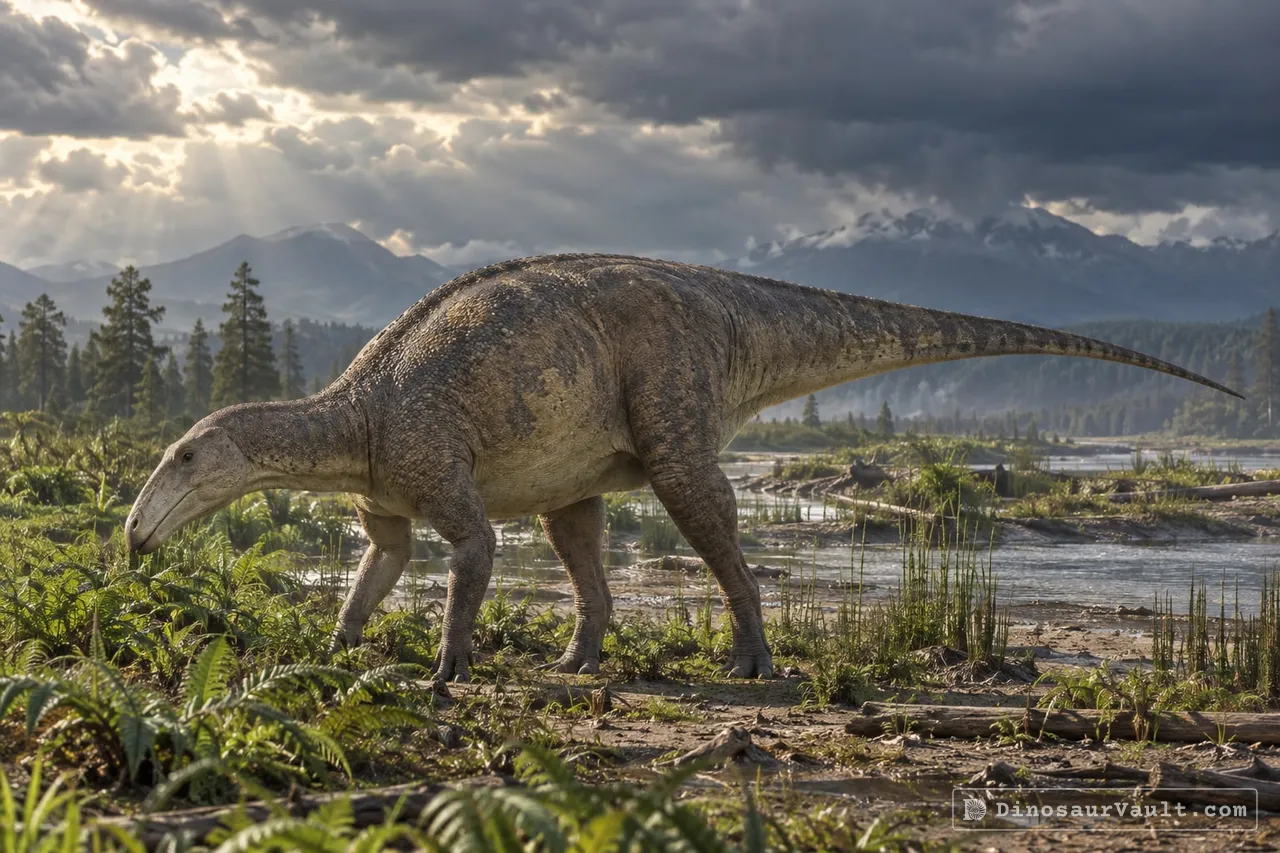
Zhanghenglong was a plant eater related to the duck-billed dinosaurs, known from part of a skull and skeleton. It shows a stage between earlier iguanodonts and true hadrosaurs.
Its world
It lived about 86 to 84 million years ago, in the Late Cretaceous, in what is now central China. Its bones come from the Majiacun Formation, where it shared the land with the troodontid Xixiasaurus, the small alvarezsaur Xixianykus and the plant eater Nanyangosaurus.
How it was found
Xing and colleagues named Zhanghenglong in 2014, after a famous scientist of ancient China.
Field gallery
More views of Zhanghenglong
Scenes reconstructed from the available fossil evidence.
Lived alongside
Found in the same rock formations


A rock formation can hold fossils laid down millions of years apart, so not every animal here met Zhanghenglong.
The evidence
The science behind Zhanghenglong
Which parts of the picture come from its own bones, and which come from its relatives.
From its own fossils
- The type specimen is a nearly complete right upper jaw with parts of the cheek bone and lower jaw.
- Back vertebrae, rib fragments, a shoulder blade and a forearm bone were tentatively assigned to Zhanghenglong from the same quarry.
- The jaws combine features of earlier plant eaters with features of the true duck-billed dinosaurs.
Borrowed from relatives
- Its missing upper bill, neck, chest and upper arms are restored after Eolambia.
Still unknown
- The complete shape of its snout and skull roof.
- Its skin texture and color.
- Its adult body size and whether the tentatively assigned skeleton belongs to it.
Discovery timeline
- 2012SkullsMcDonald et al.
- 2014Named itXing et al.
- 2023Family treeAlarcón-Muñoz et al.
- 2026Family treeMa et al.
Key papers
The research behind what we know of Zhanghenglong
Skulls
Described the skeleton of Eolambia, a comparison for the missing skull front, neck and chest of early duck-billed relatives.
Osteology of the Basal Hadrosauroid Eolambia caroljonesa (Dinosauria: Ornithopoda) from the Cedar Mountain Formation of Utah. PLoS ONE 7: e45712
Read the paper : Osteology of the Basal Hadrosauroid Eolambia caroljonesa (Dinosauria: Ornithopoda) from the Cedar Mountain Formation of Utah (opens in a new tab)Named it
Described the partial skull, tentatively assigned separate skeletal bones and placed Zhanghenglong near the origin of true duck-billed dinosaurs.
A New Basal Hadrosauroid Dinosaur (Dinosauria: Ornithopoda) with Transitional Features from the Late Cretaceous of Henan Province, China. PLoS ONE 9: e98821
Read the paper : A New Basal Hadrosauroid Dinosaur (Dinosauria: Ornithopoda) with Transitional Features from the Late Cretaceous of Henan Province, China (opens in a new tab)Family tree
Named Gonkoken and placed it among duck-billed relatives outside the true hadrosaur family.
Relict duck-billed dinosaurs survived into the last age of the dinosaurs in subantarctic Chile. Science Advances 9
Read the paper : Relict duck-billed dinosaurs survived into the last age of the dinosaurs in subantarctic Chile (opens in a new tab)Family tree
An updated family-tree analysis grouped Zhanghenglong with Eotrachodon outside the true duckbill family.
First Report of a Hollow Cranial Crest in an Early-Diverging Duck-Billed Dinosaur, with Implications for Convergent Evolution of Acoustic Signaling. Biology 15: 615
Read the paper : First Report of a Hollow Cranial Crest in an Early-Diverging Duck-Billed Dinosaur, with Implications for Convergent Evolution of Acoustic Signaling (opens in a new tab)
Close relatives
Other members of Hadrosauroidea


Sources: Wikidata