Nanyangosaurus
"Nanyang lizard"
- Lived
- 94 to 72 million years ago, Late Cretaceous
- Diet
- Herbivore
- Group
- Ornithopods
- Found in
- China
- Named by
- Xu et al. 2000
Where its fossils were found
The evidence
Today

80 million years ago
Habitat
River channels, floodplains and lakes formed the landscape recorded by the Majiacun Formation. The dinosaurs listed from these rocks include Zhanghenglong, Xixiasaurus and Xixianykus.
Field notes
About Nanyangosaurus
What it was like
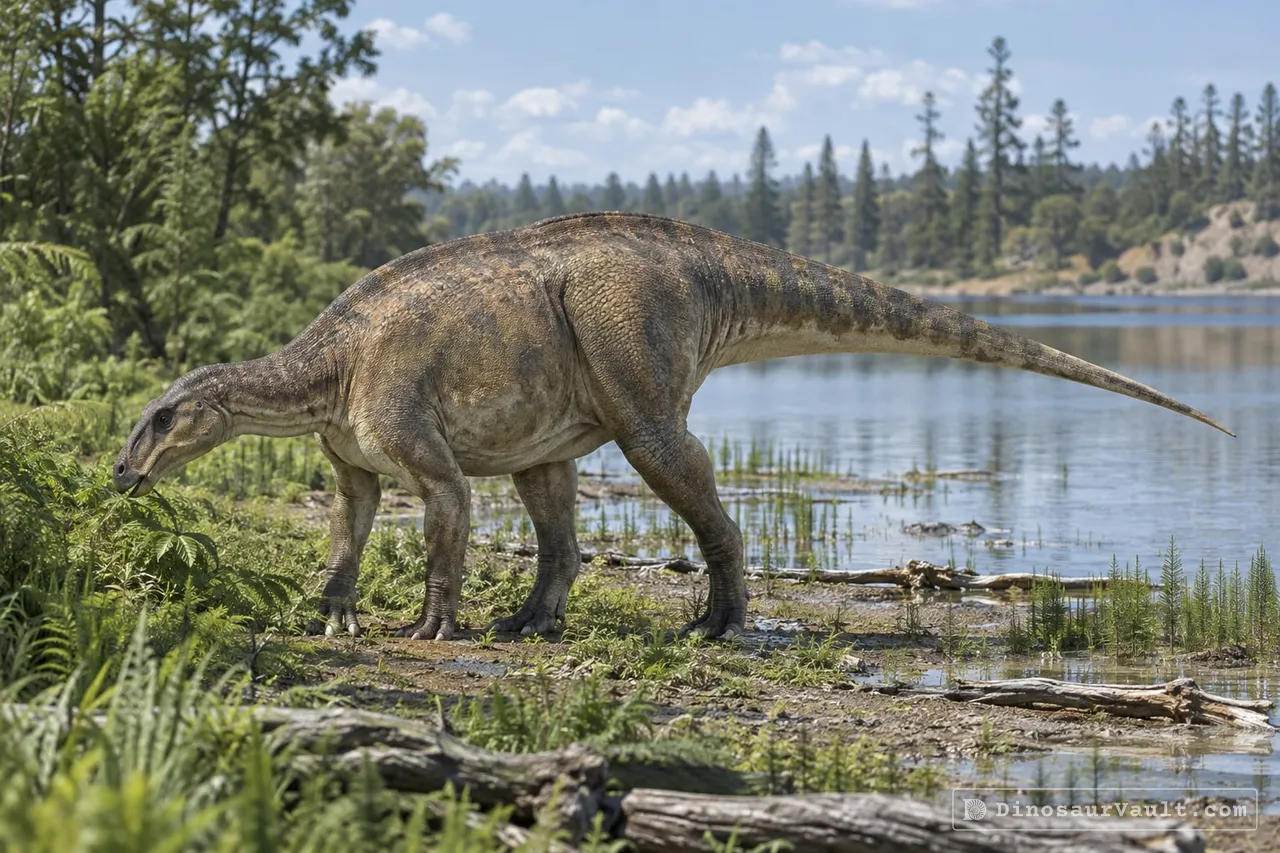
Nanyangosaurus was a plant eater related to the duck-billed dinosaurs, known from part of the skeleton, including limbs and backbones. Its hands had lost the thumb.
Its world
It lived in the Late Cretaceous in what is now central China. Its bones come from the Majiacun Formation, where it shared the land with the plant eater Zhanghenglong, the troodontid Xixiasaurus and the small alvarezsaur Xixianykus.
How it was found
Xu and colleagues named Nanyangosaurus in 2000, from a single find.
Field gallery
More views of Nanyangosaurus
Scenes reconstructed from the available fossil evidence.
Lived alongside
Found in the same rock formations


A rock formation can hold fossils laid down millions of years apart, so not every animal here met Nanyangosaurus.
The evidence
The science behind Nanyangosaurus
Which parts of the picture come from its own bones, and which come from its relatives.
From its own fossils
- The type skeleton includes several back vertebrae, the complete set of hip vertebrae, most of the tail, part of the hip and nearly complete front and hind limbs. No skull bones are among them.
- The hand lacked a thumb, and its long palm bones were partly fused. The fingers ended in hoof-shaped tips.
- The foot has no first toe, and its toes ended in hoof-shaped tips. The upper arm and forearm bones are slender, and the thigh bone is fairly straight.
Borrowed from relatives
- With no skull known, its beak, face and neck are restored after Eolambia, an early relative of the duck-billed dinosaurs.
- Eolambia also has broad, flat, hoof-like toe tips, which a study of Eolambia compared directly with those of Nanyangosaurus.
Still unknown
- The shape of its skull, beak and neck.
- Its closest relatives. Studies place it near the base of the duck-billed dinosaur family tree, and one that grouped it with Zhanghenglong found only weak support.
- Its skin covering and color.
Discovery timeline
- 2000Named itXu et al.
- 2012Family treeMcDonald
- 2012Close relativeMcDonald et al.
- 2013Family treeWang et al.
- 2014Same rocksXing et al.
Key papers
The research behind what we know of Nanyangosaurus
Named it
Described a partial skeleton with distinctive hand and foot bones and placed Nanyangosaurus near the duck-billed dinosaurs.
A new iguanodontian from Sangping Formation of Neixiang, Henan and its stratigraphical implication. Vertebrata PalAsiatica 38: 176-191
No link available
Family tree
Compared Nanyangosaurus with other iguanodonts and identified its geological age as an obstacle to tracing early duckbill evolution.
Phylogeny of Basal Iguanodonts (Dinosauria: Ornithischia): An Update. PLoS ONE 7: e36745
Read the paper : Phylogeny of Basal Iguanodonts (Dinosauria: Ornithischia): An Update (opens in a new tab)Close relative
Described the skeleton of Eolambia, an early relative of the duckbills, and compared its broad, flat, hoof-like toe tips with those of Nanyangosaurus.
Osteology of the Basal Hadrosauroid Eolambia caroljonesa (Dinosauria: Ornithopoda) from the Cedar Mountain Formation of Utah. PLoS ONE 7: e45712
Read the paper : Osteology of the Basal Hadrosauroid Eolambia caroljonesa (Dinosauria: Ornithopoda) from the Cedar Mountain Formation of Utah (opens in a new tab)Family tree
Compared Nanyangosaurus with Yunganglong and supported a Late Cretaceous age for the rocks containing Nanyangosaurus.
A New Hadrosauroid Dinosaur from the Early Late Cretaceous of Shanxi Province, China. PLoS ONE 8: e77058
Read the paper : A New Hadrosauroid Dinosaur from the Early Late Cretaceous of Shanxi Province, China (opens in a new tab)Same rocks
Named Zhanghenglong from the same rocks and found it, Nanyangosaurus and the duck-billed dinosaurs in a weakly supported group.
A New Basal Hadrosauroid Dinosaur (Dinosauria: Ornithopoda) with Transitional Features from the Late Cretaceous of Henan Province, China. PLoS ONE 9: e98821
Read the paper : A New Basal Hadrosauroid Dinosaur (Dinosauria: Ornithopoda) with Transitional Features from the Late Cretaceous of Henan Province, China (opens in a new tab)
Close relatives
Other members of Hadrosauroidea


Sources: Wikidata