Xixiasaurus
"Xixia lizard"
Type species Xixiasaurus henanensis
- Lived
- 90 to 72 million years ago, Late Cretaceous
- Diet
- Omnivore
- Group
- Theropods, Troodontidae
- Found in
- China
- Named by
- Lü et al. 2010
Where its fossils were found
The evidence
Today

80 million years ago
Habitat
Rivers split into branching channels or wound across the plain, with lakes nearby. Other dinosaurs from the Majiacun Formation included Xixianykus and Zhanghenglong.
Field notes
About Xixiasaurus
What it was like
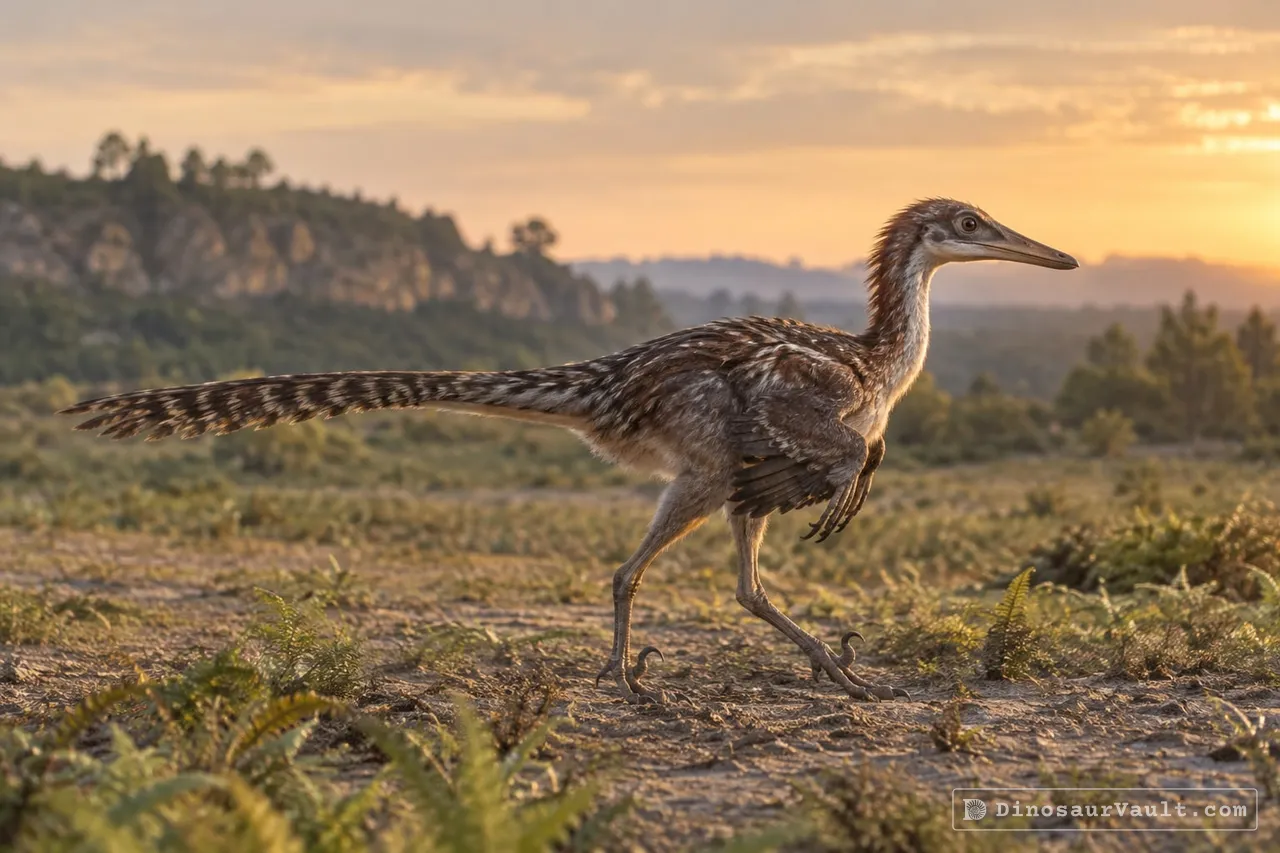
Xixiasaurus was a small feathered troodontid, known from part of a skull and skeleton. It had a long, narrow snout with many small teeth without serrations.
Its world
It lived in the Late Cretaceous in what is now central China. Its bones come from the Majiacun Formation, where it shared the land with the small alvarezsaur Xixianykus and the plant eater Zhanghenglong.
How it was found
Lü and colleagues named Xixiasaurus in 2010, from a single find.
Field gallery
More views of Xixiasaurus
Scenes reconstructed from the available fossil evidence.
1 of 3
Lived alongside
Found in the same rock formations


A rock formation can hold fossils laid down millions of years apart, so not every animal here met Xixiasaurus.
The evidence
The science behind Xixiasaurus
Which parts of the picture come from its own bones, and which come from its relatives.
From its own fossils
- The known specimen preserves much of the skull, part of the lower jaw and part of the right arm and hand.
- Its long, low snout tapers toward a rounded tip.
- Its small teeth have smooth, sharp edges without serrations.
Borrowed from relatives
- A feather coat is inferred from feathered troodontids such as Jianianhualong.
- The missing legs and tail follow other troodontids, such as Mei and Sinovenator.
Still unknown
- How much of its diet was plants, small animals or both.
- Its closest relatives within the troodontid family.
- Its feather colors and patterns.
Discovery timeline
- 2010Named itLü et al.
- 2015Its worldWang et al.
- 2017Close relativeXu et al.
Key papers
The research behind what we know of Xixiasaurus
Named it
Described the skull and smooth-edged teeth and compared Xixiasaurus with other Asian troodontids.
A New Troodontid Theropod from the Late Cretaceous of Central China, and the Radiation of Asian Troodontids. Acta Palaeontologica Polonica 55: 381-388
Read the paper : A New Troodontid Theropod from the Late Cretaceous of Central China, and the Radiation of Asian Troodontids (opens in a new tab)Its world
Studied tracks, burrows and sediments from river channels, floodplains and lake margins in the rocks where Xixiasaurus lived.
Trace fossils and sedimentary environments of the upper cretaceous in the Xixia Basin, Southwestern Henan Province, China. Geodinamica Acta 28: 53-70
Read the paper : Trace fossils and sedimentary environments of the upper cretaceous in the Xixia Basin, Southwestern Henan Province, China (opens in a new tab)Close relative
Described Jianianhualong with large feathers on its arms, legs and tail, supporting a feathered restoration of other troodontids.
Mosaic evolution in an asymmetrically feathered troodontid dinosaur with transitional features. Nature Communications 8
Read the paper : Mosaic evolution in an asymmetrically feathered troodontid dinosaur with transitional features (opens in a new tab)
Close relatives
Other members of Troodontidae


Sources: Wikidata