Yulong
- Lived
- 72 to 66 million years ago, Late Cretaceous
- Diet
- Omnivore
- Group
- Theropods, Oviraptoridae
- Found in
- China
- Named by
- Lü et al. 2013
Where its fossils were found
The evidence
Today

70 million years ago
Habitat
A landscape of shallow water and river deltas in central China. Qiupalong, Luanchuanraptor and Qiupanykus also lived in the Qiupa Formation landscape.
Field notes
About Yulong
What it was like
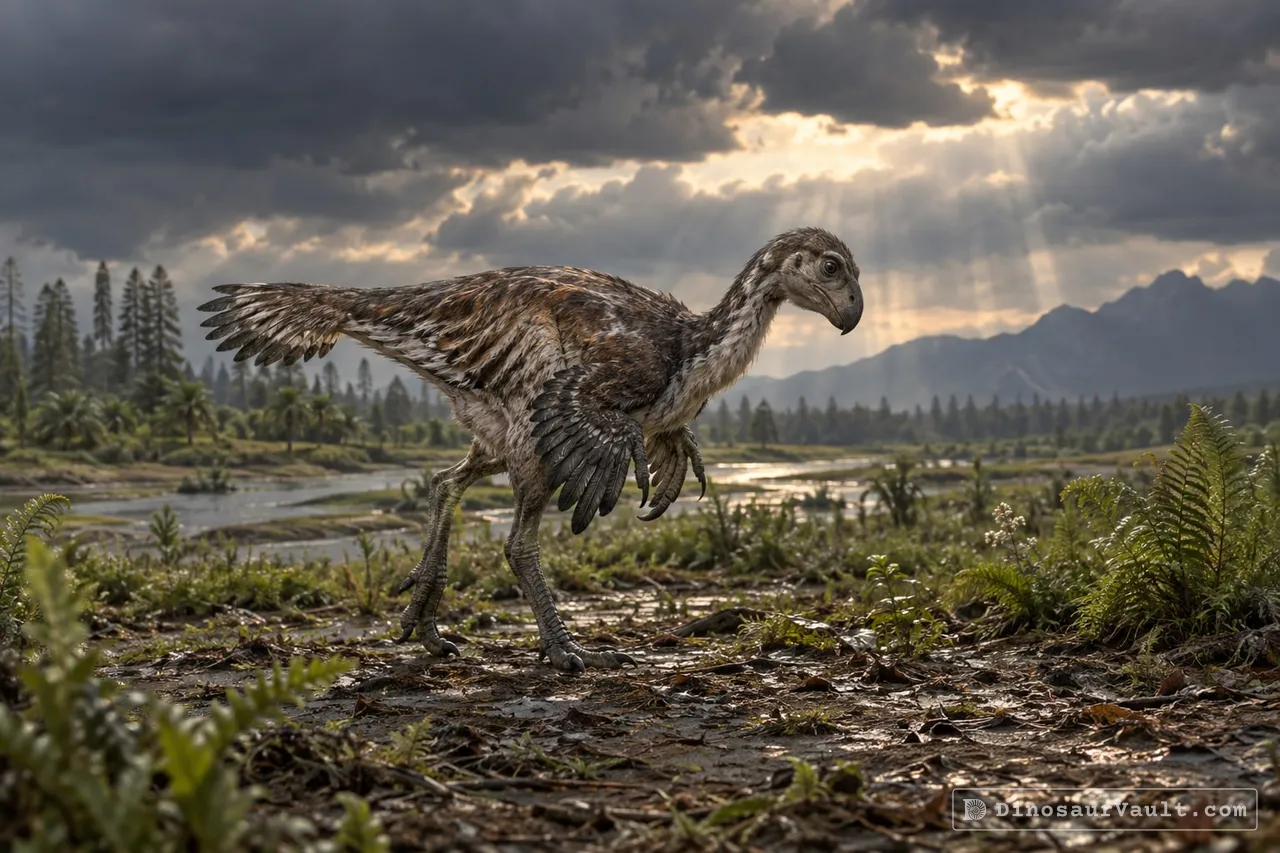
Yulong was a small oviraptorid, a toothless, feathered theropod. It is known from young animals and from embryos inside eggs.
Its world
It lived about 72 to 66 million years ago, at the end of the Late Cretaceous, in what is now central China. Its bones come from the Qiupa Formation, where the ostrich-like Qiupalong and the small raptor Luanchuanraptor also lived.
How it was found
Lü and colleagues named it in 2013. It was one of the smallest oviraptorids known.
Field gallery
More views of Yulong
Scenes reconstructed from the available fossil evidence.
1 of 3
Lived alongside
Found in the same rock formations


A rock formation can hold fossils laid down millions of years apart, so not every animal here met Yulong.
The evidence
The science behind Yulong
Which parts of the picture come from its own bones, and which come from its relatives.
From its own fossils
- Young skeletons preserve skulls and much of the body, including toothless jaws.
- A larger, partly grown animal preserves shoulder bones, arms and sections of the back and tail.
- Even young animals had a strongly downturned tip to the lower jaw.
Borrowed from relatives
- A feathered covering follows other oviraptorosaurs, such as Caudipteryx.
- Much of the skeleton is known from young animals; comparisons with Oviraptor and Citipati help restore the adult body.
Still unknown
- Its fully grown size and adult head shape.
- Its color.
- Which foods it ate most often.
Discovery timeline
- 2013Named itLü et al.
- 2013Family treeLü et al.
- 2022Growing upWei et al.
Key papers
The research behind what we know of Yulong
Named it
Named Yulong from young skeletons and found that oviraptorid leg proportions changed little as the animals grew.
Chicken-sized oviraptorid dinosaurs from central China and their ontogenetic implications. Naturwissenschaften 100: 165-175
Read the paper : Chicken-sized oviraptorid dinosaurs from central China and their ontogenetic implications (opens in a new tab)Family tree
Compared Nankangia with Yulong and other oviraptorosaurs, using their jaw shapes and skeletons to study relationships.
A New Oviraptorosaur (Dinosauria: Oviraptorosauria) from the Late Cretaceous of Southern China and Its Paleoecological Implications. PLoS ONE 8: e80557
Read the paper : A New Oviraptorosaur (Dinosauria: Oviraptorosauria) from the Late Cretaceous of Southern China and Its Paleoecological Implications (opens in a new tab)Growing up
Described a larger Yulong skeleton and used its bone tissue to identify it as a subadult.
A new subadult specimen of oviraptorid Yulong mini (Theropoda: Oviraptorosauria) from the Upper Cretaceous Qiupa Formation of Luanchuan, central China. Cretaceous Research 138: 105261
Read the paper : A new subadult specimen of oviraptorid Yulong mini (Theropoda: Oviraptorosauria) from the Upper Cretaceous Qiupa Formation of Luanchuan, central China (opens in a new tab)
Close relatives
Other members of Oviraptoridae


Sources: Wikidata