Qiupalong
"Qiupa dragon"
Type species Qiupalong henanensis
- Lived
- 72 to 66 million years ago, Late Cretaceous
- Diet
- Omnivore
- Group
- Theropods, Ornithomimidae
- Found in
- China
- Named by
- Xu et al. 2011
Where its fossils were found
The evidence
Today

70 million years ago
Habitat
The Qiupa Formation records streams spreading gravel and sand toward lake shores. Dinosaurs in its world included Yulong and Luanchuanraptor.
Field notes
About Qiupalong
What it was like
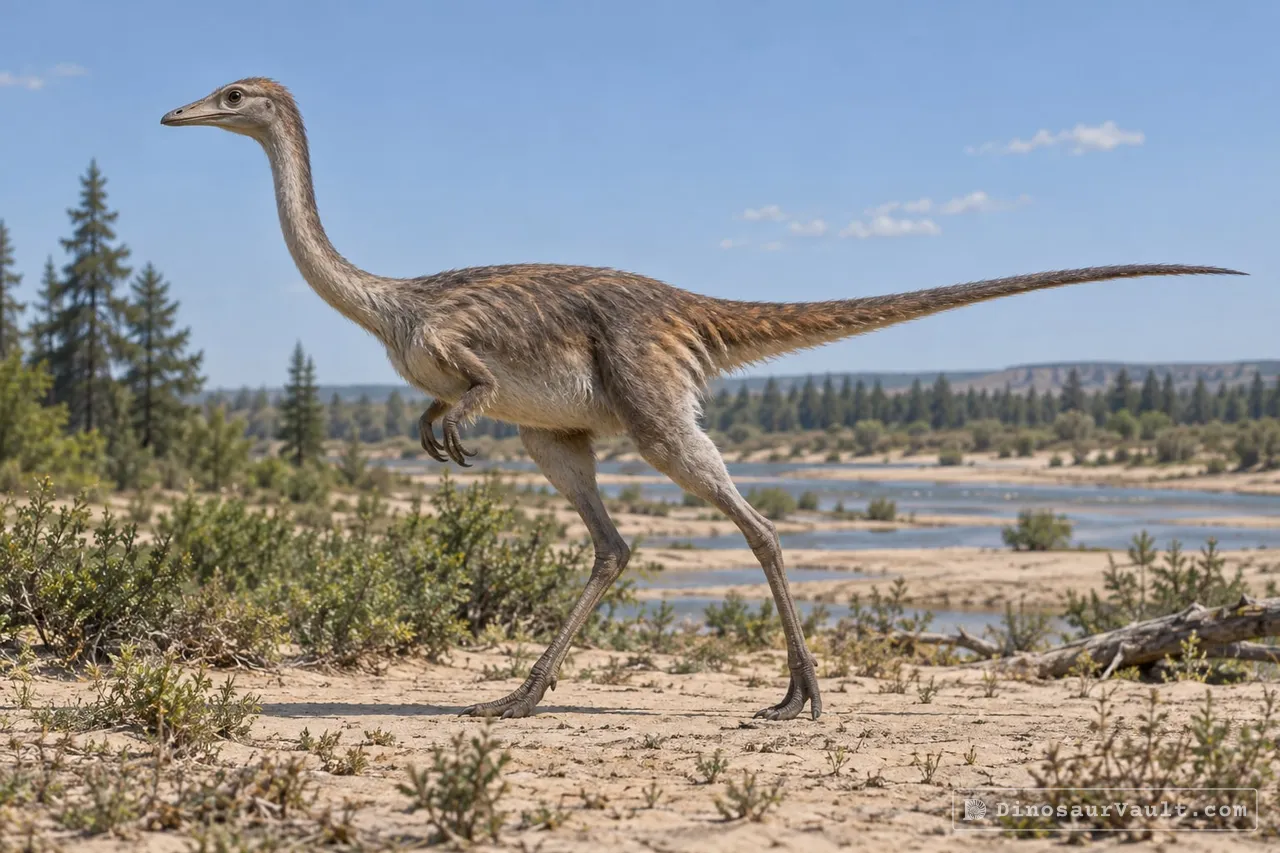
Qiupalong was an ostrich-like dinosaur, a relative of Ornithomimus and Struthiomimus, with long legs, a long neck and a toothless beak. It is known from part of the hips and legs.
Its relatives lived mostly in North America, which suggests these animals moved between Asia and North America.
Its world
It lived in the Late Cretaceous in what is now central China. Its bones come from the Qiupa Formation, where it shared the land with the tyrannosaur Tarbosaurus, the small oviraptor Yulong and the raptor Luanchuanraptor.
How it was found
Xu and colleagues named Qiupalong in 2011, from a single find.
Field gallery
More views of Qiupalong
Scenes reconstructed from the available fossil evidence.
Lived alongside
Found in the same rock formations


A rock formation can hold fossils laid down millions of years apart, so not every animal here met Qiupalong.
The evidence
The science behind Qiupalong
Which parts of the picture come from its own bones, and which come from its relatives.
From its own fossils
- The original partial skeleton preserves hip and hind-limb bones.
- Its shinbone has a distinctive notch near the top, and its ankle bones have a small pit where they meet.
- Its toe claws curve downward.
Borrowed from relatives
- The missing head and neck are restored using Ornithomimus and Struthiomimus, with a toothless beak and a long neck.
- Qiupalong probably had a feather covering like the one preserved in Ornithomimus.
Still unknown
- Its exact head shape.
- The extent and color of its feathers.
- Whether the bones assigned to Qiupalong in Canada belong to the same species as the Chinese animal.
Discovery timeline
- 2011Named itXu et al.
- 2012Close relativeZelenitsky et al.
- 2017New findMcFeeters et al.
Key papers
The research behind what we know of Qiupalong
Named it
Named Qiupalong from a partial skeleton and found close family ties to Ornithomimus and Struthiomimus.
A new ornithomimid dinosaur with North American affinities from the Late Cretaceous Qiupa Formation in Henan Province of China. Cretaceous Research 32: 213-222
Read the paper : A new ornithomimid dinosaur with North American affinities from the Late Cretaceous Qiupa Formation in Henan Province of China (opens in a new tab)Close relative
Found feathers on young and adult Ornithomimus, with winglike forelimb feathers in adults, a guide to restoring related ostrich-like dinosaurs.
Feathered Non-Avian Dinosaurs from North America Provide Insight into Wing Origins. Science 338: 510-514
Read the paper : Feathered Non-Avian Dinosaurs from North America Provide Insight into Wing Origins (opens in a new tab)New find
Assigned Canadian bones to Qiupalong and proposed that the genus spread from North America into Asia.
First North American occurrences of Qiupalong (Theropoda: Ornithomimidae) and the palaeobiogeography of derived ornithomimids. FACETS 2: 355-373
Read the paper : First North American occurrences of Qiupalong (Theropoda: Ornithomimidae) and the palaeobiogeography of derived ornithomimids (opens in a new tab)
Close relatives
Other members of Ornithomimidae


Sources: Wikidata