Corythoraptor
"helmeted thief"
Type species Corythoraptor jacobsi
- Lived
- 72 to 66 million years ago, Late Cretaceous
- Diet
- Omnivore
- Group
- Theropods, Oviraptoridae
- Found in
- China
- Named by
- Lü et al. 2017
Where its fossils were found
The evidence
Today

70 million years ago
Habitat
It lived on warm, dry plains in southern China, where streams spread sediment across broad fans. Other oviraptorids from this region include Huanansaurus and Tongtianlong.
Field notes
About Corythoraptor
What it was like
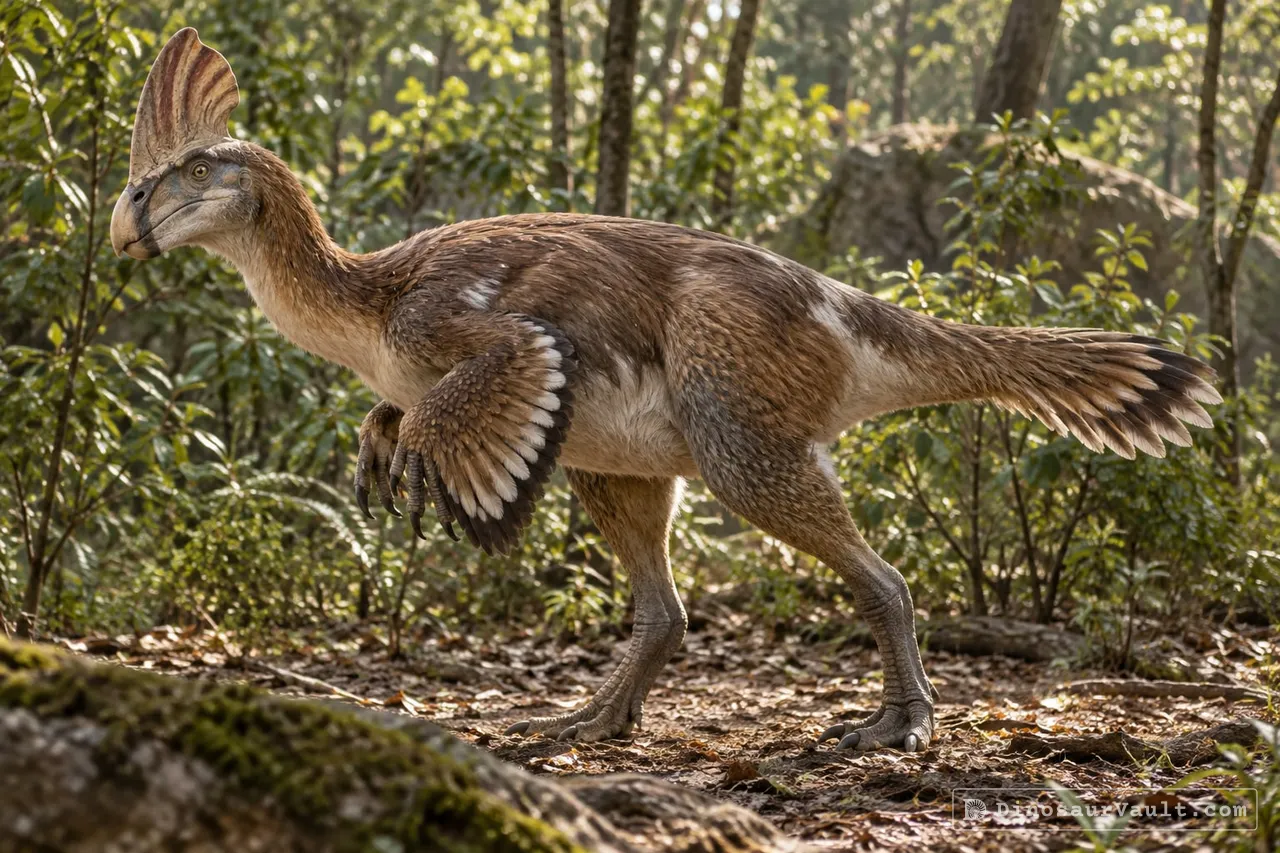
Corythoraptor was an oviraptorid, a feathered, toothless theropod with a short beak. It had a tall, thin crest on its head, much like the helmet of a cassowary. The crest may have been used for display to other members of its kind.
Its world
It lived about 72 to 66 million years ago, at the end of the Late Cretaceous, in what is now southern China. The region was rich in oviraptorids, and other members of the family found there include Huanansaurus and Tongtianlong.
How it was found
Lü and colleagues named it in 2017 from one well-preserved skeleton. The type species is Corythoraptor jacobsi.
Field gallery
More views of Corythoraptor
Scenes reconstructed from the available fossil evidence.
1 of 3
Lived alongside
Found in the same rock formations


A rock formation can hold fossils laid down millions of years apart, so not every animal here met Corythoraptor.
The evidence
The science behind Corythoraptor
Which parts of the picture come from its own bones, and which come from its relatives.
From its own fossils
- An almost complete skeleton preserves a toothless skull with a tall, thin crest containing large air spaces.
- The neck is longer than the back, and the hands carry curved claws.
- Growth marks in its bones show that the known individual was still growing.
Borrowed from relatives
- Almost the whole body is known from its own skeleton.
- Its probable feather covering follows feathered oviraptorosaurs such as Caudipteryx.
Still unknown
- The color and arrangement of its feathers.
- How the crest helped with display, communication or controlling body temperature.
- Its fully grown size and the foods it preferred.
Discovery timeline
- 1998Close relativeQiang et al.
- 2015Close relativeLü et al.
- 2017Named itLü et al.
Key papers
The research behind what we know of Corythoraptor
Close relative
Described feathers in Caudipteryx, an early oviraptorosaur that helps guide feathered restorations of its later relatives.
Two feathered dinosaurs from northeastern China. Nature 393: 753-761
Read the paper : Two feathered dinosaurs from northeastern China (opens in a new tab)Close relative
Described Huanansaurus, later recovered as a close relative of Corythoraptor, and compared the region's oviraptorid diversity.
A New Oviraptorid Dinosaur (Dinosauria: Oviraptorosauria) from the Late Cretaceous of Southern China and Its Paleobiogeographical Implications. Scientific Reports 5
Read the paper : A New Oviraptorid Dinosaur (Dinosauria: Oviraptorosauria) from the Late Cretaceous of Southern China and Its Paleobiogeographical Implications (opens in a new tab)Named it
Described an almost complete skeleton with a tall crest, a long neck and bones showing continued growth.
High diversity of the Ganzhou Oviraptorid Fauna increased by a new “cassowary-like” crested species. Scientific Reports 7
Read the paper : High diversity of the Ganzhou Oviraptorid Fauna increased by a new “cassowary-like” crested species (opens in a new tab)
Close relatives
Other members of Oviraptoridae


Sources: Wikidata