Qiupanykus
"Qiupa claw"
Type species Qiupanykus zhangi
- Lived
- 72 to 66 million years ago, Late Cretaceous
- Diet
- Carnivore
- Group
- Theropods
- Found in
- China
- Named by
- Lü et al. 2018
Where its fossils were found
The evidence
Today

70 million years ago
Habitat
Shallow lakes and branching rivers shaped the land recorded in the Qiupa Formation. Qiupalong, Luanchuanraptor and Yulong lived in the same region.
Field notes
About Qiupanykus
What it was like
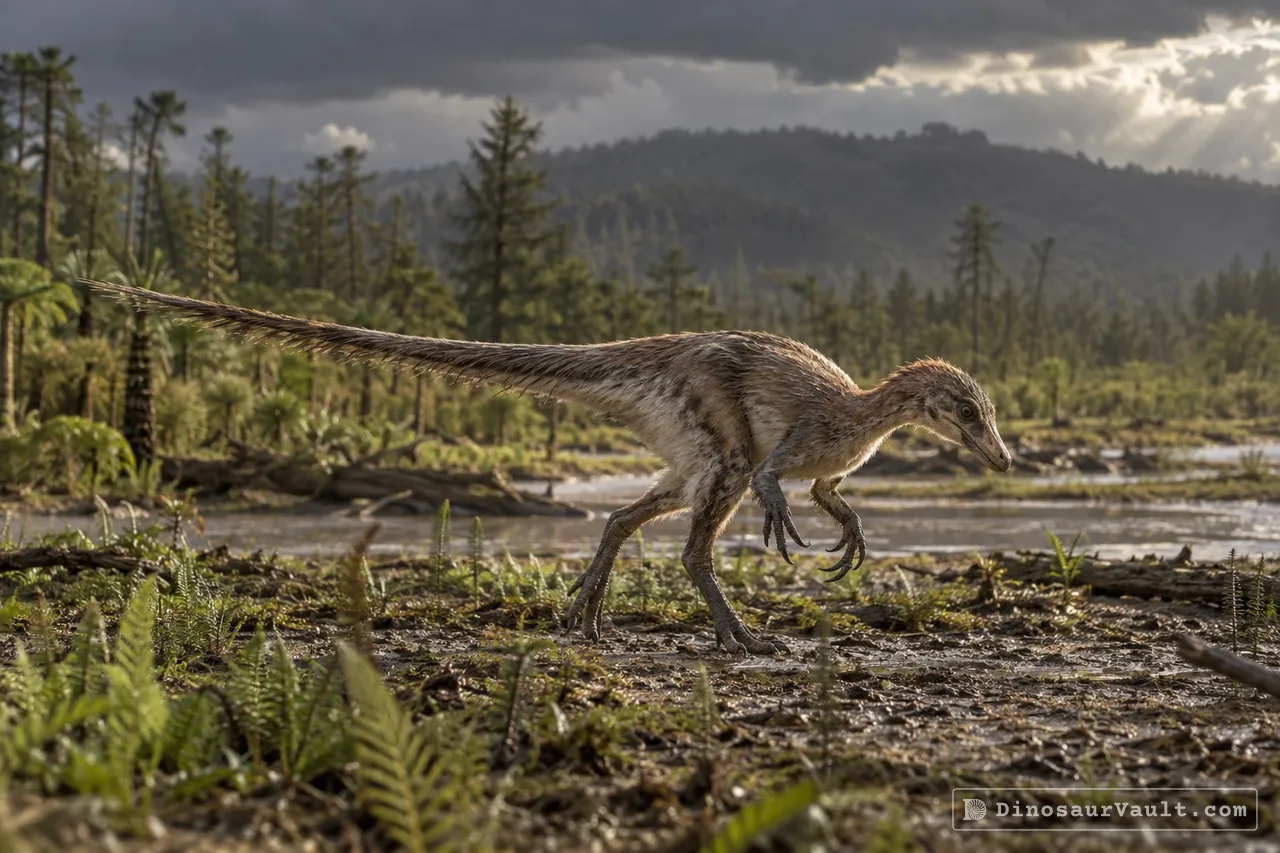
Qiupanykus was a small alvarezsaur, a bird-like dinosaur with short arms and long legs. It is known from part of a skeleton.
An eggshell found with its bones may be from an oviraptor egg, and some scientists think these small animals cracked open eggs to eat.
Its world
It lived about 72 to 66 million years ago, at the end of the Late Cretaceous, in what is now central China. Its bones come from the Qiupa Formation, where it shared the land with the tyrannosaur Tarbosaurus, the ostrich-like Qiupalong and the raptor Luanchuanraptor.
How it was found
Lü and colleagues named Qiupanykus in 2018, from a single find.
Field gallery
More views of Qiupanykus
Scenes reconstructed from the available fossil evidence.
1 of 3
Lived alongside
Found in the same rock formations


A rock formation can hold fossils laid down millions of years apart, so not every animal here met Qiupanykus.
The evidence
The science behind Qiupanykus
Which parts of the picture come from its own bones, and which come from its relatives.
From its own fossils
- The only described skeleton is poorly preserved. It includes four neck vertebrae, the hip vertebrae, much of the tail, parts of the hips and a right leg still lying nearly in place.
- The thigh bone curves strongly forward, and the middle bone of the foot is reduced near the ankle, closely enclosed by its neighbors. Its toe claws are moderately long, tapering and slightly curved.
- Broken dinosaur eggshells lay beside its tail.
Borrowed from relatives
- Its missing head, arms and hands are restored by comparison with Jaculinykus, a related alvarezsaur whose skull and arms are known.
- Hands of Jaculinykus and Linhenykus suggest one large, curved main claw, though alvarezsaurs differ in how many fingers they kept.
Still unknown
- Its skull, arms and back are unknown.
- Whether it ate eggs, insects or other foods.
- Whether the eggshells beside its skeleton belonged to an oviraptorosaur or a small alvarezsaur. Experts disagree.
Discovery timeline
- 2018Named itLü et al.
- 2018Close relativeXu et al.
- 2021Growing upQin et al.
- 2023Close relativeKubo et al.
- 2024Family treeMeso et al.
Key papers
The research behind what we know of Qiupanykus
Named it
Named Qiupanykus from a partial skeleton beside broken eggshells and proposed that alvarezsaurs might have eaten eggs.
A new alvarezsaurid dinosaur from the Late Cretaceous Qiupa Formation of Luanchuan, Henan Province, central China. China Geology 1: 28-35
Read the paper : A new alvarezsaurid dinosaur from the Late Cretaceous Qiupa Formation of Luanchuan, Henan Province, central China (opens in a new tab)Close relative
Described Bannykus and Xiyunykus, showing stages in the evolution of the short arms and specialized hands of later alvarezsaurs.
Two Early Cretaceous Fossils Document Transitional Stages in Alvarezsaurian Dinosaur Evolution. Current Biology 28: 2853-2860.e3
Read the paper : Two Early Cretaceous Fossils Document Transitional Stages in Alvarezsaurian Dinosaur Evolution (opens in a new tab)Growing up
Compared alvarezsaur growth and body size, assessing the known Qiupanykus skeleton as a subadult.
Growth and miniaturization among alvarezsauroid dinosaurs. Current Biology 31: 3687-3693.e5
Read the paper : Growth and miniaturization among alvarezsauroid dinosaurs (opens in a new tab)Close relative
Described Jaculinykus, a related alvarezsaur preserving a skull, short sturdy arms and hands, found curled up like a sleeping bird.
A new alvarezsaurid dinosaur (Theropoda, Alvarezsauria) from the Upper Cretaceous Baruungoyot Formation of Mongolia provides insights for bird-like sleeping behavior in non-avian dinosaurs. PLOS ONE 18: e0293801
Read the paper : A new alvarezsaurid dinosaur (Theropoda, Alvarezsauria) from the Upper Cretaceous Baruungoyot Formation of Mongolia provides insights for bird-like sleeping behavior in non-avian dinosaurs (opens in a new tab)Family tree
Traced body size across the alvarezsaur family tree, kept Qiupanykus as a separate genus, and suggested the eggshells found with it could belong to a small alvarezsaur.
Body size and evolutionary rate analyses reveal complex evolutionary history of Alvarezsauria. Cladistics 41: 135-155
Read the paper : Body size and evolutionary rate analyses reveal complex evolutionary history of Alvarezsauria (opens in a new tab)
Close relatives
Other members of Alvarezsauroidea


Sources: Wikidata