Tanius
"of Tan"
- Lived
- 90 to 72 million years ago, Late Cretaceous
- Diet
- Herbivore
- Group
- Ornithopods
- Found in
- China
- Named by
- Wiman 1929
Where its fossils were found
The evidence
Today

80 million years ago
Habitat
Rivers and lakes spread across low floodplains in what is now eastern China. Dinosaurs from the same regional rock sequence include Tsintaosaurus, Micropachycephalosaurus and Laiyangosaurus.
Field notes
About Tanius
What it was like
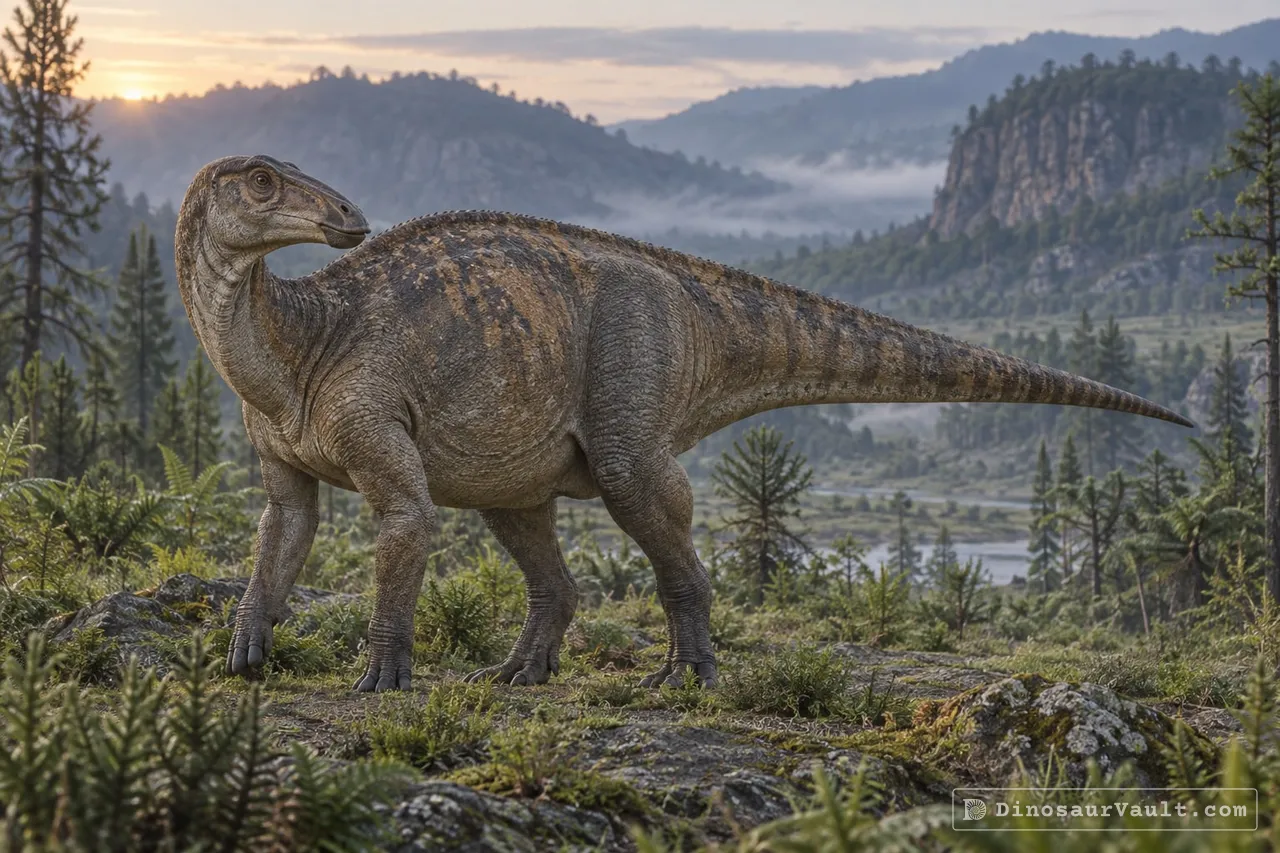
Tanius was a large plant eater, an early relative of the duck-billed dinosaurs, with a beak and rows of grinding teeth. It is known from part of the skull and skeleton.
Its world
It lived in the Late Cretaceous in what is now eastern China. Its bones come from the Jingangkou Formation, where it shared the land with the crested hadrosaur Tsintaosaurus and the small Micropachycephalosaurus.
How it was found
Wiman named Tanius in 1929, after a Chinese geologist. Five finds are known.
Field gallery
More views of Tanius
Scenes reconstructed from the available fossil evidence.
Lived alongside
Found in the same rock formations


A rock formation can hold fossils laid down millions of years apart, so not every animal here met Tanius.
The evidence
The science behind Tanius
Which parts of the picture come from its own bones, and which come from its relatives.
From its own fossils
- The original find includes part of the skull and bones from the backbone, shoulders, hips and limbs.
- Its shoulder blade has a strongly curved upper edge.
- The lower end of the thigh bone encloses a tunnel between its joint surfaces.
Borrowed from relatives
- Other early hadrosauroids such as Bactrosaurus provide comparisons for restoring missing parts of the skull and body.
Still unknown
- Its skin covering and color.
- How it changed shape as it grew.
- Whether it cared for its young.
Discovery timeline
- 1929Named itWiman
- 2019RedescriptionZhang et al.
- 2021RedescriptionBorinder et al.
Key papers
The research behind what we know of Tanius
Named it
Named Tanius from a partial skull and skeleton found in China.
Die Kreide-Dinosaurier aus Shantung [The Cretaceous dinosaurs of Shantung]. Palaeontologia Sinica, Series C 6: 1-67
No link available
Redescription
Found that bones assigned to Tanius laiyangensis belonged to a different duck-billed dinosaur, removing them from Tanius.
Osteological Re‐Assessment and Taxonomic Revision of “Tanius laiyangensis” (Ornithischia: Hadrosauroidea) from the Upper Cretaceous of Shandong, China. The Anatomical Record 303: 790-800
Read the paper : Osteological Re‐Assessment and Taxonomic Revision of “Tanius laiyangensis” (Ornithischia: Hadrosauroidea) from the Upper Cretaceous of Shandong, China (opens in a new tab)Redescription
Restudied the skeleton and identified shoulder, hip and limb features that distinguish Tanius from other early hadrosauroids.
Postcranial osteology of the basally branching hadrosauroid dinosaur Tanius sinensis from the Upper Cretaceous Wangshi Group of Shandong, China. Journal of Vertebrate Paleontology 41
Read the paper : Postcranial osteology of the basally branching hadrosauroid dinosaur Tanius sinensis from the Upper Cretaceous Wangshi Group of Shandong, China (opens in a new tab)
Close relatives
Other members of Hadrosauroidea


Sources: Wikidata