Laiyangosaurus
"Laiyang lizard"
Type species Laiyangosaurus youngi
- Lived
- 84 to 72 million years ago, Late Cretaceous
- Diet
- Herbivore
- Group
- Ornithopods, Hadrosauridae
- Found in
- China
- Named by
- Zhang et al. 2019
Where its fossils were found
The evidence
Today

80 million years ago
Habitat
Rivers and lakes shaped its landscape in China. Other plant eaters in the local dinosaur fauna included Tsintaosaurus and Tanius.
Field notes
About Laiyangosaurus
What it was like
Laiyangosaurus was a duckbill, a plant eater related to Edmontosaurus. It is known from skull bones, with neck, shoulder, limb and hip bones later assigned to it.
Its world
It lived in the Late Cretaceous, in what is now China. It comes from the Jingangkou Formation, where it shared the land with the crested duckbill Tsintaosaurus and the plant eater Tanius.
How it was found
Zhang and colleagues named Laiyangosaurus in 2019. The type species is Laiyangosaurus youngi.
Field gallery
More views of Laiyangosaurus
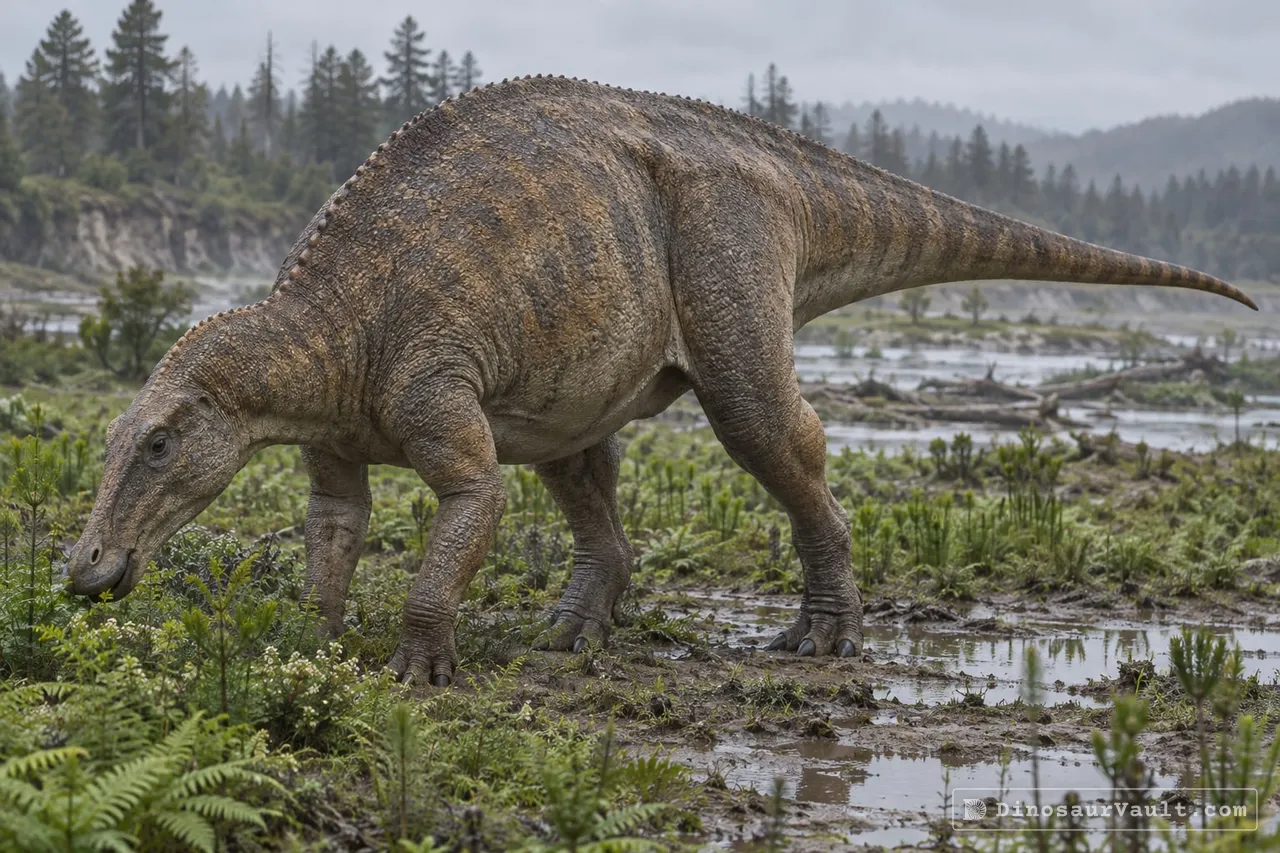
Scenes reconstructed from the available fossil evidence.
1 of 2
Lived alongside
Found in the same rock formations


A rock formation can hold fossils laid down millions of years apart, so not every animal here met Laiyangosaurus.
The evidence
The science behind Laiyangosaurus
Which parts of the picture come from its own bones, and which come from its relatives.
From its own fossils
- The type specimen is an upper jaw bone, a bone from the back of the skull and a lower jaw bone, all damaged and found apart.
- A nose bone referred to it has a flat top and a narrow raised ridge around a hollow beside the nostril. The describers did not reconstruct a crest on top of the skull.
- Neck, shoulder, limb and hip bones from the same area were later assigned to it. A weakly expanded crest on the upper arm bone and a shelf on the hip bone help tell it apart.
Borrowed from relatives
- Edmontosaurus guides the missing skull roof and the area around the eye.
- Eolambia, a more distant relative, guides the neck, chest, shoulder and upper arm.
Still unknown
- Which of the first referred jaw bones really belong to it. A later study argued that several may come from other kinds of duckbills.
- The shape of its skull roof and eye region.
- Whether it lived in herds.
Discovery timeline
- 2017Close relativeXing, Mallon & Currie
- 2019Named itZHANG et al.
- 2019Same rocksZhang et al.
- 2023Full descriptionZhang et al.
Key papers
The research behind what we know of Laiyangosaurus
Close relative
Redescribed the skull bones of the first Edmontosaurus fossils, including its flat-topped nose and the bones around the eye.
Supplementary cranial description of the types of Edmontosaurus regalis (Ornithischia: Hadrosauridae), with comments on the phylogenetics and biogeography of Hadrosaurinae. PLOS ONE 12: e0175253
Read the paper : Supplementary cranial description of the types of Edmontosaurus regalis (Ornithischia: Hadrosauridae), with comments on the phylogenetics and biogeography of Hadrosaurinae (opens in a new tab)Named it
Named a new duckbill from skull bones with distinctive features of the nose, cheek and lower jaw.
A new saurolophine hadrosaurid (Dinosauria: Ornithopoda) from the Upper Cretaceous of Shandong, China. Anais da Academia Brasileira de Ciências 91
Read the paper : A new saurolophine hadrosaurid (Dinosauria: Ornithopoda) from the Upper Cretaceous of Shandong, China (opens in a new tab)Same rocks
Restudied Tanius from the same area and argued that several jaw bones first referred to Laiyangosaurus may belong to other duckbill groups.
Osteological Re‐Assessment and Taxonomic Revision of “Tanius laiyangensis” (Ornithischia: Hadrosauroidea) from the Upper Cretaceous of Shandong, China. The Anatomical Record 303: 790-800
Read the paper : Osteological Re‐Assessment and Taxonomic Revision of “Tanius laiyangensis” (Ornithischia: Hadrosauroidea) from the Upper Cretaceous of Shandong, China (opens in a new tab)Full description
Described its body bones and named features of the upper arm and hip that set it apart, keeping it close to Edmontosaurus.
The postcranial anatomy of the saurolophine hadrosaurid Laiyangosaurus youngi from the upper cretaceous of Laiyang, Shandong, China. The Anatomical Record 308: 2613-2629
Read the paper : The postcranial anatomy of the saurolophine hadrosaurid Laiyangosaurus youngi from the upper cretaceous of Laiyang, Shandong, China (opens in a new tab)
Close relatives
Other members of Hadrosauridae


Sources: Wikidata