Leaellynasaura
lee-EL-in-uh-SORE-uh
"Leaellyn's lizard"
- Lived
- 113 to 110 million years ago, Early Cretaceous
- Diet
- Herbivore
- Length
- about 2 m (7 ft)
- Group
- Ornithopods
- Found in
- Australia
- Named by
- Rich and Vickers-Rich 1989
Size comparison
To scale

Scale in metersOutline: typical ornithopod shape
Where its fossils were found
The evidence
Today

110 million years ago
Habitat
It lived among rivers and forests far south in Australia, with long winter darkness. Atlascopcosaurus, Timimus and Diluvicursor also occur in the Eumeralla Formation.
Field notes
About Leaellynasaura
What it was like
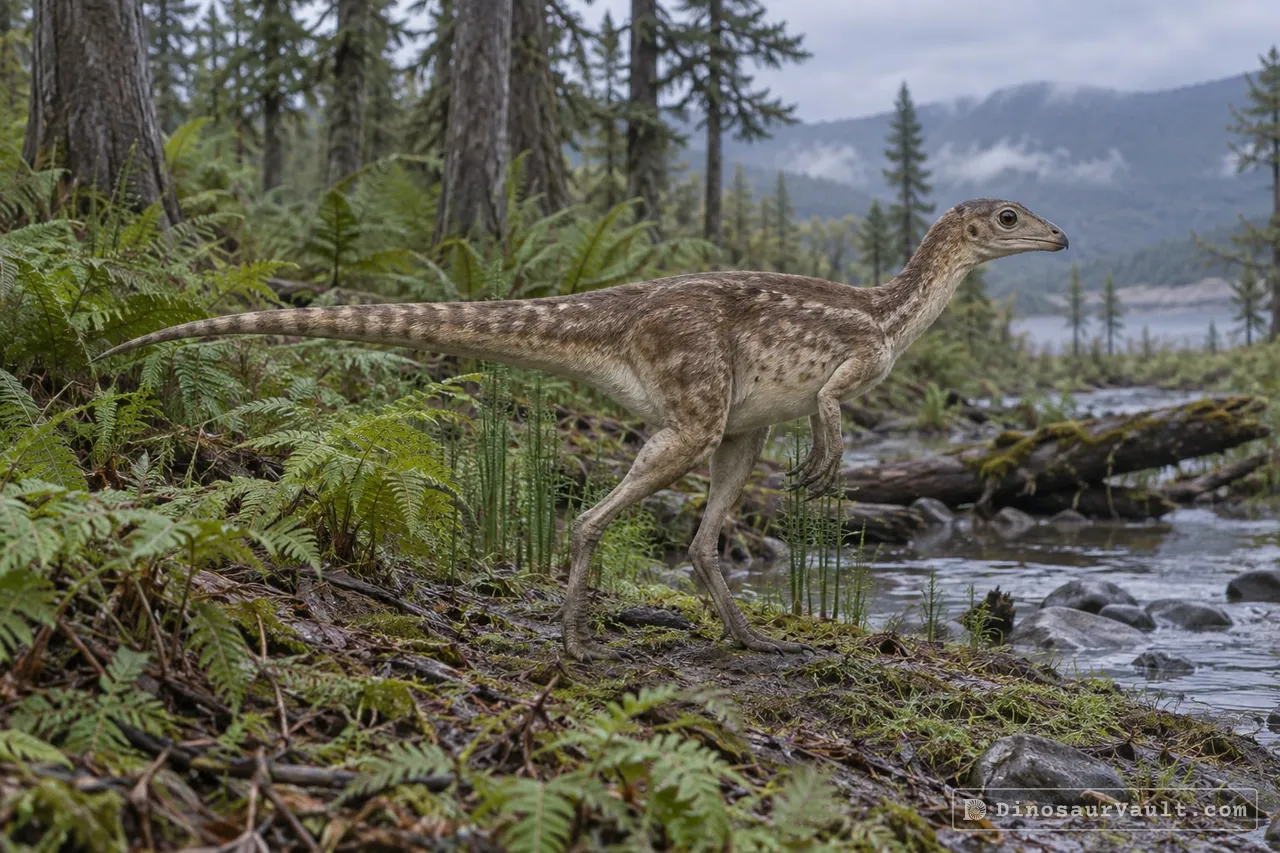
Leaellynasaura was a small plant eater about 2 meters (7 feet) long, much of that a very long tail. It ran on two legs and had large eye sockets.
Its tail may have had more bones than that of almost any other small plant-eating dinosaur, and some scientists think the animal may have wrapped it around its body for warmth.
Its world
It lived about 113 to 110 million years ago, in the Early Cretaceous, in what is now Australia. At that time Australia lay far south, close to the pole, so winters were cold and dark for weeks at a time.
Its fossils come from the Eumeralla Formation, where it lived alongside the small plant eater Atlascopcosaurus and the ornithomimid-like Timimus. Its big eyes may have helped it see during the long polar winter.
How it was found
Rich and Vickers-Rich named Leaellynasaura in 1989. They named it after their daughter. Four finds are known.
Field gallery
More views of Leaellynasaura
Scenes reconstructed from the available fossil evidence.
1 of 3
Lived alongside
Found in the same rock formations


A rock formation can hold fossils laid down millions of years apart, so not every animal here met Leaellynasaura.
The evidence
The science behind Leaellynasaura
Which parts of the picture come from its own bones, and which come from its relatives.
From its own fossils
- A partial cheek preserves upper jaw bones, teeth and bones around the side of the face.
- Additional upper jaws show a cheek that widens toward the back.
Borrowed from relatives
- Thescelosaurus guides the missing skull roof, snout and lower jaw.
- Oryctodromeus guides the missing body, limbs and balancing tail as a small dinosaur that walked on its hind legs.
Still unknown
- Whether the skull roof and long-tailed skeletons traditionally assigned to it really belong to Leaellynasaura.
- Its complete eye shape, tail length and body covering.
- Whether it stayed active through the polar winter.
Discovery timeline
- 1989Named itRich & Vickers-Rich
- 2014Close relativeBoyd
- 2021New findDuncan et al.
Key papers
The research behind what we know of Leaellynasaura
Named it
Named a small plant eater from a partial cheek and other bones found in Australia.
Polar dinosaurs and biotas of the Early Cretaceous of southeastern Australia. National Geographic Research 5(1):15–53.
No link available
Close relative
Described the skull of Thescelosaurus, a useful comparison for the missing parts of the Leaellynasaura head.
The cranial anatomy of the neornithischian dinosaur Thescelosaurus neglectus. PeerJ 2: e669
Read the paper : The cranial anatomy of the neornithischian dinosaur Thescelosaurus neglectus (opens in a new tab)New find
Described additional upper jaws assigned to Leaellynasaura and compared the varied small plant eaters from the same rocks.
Ornithopod jaws from the Lower Cretaceous Eumeralla Formation, Victoria, Australia, and their implications for polar neornithischian dinosaur diversity. Journal of Vertebrate Paleontology 41
Read the paper : Ornithopod jaws from the Lower Cretaceous Eumeralla Formation, Victoria, Australia, and their implications for polar neornithischian dinosaur diversity (opens in a new tab)
Close relatives
Other members of Elasmaria


Sources: Wikidata