Atlascopcosaurus
- Lived
- 113 to 110 million years ago, Early Cretaceous
- Diet
- Herbivore
- Length
- about 3 m (10 ft)
- Group
- Ornithopods
- Found in
- Australia
- Named by
- Rich and Vickers-Rich 1989
Size comparison
To scale

Scale in metersOutline: typical ornithopod shape
Where its fossils were found
The evidence
Today

110 million years ago
Habitat
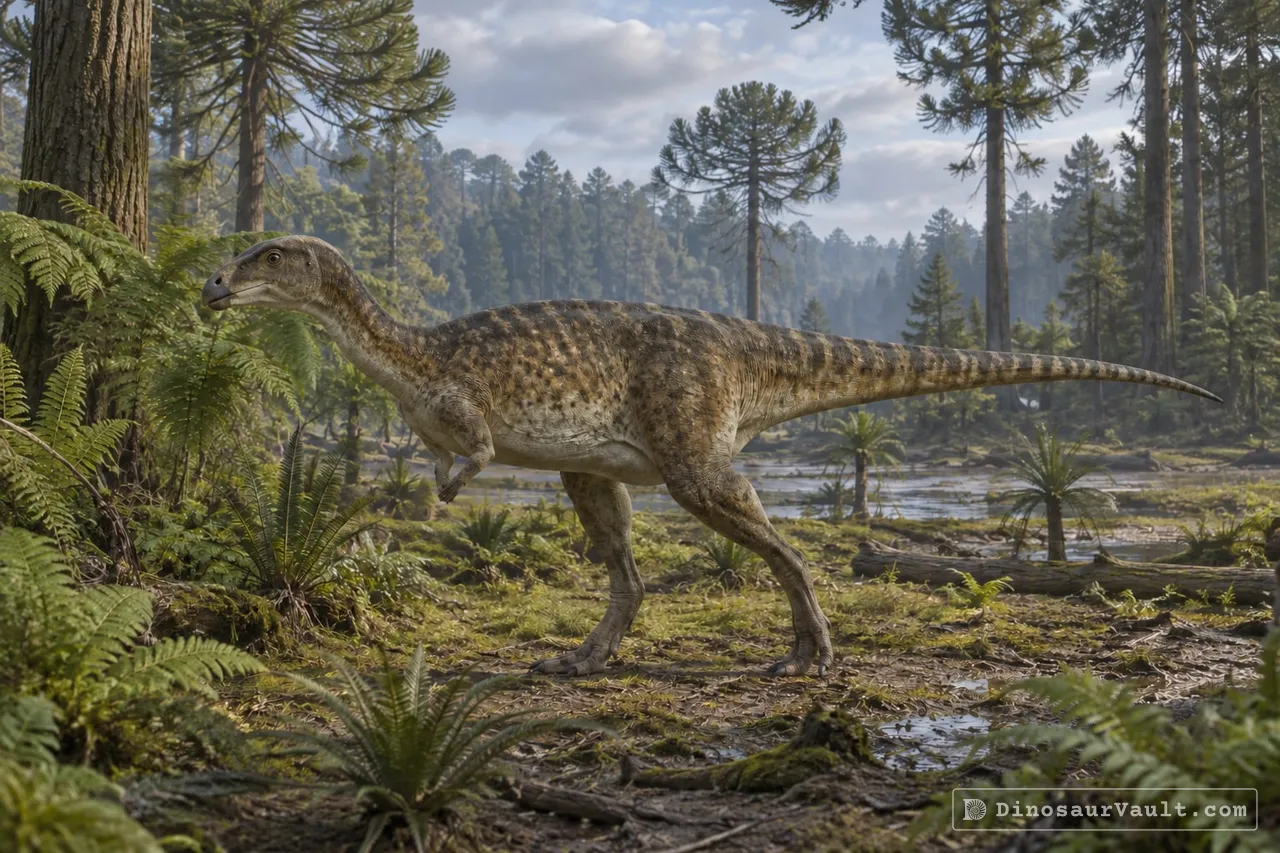
Rivers crossed a forested landscape near the pole, with long dark winters. Conifers and ferns grew in the region preserved by the Eumeralla Formation, where other dinosaurs included Leaellynasaura, Timimus and Diluvicursor.
Field notes
About Atlascopcosaurus
What it was like
Atlascopcosaurus was a small, two-legged plant eater, perhaps about 3 meters (10 feet) long. It is known mainly from jaws and teeth.
Its world
It lived about 113 to 110 million years ago, in the Early Cretaceous, in Australia. The land then lay close to the pole, with long dark winters. Its bones come from the Eumeralla Formation, where it lived alongside the small plant eater Leaellynasaura and the theropod Timimus.
How it was found
Rich and Vickers-Rich named Atlascopcosaurus in 1989. The name honors a company that provided tools for the dig.
Field gallery
More views of Atlascopcosaurus
Scenes reconstructed from the available fossil evidence.
1 of 3
Lived alongside
Found in the same rock formations


A rock formation can hold fossils laid down millions of years apart, so not every animal here met Atlascopcosaurus.
The evidence
The science behind Atlascopcosaurus
Which parts of the picture come from its own bones, and which come from its relatives.
From its own fossils
- Part of an upper jaw with cheek teeth, followed by other upper-jaw finds.
- Ridges on the tooth crowns help distinguish it from other small plant eaters in the region.
Borrowed from relatives
- Fona provides a broader comparison for the missing snout and lower jaw.
- The small, two-legged body, arms and feet are inferred from other small plant eaters such as Fona.
Still unknown
- Which isolated lower jaws and teeth belong to Atlascopcosaurus.
- The full shape and proportions of its body.
- Its skin covering and color.
Discovery timeline
- 1989Named itRich & Vickers-Rich
- 2019SkullHerne et al.
- 2021New findDuncan et al.
- 2024Close relativeAvrahami et al.
- 2026Close relativeAvrahami & Zanno
Key papers
The research behind what we know of Atlascopcosaurus
Named it
Named Atlascopcosaurus from jaw and tooth fossils among the small plant eaters of polar Australia.
Polar dinosaurs and biotas of the Early Cretaceous of southeastern Australia. National Geographic Research 5(1):15–53.
No link available
Skull
Compared regional jaws and teeth, distinguishing Atlascopcosaurus from Galleonosaurus and questioning the assignment of isolated lower jaws.
New small-bodied ornithopods (Dinosauria, Neornithischia) from the Early Cretaceous Wonthaggi Formation (Strzelecki Group) of the Australian-Antarctic rift system, with revision of Qantassaurus intrepidus Rich and Vickers-Rich, 1999. Journal of Paleontology 93: 543-584
Read the paper : New small-bodied ornithopods (Dinosauria, Neornithischia) from the Early Cretaceous Wonthaggi Formation (Strzelecki Group) of the Australian-Antarctic rift system, with revision of Qantassaurus intrepidus Rich and Vickers-Rich, 1999 (opens in a new tab)New find
Described a more complete upper jaw assigned to Atlascopcosaurus and revised the features used to identify it.
Ornithopod jaws from the Lower Cretaceous Eumeralla Formation, Victoria, Australia, and their implications for polar neornithischian dinosaur diversity. Journal of Vertebrate Paleontology 41
Read the paper : Ornithopod jaws from the Lower Cretaceous Eumeralla Formation, Victoria, Australia, and their implications for polar neornithischian dinosaur diversity (opens in a new tab)Close relative
Described the skeleton of Fona, a small plant eater used as a broader comparison for the missing body of Atlascopcosaurus.
A new semi‐fossorial thescelosaurine dinosaur from the Cenomanian‐age Mussentuchit Member of the Cedar Mountain Formation, Utah. The Anatomical Record 307: 3717-3781
Read the paper : A new semi‐fossorial thescelosaurine dinosaur from the Cenomanian‐age Mussentuchit Member of the Cedar Mountain Formation, Utah (opens in a new tab)Close relative
Detailed the skull bones of Fona, providing a broader comparison for the missing snout and lower jaw of Atlascopcosaurus.
Cranial Osteology of Fona herzogae (Dinosauria: Thescelosaurinae) from the Mussentuchit Member of the Cedar Mountain Formation. PLOS One 21: e0353169
Read the paper : Cranial Osteology of Fona herzogae (Dinosauria: Thescelosaurinae) from the Mussentuchit Member of the Cedar Mountain Formation (opens in a new tab)
Close relatives
Other members of Elasmaria


Sources: Wikidata