Qantassaurus
KWON-ta-SORE-us
- Lived
- 126 to 121 million years ago, Early Cretaceous
- Diet
- Herbivore
- Group
- Ornithopods
- Found in
- Australia
- Named by
- Rich and Vickers-Rich 1999
Where its fossils were found
The evidence
Today

125 million years ago
Habitat
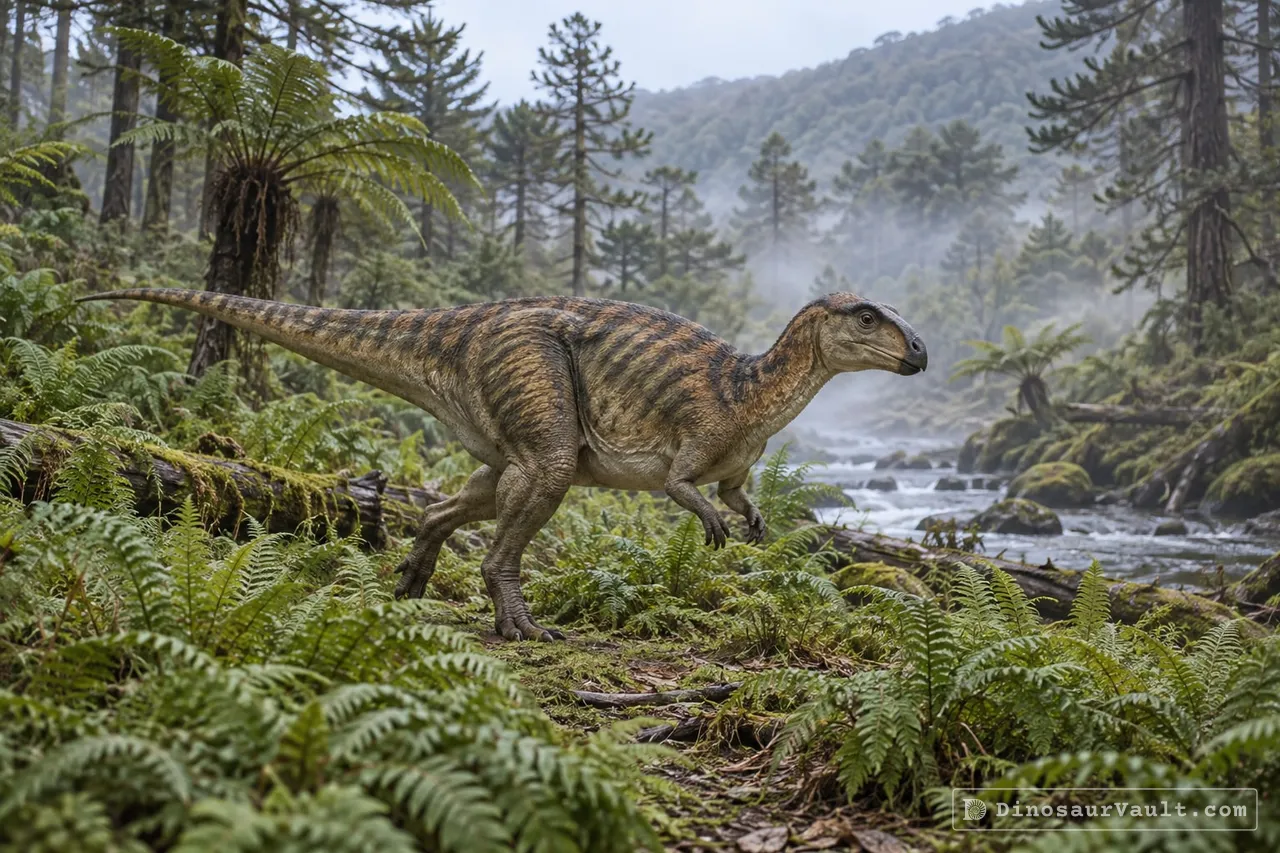
It lived beside rivers in southern Australia, where conifer forests faced long winter nights. Other plant eaters from this part of Australia included Galleonosaurus and Atlascopcosaurus.
Field notes
About Qantassaurus
What it was like
Qantassaurus was a small plant eater that walked on two legs. It is known from lower jaws, which were short and deep compared with those of its relatives.
Its world
It lived in the Early Cretaceous, in what is now Australia. Australia was then much farther south, with cold, dark winters. It shared that land with the small plant eater Galleonosaurus.
How it was found
Rich and Vickers-Rich named Qantassaurus in 1999. Its name honors an airline that supported the work.
Field gallery
More views of Qantassaurus
Scenes reconstructed from the available fossil evidence.
1 of 3
Lived alongside
Found in the same rock formations


A rock formation can hold fossils laid down millions of years apart, so not every animal here met Qantassaurus.
The evidence
The science behind Qantassaurus
Which parts of the picture come from its own bones, and which come from its relatives.
From its own fossils
- The original lower jaw is unusually short and deep, with a rounded underside.
- Its cheek teeth have ridged crowns suited to processing plants.
Borrowed from relatives
- The missing upper face and body are inferred from other ornithopods, including Talenkauen.
- Hands and feet can be modeled on small plant eaters such as Fona, as a broad comparison.
Still unknown
- Its complete head shape and body proportions.
- Whether the original jaw belonged to a young animal or an adult.
- Its skin covering and color.
Often drawn wrong
- A narrow, shallow lower jaw misses its most distinctive feature.
- Galleonosaurus upper jaws belong to a separate animal and should not be treated as parts of Qantassaurus.
Discovery timeline
- 1999Named itRich & Vickers-Rich
- 2019Full descriptionHerne et al.
- 2019Close relativeRozadilla, Agnolín & Novas
Key papers
The research behind what we know of Qantassaurus
Named it
Named a small Australian plant eater from its short, deep lower jaws.
The Hypsilophodontidae from southeastern Australia. Proceedings of the Second Gondwanan Dinosaur Symposium, National Science Museum Monographs 15: 167-180
No link available
Full description
Revised Qantassaurus around its original lower jaw and separated it from other small Australian plant eaters, including the newly named Galleonosaurus.
New small-bodied ornithopods (Dinosauria, Neornithischia) from the Early Cretaceous Wonthaggi Formation (Strzelecki Group) of the Australian-Antarctic rift system, with revision of Qantassaurus intrepidus Rich and Vickers-Rich, 1999. Journal of Paleontology 93: 543-584
Read the paper : New small-bodied ornithopods (Dinosauria, Neornithischia) from the Early Cretaceous Wonthaggi Formation (Strzelecki Group) of the Australian-Antarctic rift system, with revision of Qantassaurus intrepidus Rich and Vickers-Rich, 1999 (opens in a new tab)Close relative
Described the skull and skeleton of Talenkauen, providing comparisons for the missing parts of other southern ornithopods.
Osteology of the Patagonian ornithopod Talenkauen santacrucensis (Dinosauria, Ornithischia). Journal of Systematic Palaeontology 17: 2043-2089
Read the paper : Osteology of the Patagonian ornithopod Talenkauen santacrucensis (Dinosauria, Ornithischia) (opens in a new tab)
Close relatives
Other members of Elasmaria


Sources: Wikidata