Anabisetia
AN-a-bee-SET-ee-a
- Lived
- 94 to 90 million years ago, Late Cretaceous
- Diet
- Herbivore
- Group
- Ornithopods
- Found in
- Argentina
- Named by
- Coria and Calvo 2002
Where its fossils were found
The evidence
Today

90 million years ago
Habitat
Slow rivers and swampy ground occupied the landscape recorded in the Cerro Lisandro Formation. The long-necked plant eater Quetecsaurus also lived in this region.
Field notes
About Anabisetia
What it was like
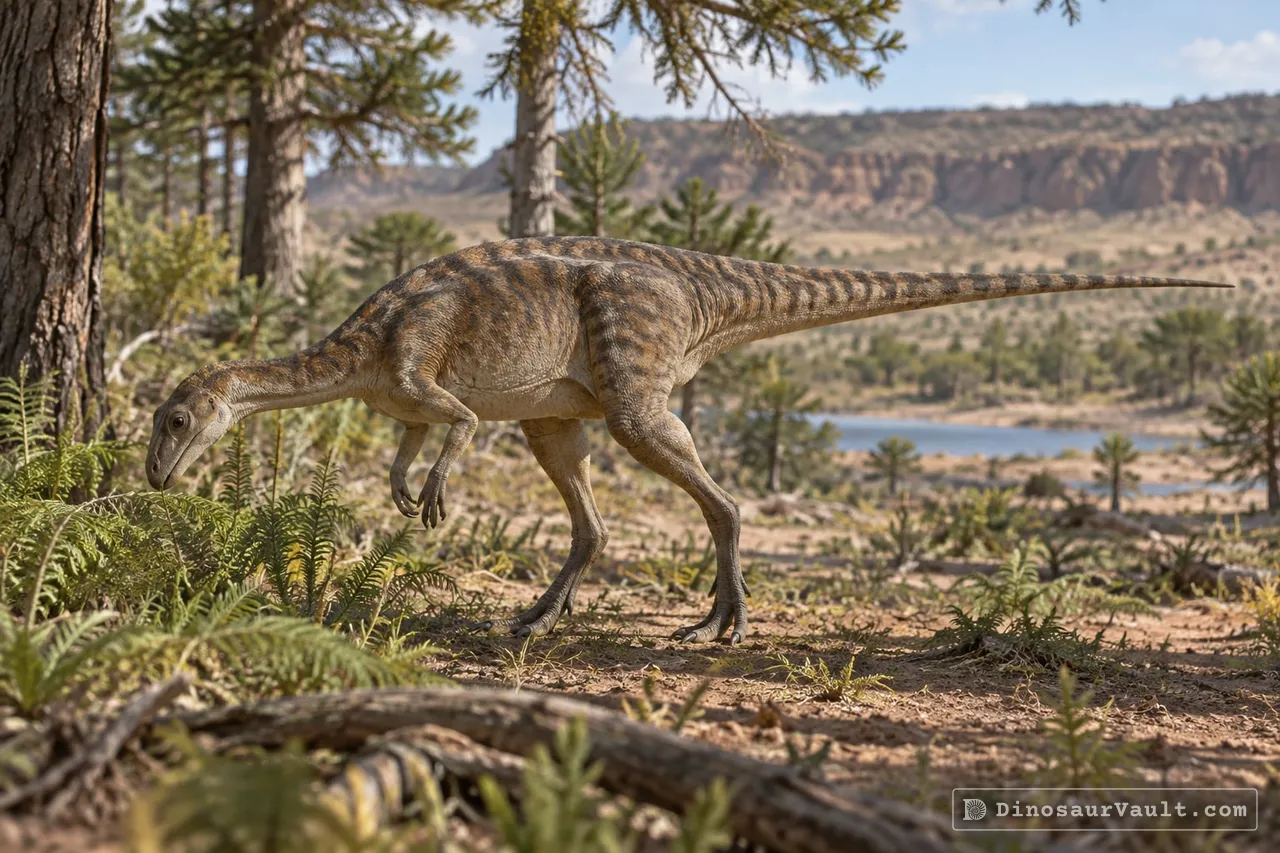
Anabisetia was a small plant eater that walked on two legs. It was an elasmarian, part of a group of ornithopods found mainly on the southern continents. Several partial skeletons are known.
Its world
It lived about 94 to 90 million years ago, in the Late Cretaceous, in what is now Argentina. It comes from the Cerro Lisandro Formation, where the sauropod Quetecsaurus also lived.
How it was found
Coria and Calvo named Anabisetia in 2002. The name honors an Argentine archaeologist.
Field gallery
More views of Anabisetia
Scenes reconstructed from the available fossil evidence.
1 of 3
Lived alongside
Found in the same rock formations

A rock formation can hold fossils laid down millions of years apart, so not every animal here met Anabisetia.
The evidence
The science behind Anabisetia
Which parts of the picture come from its own bones, and which come from its relatives.
From its own fossils
- Several partial skeletons preserve pieces of the skull, backbone, shoulders, hips and limbs.
- The shoulder blade has a strong projecting ridge, and the front of the upper hip bone is unusually long.
- Each upper cheek tooth has a prominent ridge running down its outer face.
Borrowed from relatives
- Missing parts of the head are restored by comparison with small ornithopods such as Gasparinisaura.
- Its bowed upper arm bone resembles those of Talenkauen and Trinisaura.
Still unknown
- The complete shape of its skull.
- Its skin covering and color.
- Whether it lived in groups.
Discovery timeline
- 2002Named itCoria & Calvo
- 2004Its worldLeanza et al.
- 2016Family treeRozadilla et al.
Key papers
The research behind what we know of Anabisetia
Named it
Described a small ornithopod from partial skeletons, with distinctive shoulder, hand and hip bones.
A new iguanodontian ornithopod from Neuquen Basin, Patagonia, Argentina. Journal of Vertebrate Paleontology 22: 503-509
Read the paper : A new iguanodontian ornithopod from Neuquen Basin, Patagonia, Argentina (opens in a new tab)Its world
Reviewed the dinosaur-bearing rocks of Argentina, including the river and swamp deposits that preserve Anabisetia.
Cretaceous terrestrial beds from the Neuquén Basin (Argentina) and their tetrapod assemblages. Cretaceous Research 25: 61-87
Read the paper : Cretaceous terrestrial beds from the Neuquén Basin (Argentina) and their tetrapod assemblages (opens in a new tab)Family tree
Grouped Anabisetia with other southern ornithopods, including Talenkauen, Trinisaura and Morrosaurus, using shared features of their bones.
A new ornithopod (Dinosauria, Ornithischia) from the Upper Cretaceous of Antarctica and its palaeobiogeographical implications. Cretaceous Research 57: 311-324
Read the paper : A new ornithopod (Dinosauria, Ornithischia) from the Upper Cretaceous of Antarctica and its palaeobiogeographical implications (opens in a new tab)
Close relatives
Other members of Elasmaria


Sources: Wikidata