Morrosaurus
- Lived
- 72 to 66 million years ago, Late Cretaceous
- Diet
- Herbivore
- Group
- Ornithopods
- Found in
- Antarctica
- Named by
- Rozadilla et al. 2016
Where its fossils were found
The evidence
Today

70 million years ago
Habitat
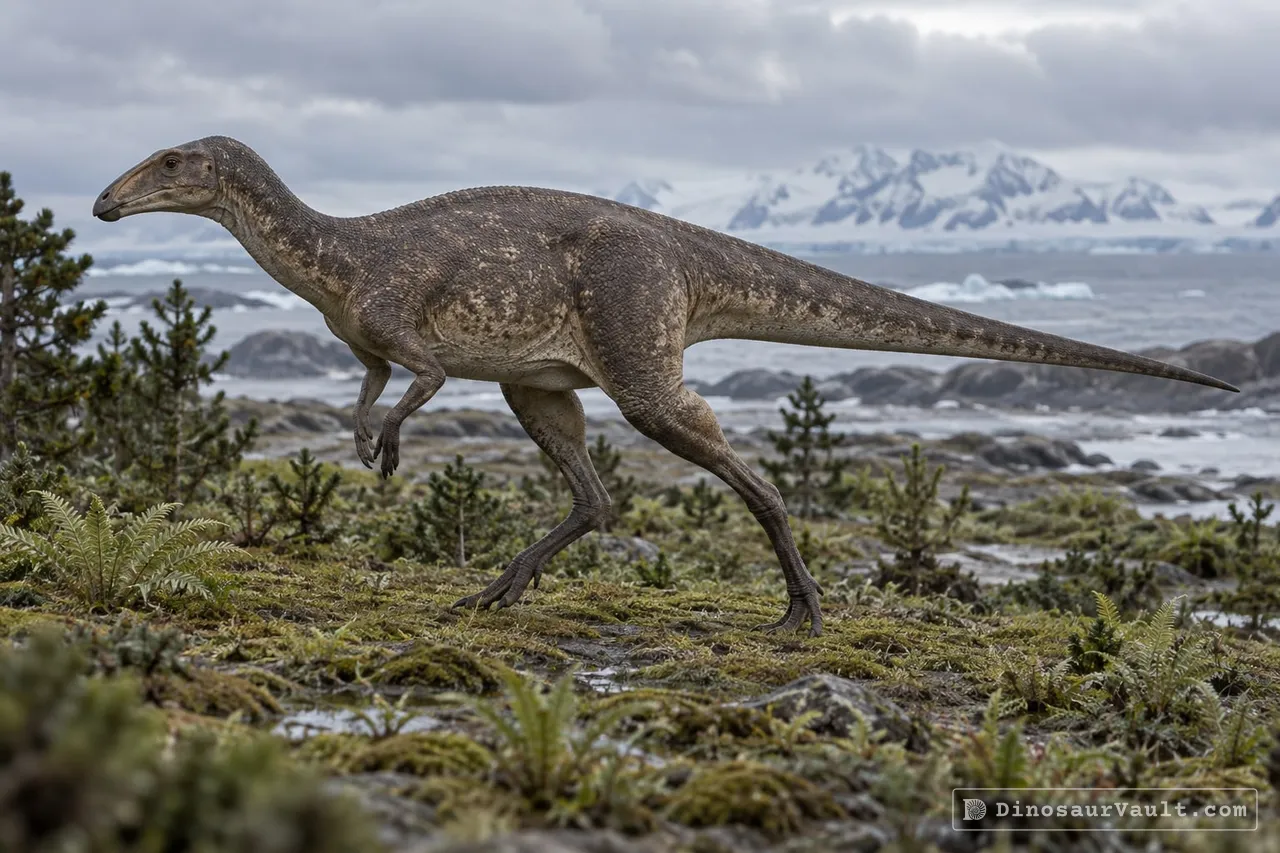
It lived in cool, humid forests in Antarctica, where the climate was much warmer than today. Other dinosaurs from the region include Trinisaura, Antarctopelta and Imperobator.
Field notes
About Morrosaurus
What it was like
Morrosaurus was a small, two-legged plant eater from a group of southern ornithopods called elasmarians. It is known only from a hind leg, which shows it was probably a quick runner.
Its world
It lived about 72 to 66 million years ago, at the end of the Late Cretaceous, in Antarctica. The land was forested and much warmer than today. Its bones come from the Snow Hill Island Formation, and other dinosaurs from the region include the plant eater Trinisaura, the armored Antarctopelta and the hunter Imperobator.
How it was found
Rozadilla and colleagues named it in 2016 from one find. The type species is Morrosaurus antarcticus.
Field gallery
More views of Morrosaurus
Scenes reconstructed from the available fossil evidence.
1 of 3
Lived alongside
Found in the same rock formations


A rock formation can hold fossils laid down millions of years apart, so not every animal here met Morrosaurus.
The evidence
The science behind Morrosaurus
Which parts of the picture come from its own bones, and which come from its relatives.
From its own fossils
- Parts of a right hind leg preserve the ends of the thigh and shin bones, foot bones and a toe bone.
- The long foot bones were slender and closely packed, with a strong central bone.
Borrowed from relatives
- The missing head, neck, trunk and tail are restored by comparison with southern ornithopods such as Talenkauen.
- The bones around the eye follow broader comparisons with Thescelosaurus, while the small hands draw on Fona.
Still unknown
- The shape of its skull and the proportions of its whole body.
- Its skin covering and color.
- Its closest relative among southern ornithopods.
Discovery timeline
- 2014Close relativeBoyd
- 2016Named itRozadilla et al.
- 2019Close relativeRozadilla, Agnolín & Novas
Key papers
The research behind what we know of Morrosaurus
Close relative
Described the skull of Thescelosaurus, providing a broader comparison for the bones around the eye in restorations of Morrosaurus.
The cranial anatomy of the neornithischian dinosaur Thescelosaurus neglectus. PeerJ 2: e669
Read the paper : The cranial anatomy of the neornithischian dinosaur Thescelosaurus neglectus (opens in a new tab)Named it
Named an Antarctic plant eater from a partial hind leg and linked it with a group of southern ornithopods.
A new ornithopod (Dinosauria, Ornithischia) from the Upper Cretaceous of Antarctica and its palaeobiogeographical implications. Cretaceous Research 57: 311-324
Read the paper : A new ornithopod (Dinosauria, Ornithischia) from the Upper Cretaceous of Antarctica and its palaeobiogeographical implications (opens in a new tab)Close relative
Described the skeleton of Talenkauen, a southern ornithopod used to restore the missing head and body of Morrosaurus.
Osteology of the Patagonian ornithopod Talenkauen santacrucensis (Dinosauria, Ornithischia). Journal of Systematic Palaeontology 17: 2043-2089
Read the paper : Osteology of the Patagonian ornithopod Talenkauen santacrucensis (Dinosauria, Ornithischia) (opens in a new tab)
Close relatives
Other members of Elasmaria


Sources: Wikidata