Muttaburrasaurus
MUT-uh-BUR-uh-SORE-us
"Muttaburra lizard"
- Lived
- 106 to 94 million years ago, Early Cretaceous to Late Cretaceous
- Diet
- Herbivore
- Length
- about 7 m (23 ft)
- Group
- Ornithopods
- Found in
- Australia
- Named by
- Bartholomai and Molnar 1981
Size comparison
To scale


Scale in meters
Where its fossils were found
The evidence
Today

100 million years ago
Habitat
It probably browsed coastal lowlands in Australia, among patches of woody vegetation and low plants. Austrosaurus was another large plant eater in the region.
Field notes
About Muttaburrasaurus
What it was like
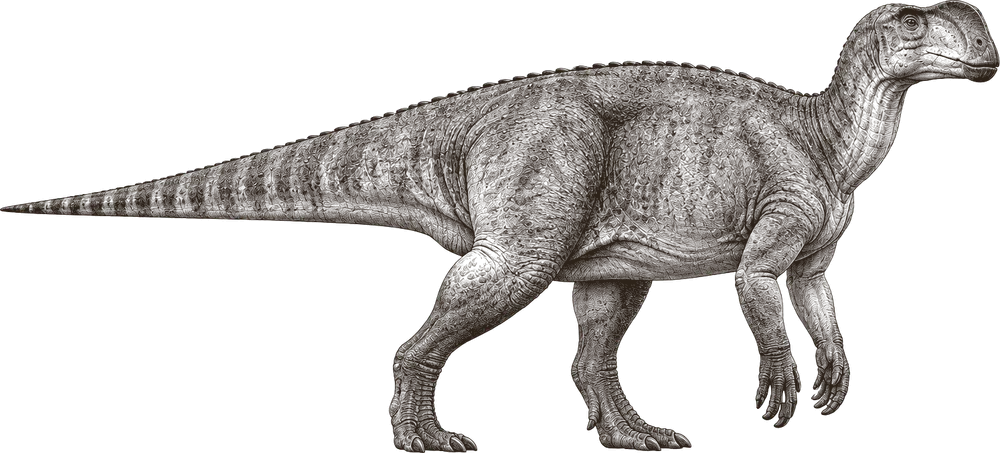
Muttaburrasaurus was a large plant eater with a distinctive, swollen bump on its snout in front of the eyes, whose purpose is still debated. It grew to about 7 meters (23 feet) long and likely moved on two legs, though it may have dropped to four when feeding or moving slowly.
Its jaws held rows of ridged teeth suited for shredding tough plants, and some researchers have suggested the bump on its snout could have supported a fleshy pad used for making sounds or for display, though this remains uncertain.
Its world
Muttaburrasaurus lived from about 106 to 94 million years ago, spanning the Early and Late Cretaceous, in what is now Australia. Its fossils come from the Allaru Mudstone and Mackunda formations.
It shared its world with the long-necked plant eater Austrosaurus, one of the few other dinosaurs known from the same region and time.
How it was found
Bartholomai and Molnar named Muttaburrasaurus in 1981. Around three fossil finds are known, making it one of the more completely known dinosaurs from Australia. Its relatives include Talenkauen and Atlascopcosaurus, part of a wider group of ornithopods once common across the southern continents.
Field gallery
More views of Muttaburrasaurus
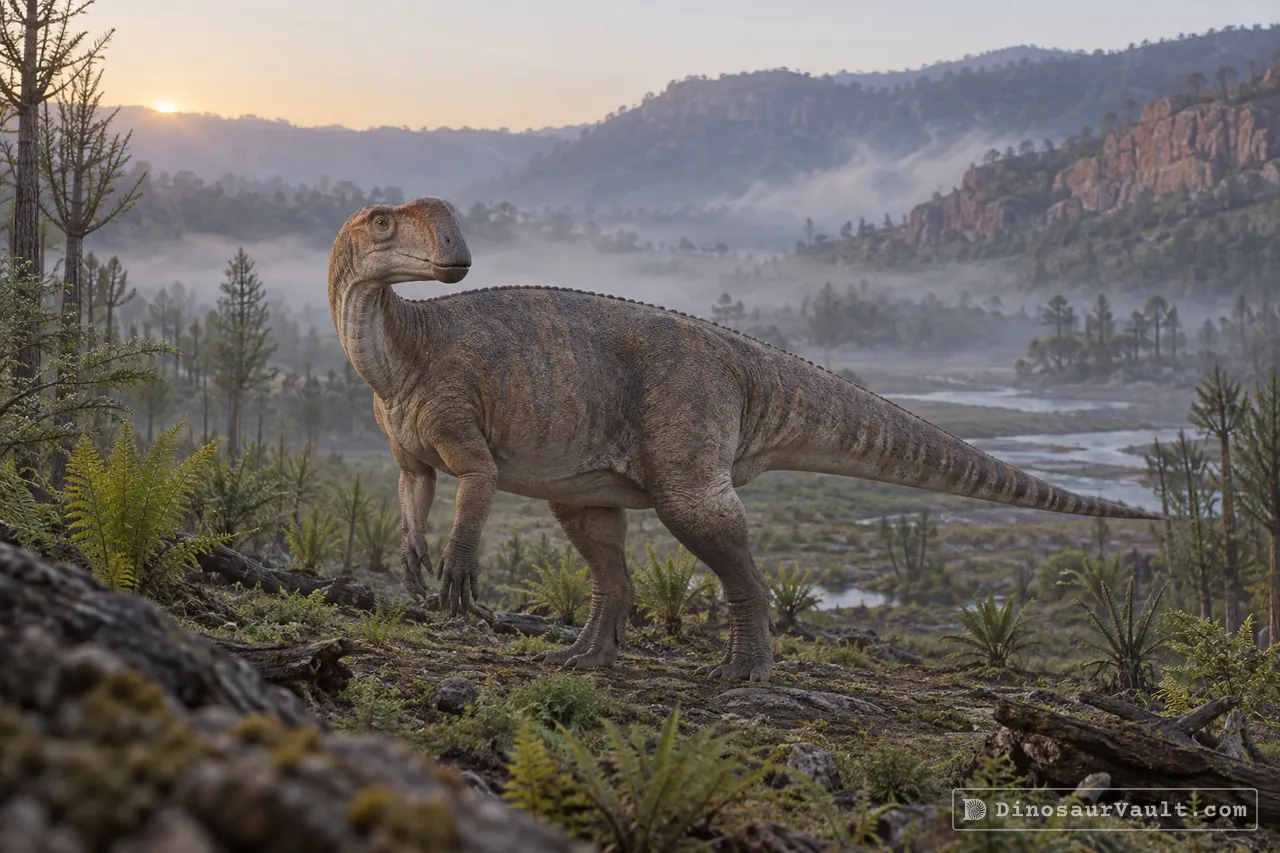
Scenes reconstructed from the available fossil evidence.
1 of 7
Lived alongside
Found in the same rock formations

A rock formation can hold fossils laid down millions of years apart, so not every animal here met Muttaburrasaurus.
The evidence
The science behind Muttaburrasaurus
Which parts of the picture come from its own bones, and which come from its relatives.
From its own fossils
- A partial skeleton preserves the skull, backbone and limbs of a large plant eater with strong hindquarters.
- The swollen muzzle contains a complex arrangement of bones and nasal passages.
- Teeth grew at the front of the upper jaw as well as farther back in the cheeks.
Borrowed from relatives
- Missing parts of the limbs and tail are filled in by comparison with other ornithopods, including Iguanodon.
- Scaly skin follows comparisons with other plant-eating dinosaurs.
Still unknown
- Whether the swollen snout helped make sounds or served as a display.
- The shape of the living nose, its skin color and the details of its hands.
- Exactly where it belongs among ornithopods.
Often drawn wrong
- A wholly toothless duck bill misses the teeth at the front of its upper jaw.
- A simple hollow horn oversimplifies the swollen muzzle.
Discovery timeline
- 1981Named itBartholomai & Molnar
- 2015Family treeBoyd
- 2026SkullHerne et al.
Key papers
The research behind what we know of Muttaburrasaurus
Named it
Named a large Australian plant eater from a partial skeleton with an unusually swollen snout.
Muttaburrasaurus, a new iguanodontid (Ornithischia: Ornithopoda) dinosaur from the Lower Cretaceous of Queensland. Memoirs of the Queensland Museum 20: 319-349
No link available
Family tree
Compared plant-eating dinosaurs and tested where Muttaburrasaurus fits among the early branches of ornithopods.
The systematic relationships and biogeographic history of ornithischian dinosaurs. PeerJ 3: e1523
Read the paper : The systematic relationships and biogeographic history of ornithischian dinosaurs (opens in a new tab)Skull
Reexamined the skull, revealing front upper teeth and a complex swollen muzzle, and investigated the age of the rocks near the original find.
Cranial anatomy, palaeoneurology, palaeobiology and stratigraphic age of the large-bodied ornithopod, Muttaburrasaurus langdoni Bartholomai and Molnar, 1981, from the mid-Cretaceous of Australia. PeerJ 14: e20794
Read the paper : Cranial anatomy, palaeoneurology, palaeobiology and stratigraphic age of the large-bodied ornithopod, Muttaburrasaurus langdoni Bartholomai and Molnar, 1981, from the mid-Cretaceous of Australia (opens in a new tab)
Close relatives
Other members of Elasmaria


Sources: Wikidata