Rugops
ROO-gops
"wrinkle face"
Type species Rugops primus
- Lived
- 101 to 94 million years ago, Late Cretaceous
- Diet
- Carnivore
- Group
- Theropods, Abelisauridae
- Found in
- Niger
- Named by
- Sereno et al. 2004
Where its fossils were found
The evidence
Today

95 million years ago
Habitat
The Echkar landscape included river channels and floodplains that probably dried out seasonally. Other large predators in these rocks include Spinosaurus and Carcharodontosaurus.
Field notes
About Rugops
What it was like
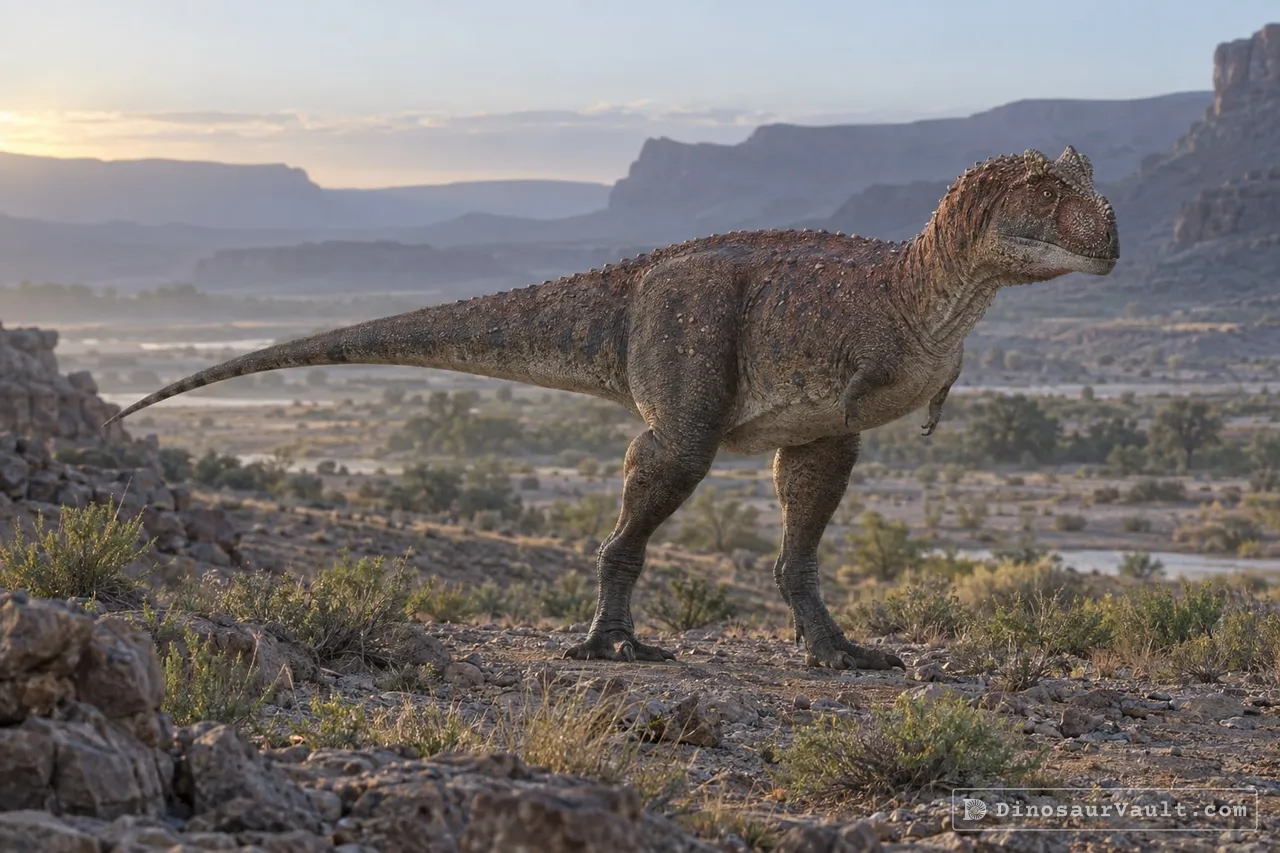
Rugops was an abelisaurid carnivore whose full body size remains uncertain. Its skull, the only part of the skeleton known, had a short, boxy shape typical of abelisaurids, along with rows of small pits across its surface.
Those pits likely held blood vessels feeding scales or a thin covering of skin, rather than muscle for a powerful bite, suggesting Rugops relied less on jaw strength than some of its relatives. The front of its snout also shows signs of a tough, armor-like covering.
Its world
Rugops lived from about 101 to 94 million years ago, in the Late Cretaceous, in what is now Niger. Its remains come from the Echkar Formation.
It shared its world with some of the largest predators ever known, including Spinosaurus and Carcharodontosaurus, as well as the disputed Bahariasaurus and the plant-eating Aegyptosaurus.
How it was found
Sereno and colleagues named Rugops in 2004, giving it the species name Rugops primus, based on a single partial skull. Its relatives include Carnotaurus, Majungasaurus, and Abelisaurus, and its short snout and light build are considered typical of early abelisaurids.
Field gallery
More views of Rugops
Scenes reconstructed from the available fossil evidence.
1 of 7
Lived alongside
Found in the same rock formations


A rock formation can hold fossils laid down millions of years apart, so not every animal here met Rugops.
The evidence
The science behind Rugops
Which parts of the picture come from its own bones, and which come from its relatives.
From its own fossils
- A partial skull has a rough outer surface covered with pits and grooves.
- Low ridges run along the paired bones on top of the snout.
Borrowed from relatives
- The body and tiny arms are restored from abelisaurids such as Carnotaurus and Majungasaurus.
- Scaly skin follows preserved skin in Carnotaurus and comparisons of skull surfaces across abelisaurids.
Still unknown
- The proportions of its body and hands.
- Its skin pattern and color.
- How it hunted and what prey it preferred.
Often drawn wrong
- Large horns above the eyes belong to Carnotaurus, rather than Rugops.
Discovery timeline
- 2004Named itSereno, Wilson & Conrad
- 2018SkullDelcourt
- 2020Close relativeCerroni et al.
Key papers
The research behind what we know of Rugops
Named it
Described the rough skull of Rugops from Niger and used its relatives to explore connections between southern landmasses.
New dinosaurs link southern landmasses in the Mid–Cretaceous. Proceedings of the Royal Society of London. Series B: Biological Sciences 271: 1325-1330
Read the paper : New dinosaurs link southern landmasses in the Mid–Cretaceous (opens in a new tab)Skull
Compared ceratosaur skull surfaces, including Rugops, to explore facial coverings and the evolution of short, deep skulls.
Ceratosaur palaeobiology: new insights on evolution and ecology of the southern rulers. Scientific Reports 8
Read the paper : Ceratosaur palaeobiology: new insights on evolution and ecology of the southern rulers (opens in a new tab)Close relative
Traced blood vessel and nerve passages in Skorpiovenator and compared its snout pits with those of Rugops.
An exceptional neurovascular system in abelisaurid theropod skull: New evidence from Skorpiovenator bustingorryi. Journal of Anatomy 240: 612-626
Read the paper : An exceptional neurovascular system in abelisaurid theropod skull: New evidence from Skorpiovenator bustingorryi (opens in a new tab)
Close relatives
Other members of Abelisauridae


Sources: Wikidata