Carnotaurus
kar-no-TOR-us
"meat-eating bull"
- Lived
- 72 to 66 million years ago, Late Cretaceous
- Diet
- Carnivore
- Length
- about 8 m (26 ft)
- Group
- Theropods, Abelisauridae
- Found in
- Argentina
- Named by
- Bonaparte 1985
Size comparison
To scale


Scale in meters
Where its fossils were found
The evidence
Today

70 million years ago
Habitat
Low coastal land beside a shallow sea, with estuaries and tidal flats.
Field notes
About Carnotaurus
What it was like
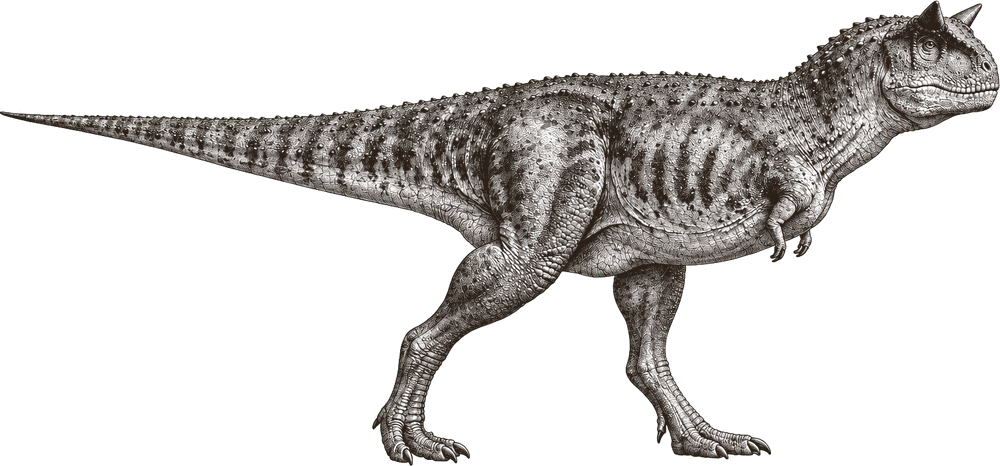
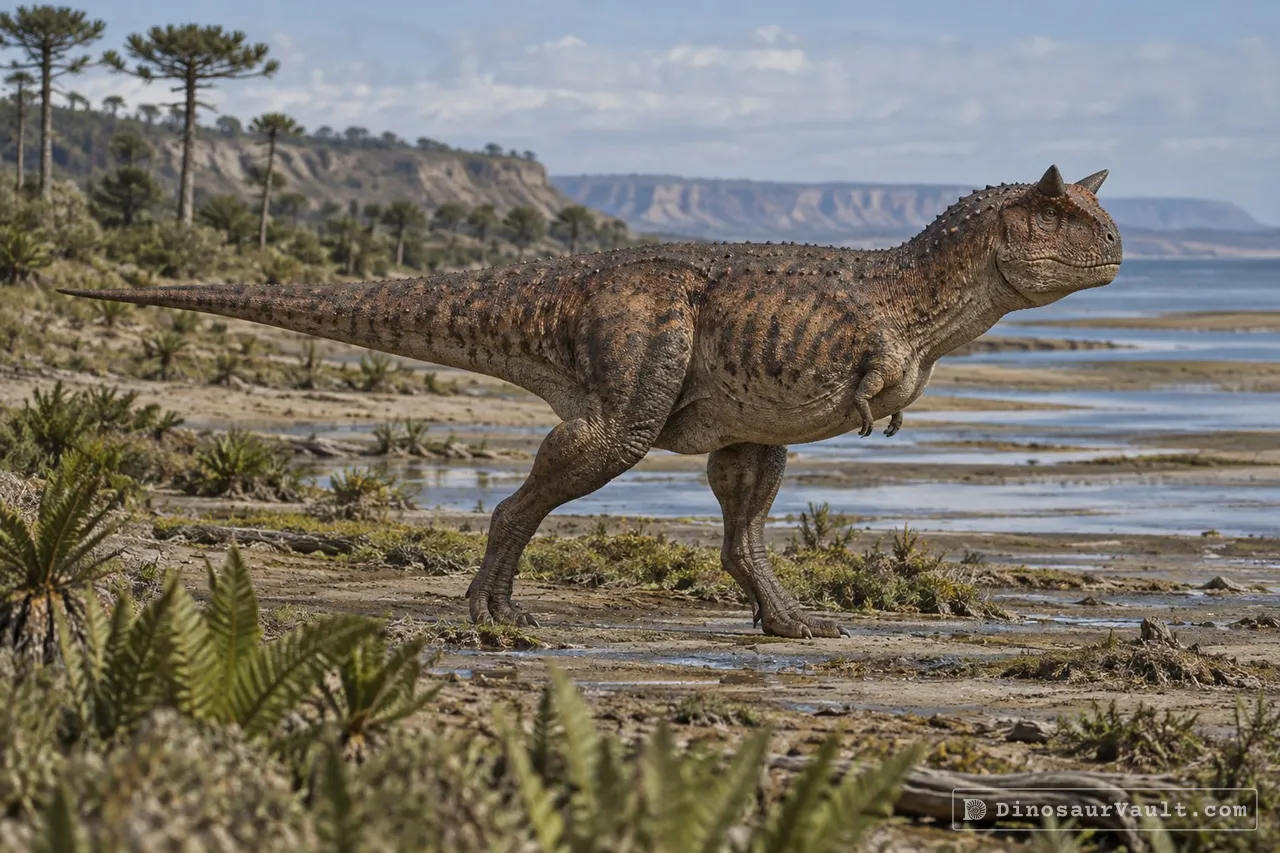
Carnotaurus was a lightly built hunter with an unusual face. Two thick, blunt horns rose above its eyes, and its skull was short and deep, unlike the long snouts of most large meat-eating dinosaurs. At about 8 meters long, it combined a powerful bite with a body built for speed.
Its arms were tiny, barely more than stumps compared with its long, muscular legs, so its legs likely did most of the work in catching prey. Fossilized skin found with its skeleton shows rows of small, bumpy scales rather than feathers, some rising into larger bumps along its sides.
Its world
Carnotaurus lived in the Late Cretaceous, from about 72 to 66 million years ago, in what is now Argentina. Its only known skeleton was preserved in the La Colonia formation, alongside the remains of other animals from the same ancient landscape, including Koleken and Titanomachya.
As one of the larger predators of its region, Carnotaurus probably had few rivals for the animals it hunted. Its close relatives, such as Majungasaurus and Rajasaurus, lived on other parts of Gondwana, showing how widely this horned family of predators had spread.
How it was found
Carnotaurus was named by Bonaparte in 1985, based on a single, well-preserved skeleton, making it one of the most completely known predators found in South America. Scientists still debate exactly how its horns were used, with some suggesting head-to-head shoves between rivals and others suggesting the horns absorbed the force of a ramming blow.
Field gallery
More views of Carnotaurus
Scenes reconstructed from the available fossil evidence.
1 of 7
Lived alongside
Found in the same rock formations


A rock formation can hold fossils laid down millions of years apart, so not every animal here met Carnotaurus.
The evidence
The science behind Carnotaurus
Which parts of the picture come from its own bones, and which come from its relatives.
From its own fossils
- Much of one skeleton from Argentina, including a complete skull with its two horns.
- Large patches of skin impressions: small scales with bigger, rounded scales scattered among them.
- Forearms so short that the lower arm bones are tiny.
Borrowed from relatives
- The end of the tail and the lower legs are restored from other abelisaurids.
- Lips over the teeth follow other large theropods.
Still unknown
- What a young Carnotaurus looked like, and how its horns grew.
- Its color.
- Whether the titanosaur found in the same rock formation lived at exactly the same time.
Often drawn wrong
- It had two horns, one over each eye. Pictures sometimes add a third on the nose.
- It is sometimes drawn with long arms and big claws. Its arms were tiny stubs.
- A coat of fur or feathers has no support: its skin impressions show scales.
Discovery timeline
- 1985Named itBonaparte
- 1990Full descriptionBonaparte, Novas & Coria
- 2024Same rocksPérez-Moreno et al.
Key papers
The research behind what we know of Carnotaurus
Named it
First announced Carnotaurus, a horned meat eater from Patagonia, from a single skeleton found in Argentina.
A horned Cretaceous carnosaur from Patagonia. National Geographic Research 1: 149-151
No link available
Full description
Described the skeleton in detail: a short, deep skull with a horn over each eye, tiny forelimbs, and skin impressions showing small scales set with larger ones.
Carnotaurus sastrei Bonaparte, the horned, lightly built carnosaur from the Middle Cretaceous of Patagonia. Contributions in Science 416: 1-41
Read the paper : Carnotaurus sastrei Bonaparte, the horned, lightly built carnosaur from the Middle Cretaceous of Patagonia (opens in a new tab)Same rocks
Named a new titanosaur, a giant long-necked plant eater, from the rock formation where Carnotaurus was found.
A new titanosaur from the La Colonia Formation (Campanian-Maastrichtian), Chubut Province, Argentina. Historical Biology 37: 792-811
Read the paper : A new titanosaur from the La Colonia Formation (Campanian-Maastrichtian), Chubut Province, Argentina (opens in a new tab)
Close relatives
Other members of Abelisauridae


Sources: Wikidata