Pycnonemosaurus
"dense forest lizard"
- Lived
- 101 to 66 million years ago, Late Cretaceous
- Diet
- Carnivore
- Group
- Theropods, Abelisauridae
- Found in
- Brazil
- Named by
- Kellner and Campos 2002
Where its fossils were found
The evidence
Today

80 million years ago
Habitat
Its bones were buried in red sandstone and gravel laid down by flowing water in Brazil. The wider region also supported titanosaurs such as Adamantisaurus and Uberabatitan.
Field notes
About Pycnonemosaurus
What it was like
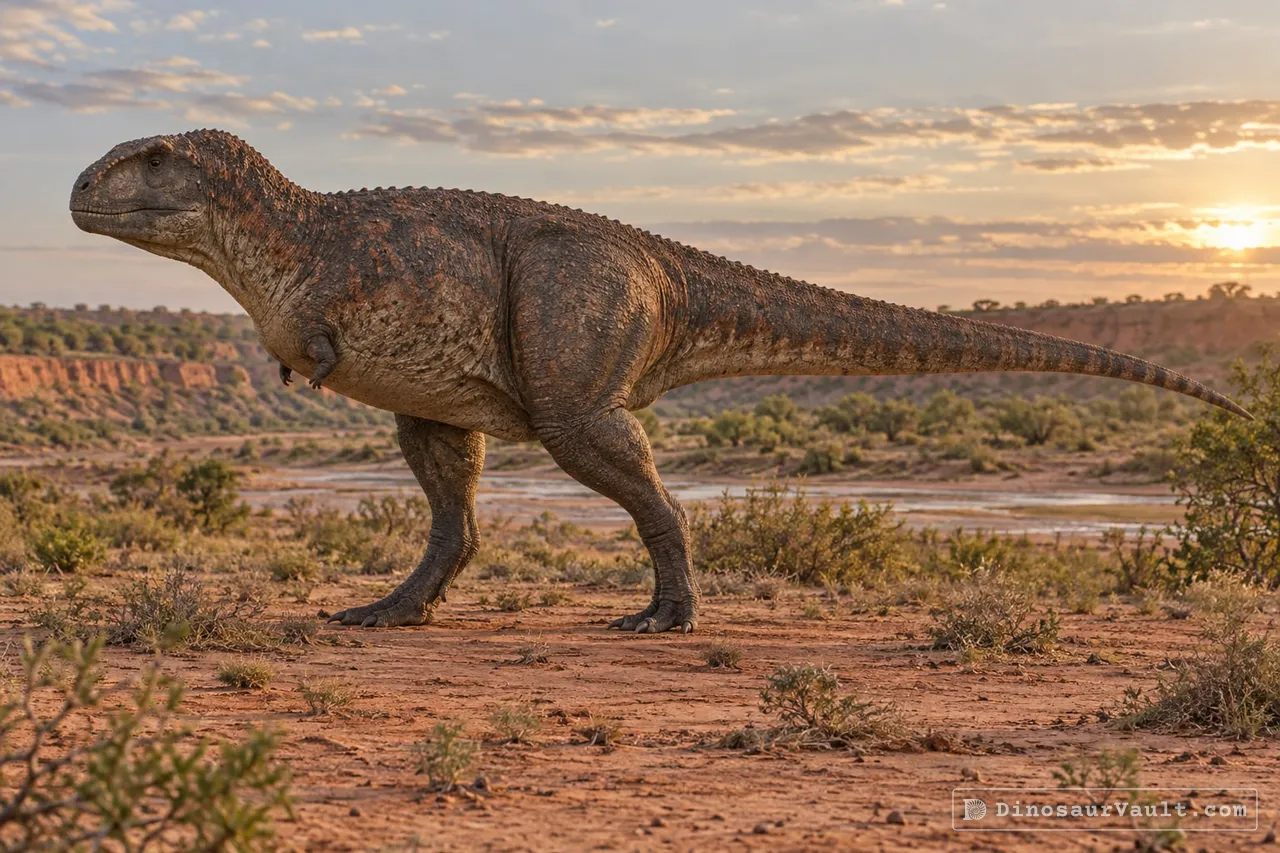
Pycnonemosaurus was an abelisaurid, a relative of Carnotaurus with a short, deep skull and tiny arms. It is known from only a few bones, including teeth, parts of the tail and a leg bone. It seems to have been one of the largest abelisaurids.
Its world
It lived in the Late Cretaceous in what is now Brazil.
How it was found
Kellner and Campos named Pycnonemosaurus in 2002. Only one find is known.
Field gallery
More views of Pycnonemosaurus
Scenes reconstructed from the available fossil evidence.
1 of 3
The evidence
The science behind Pycnonemosaurus
Which parts of the picture come from its own bones, and which come from its relatives.
From its own fossils
- Parts of the tail, ribs, pelvis and hind legs survive from a partial skeleton.
- A stout shin bone and broad projections on the tail bones supported powerful muscles.
Borrowed from relatives
- The short, deep head is inferred from abelisaurids such as Skorpiovenator.
- Tiny arms are inferred from Carnotaurus, Aucasaurus and Majungasaurus, whose hands differed from one another.
- Scaly skin is inferred from preserved skin in Carnotaurus.
Still unknown
- Its complete skull shape and hand anatomy.
- Its exact body length and tail proportions.
- Its color.
Often drawn wrong
- Paired horns like those of Carnotaurus are an unsupported addition.
- The broad projections on its tail bones were buried inside muscle, rather than sticking through the skin.
Discovery timeline
- 2002Named itKellner & Campos
- 2017Full descriptionDELCOURT
- 2021Close relativeHendrickx & Bell
Key papers
The research behind what we know of Pycnonemosaurus
Named it
Named an abelisaurid from a partial skeleton found in Brazil.
On a theropod dinosaur (Abelisauria) from the continental Cretaceous of Brazil. Arquivos do Museu Nacional, Rio de Janeiro 60: 163-170
No link available
Full description
Restudied the surviving bones, refined the features that distinguish Pycnonemosaurus and examined its place among abelisaurids.
Revised morphology of Pycnonemosaurus nevesi Kellner & Campos, 2002 (Theropoda: Abelisauridae) and its phylogenetic relationships. Zootaxa 4276
Read the paper : Revised morphology of Pycnonemosaurus nevesi Kellner & Campos, 2002 (Theropoda: Abelisauridae) and its phylogenetic relationships (opens in a new tab)Close relative
Described small scales and larger bumps in Carnotaurus skin, a comparison for the covering of other abelisaurids.
The scaly skin of the abelisaurid Carnotaurus sastrei (Theropoda: Ceratosauria) from the Upper Cretaceous of Patagonia. Cretaceous Research 128: 104994
Read the paper : The scaly skin of the abelisaurid Carnotaurus sastrei (Theropoda: Ceratosauria) from the Upper Cretaceous of Patagonia (opens in a new tab)
Close relatives
Other members of Abelisauridae


Sources: Wikidata