Penelopognathus
"wild duck jaw"
- Lived
- 121 to 113 million years ago, Early Cretaceous
- Diet
- Herbivore
- Group
- Ornithopods
- Found in
- China
- Named by
- Godefroit et al. 2005
Where its fossils were found
The evidence
Today

115 million years ago
Habitat
The Bayangobi Formation records inland lake basins in what is now China. Other dinosaurs from these rocks include Alxasaurus, Bannykus and Psittacosaurus.
Field notes
About Penelopognathus
What it was like
Penelopognathus was described as a plant eater and an early relative of the duck-billed dinosaurs. It is known from a lower jaw. A later study treated the name as doubtful because its distinguishing jaw features also occur in other relatives of the duck-billed dinosaurs.
Its world
It lived in the Early Cretaceous in what is now northern China. Its jaw comes from the Bayangobi Formation, where the early therizinosaur Alxasaurus and the alvarezsaur Bannykus also lived.
How it was found
Godefroit and colleagues named it in 2005.
Field gallery
More views of Penelopognathus
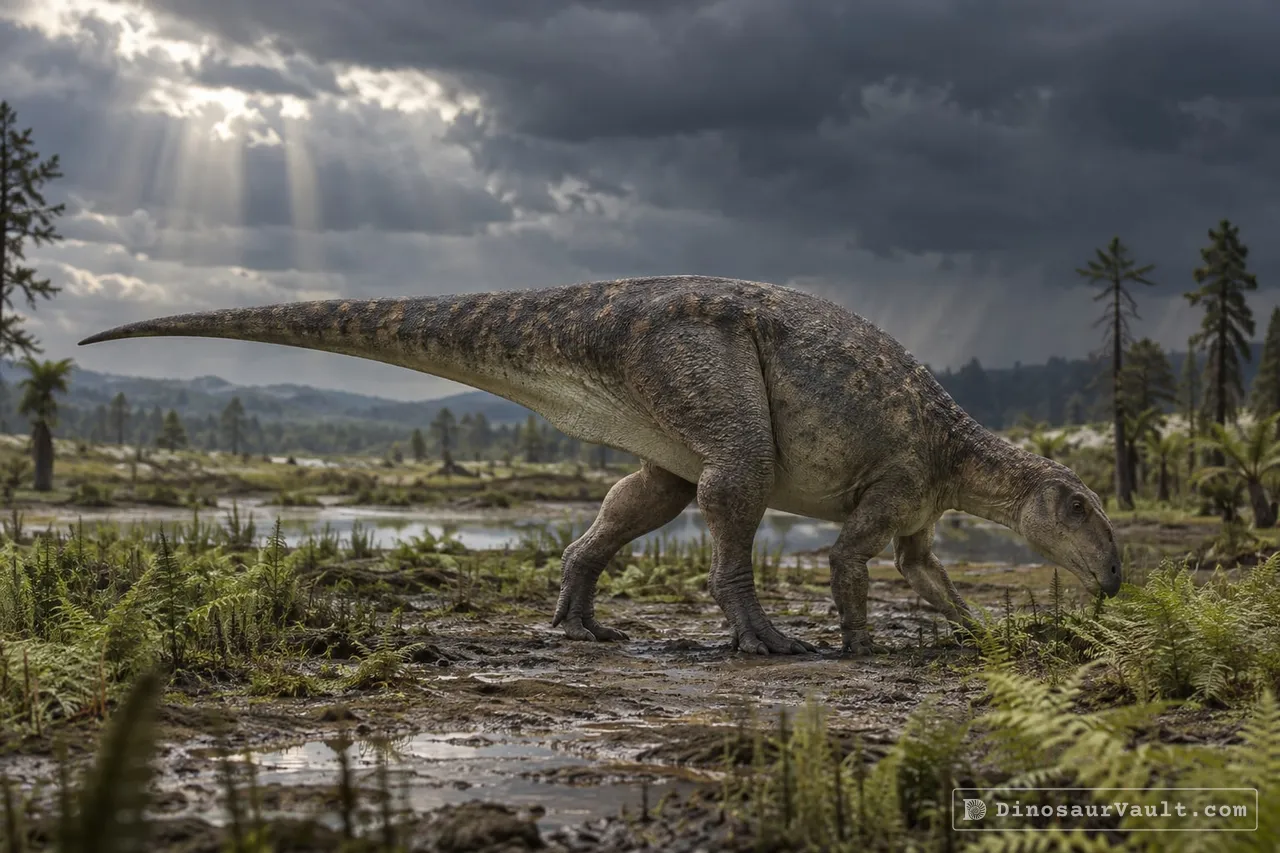
Scenes reconstructed from the available fossil evidence.
Lived alongside
Found in the same rock formations


A rock formation can hold fossils laid down millions of years apart, so not every animal here met Penelopognathus.
The evidence
The science behind Penelopognathus
Which parts of the picture come from its own bones, and which come from its relatives.
From its own fossils
- It is known from the tooth-bearing bone of the right lower jaw, with teeth still in place and some loose tooth crowns.
- The jaw is long, low and nearly straight, with many small openings scattered along its outer surface. Its front end shows where the toothless bone at the tip of the lower jaw attached.
- Behind the teeth, a raised projection for the jaw muscles leans slightly backward.
Borrowed from relatives
- The naming study compared its jaw and teeth with Altirhinus and Probactrosaurus. The rest of its head and body can only be restored in a general way from early relatives of the duck-billed dinosaurs.
Still unknown
- The shape of its complete skull and any head ornament.
- Its body size, limb proportions, skin covering and color.
- Whether it is a distinct genus. Its namers found its jaw and teeth distinctive, but one later study judged those features to be shared with many relatives and treated the name as doubtful.
Discovery timeline
- 2005Named itGodefroit, Li & Shang
- 2010Family treeMcDonald et al.
- 2012Family treeMcDonald
- 2022Family treePoole
Key papers
The research behind what we know of Penelopognathus
Named it
Named Penelopognathus from a long lower jaw and compared its teeth with Altirhinus and Probactrosaurus.
A new primitive hadrosauroid dinosaur from the Early Cretaceous of Inner Mongolia (P.R. China). Comptes Rendus Palevol 4: 697-705
Read the paper : A new primitive hadrosauroid dinosaur from the Early Cretaceous of Inner Mongolia (P.R. China) (opens in a new tab)Family tree
An earlier family tree grouped Penelopognathus with another Asian genus among early relatives of the duck-billed dinosaurs.
New Basal Iguanodonts from the Cedar Mountain Formation of Utah and the Evolution of Thumb-Spiked Dinosaurs. PLoS ONE 5: e14075
Read the paper : New Basal Iguanodonts from the Cedar Mountain Formation of Utah and the Evolution of Thumb-Spiked Dinosaurs (opens in a new tab)Family tree
Included Penelopognathus in a broad family tree and highlighted how fragmentary skeletons make relationships difficult to resolve.
Phylogeny of Basal Iguanodonts (Dinosauria: Ornithischia): An Update. PLoS ONE 7: e36745
Read the paper : Phylogeny of Basal Iguanodonts (Dinosauria: Ornithischia): An Update (opens in a new tab)Family tree
A large study of iguanodont relationships judged the jaw features of Penelopognathus to be widespread, treated it as doubtful and left it out.
Phylogeny of iguanodontian dinosaurs and the evolution of quadrupedality. Palaeontologia Electronica
Read the paper : Phylogeny of iguanodontian dinosaurs and the evolution of quadrupedality (opens in a new tab)
Close relatives
Other members of Hadrosauroidea


Sources: Wikidata