Bannykus
"half claw"
- Lived
- 121 to 113 million years ago, Early Cretaceous
- Diet
- Carnivore
- Group
- Theropods
- Found in
- China
- Named by
- Xu et al. 2018
Where its fossils were found
The evidence
Today

115 million years ago
Habitat
The Bayangobi Formation records a landscape of lakes and their shores in what is now northern China. Other dinosaurs from these rocks include Psittacosaurus, Alxasaurus and Penelopognathus.
Field notes
About Bannykus
What it was like
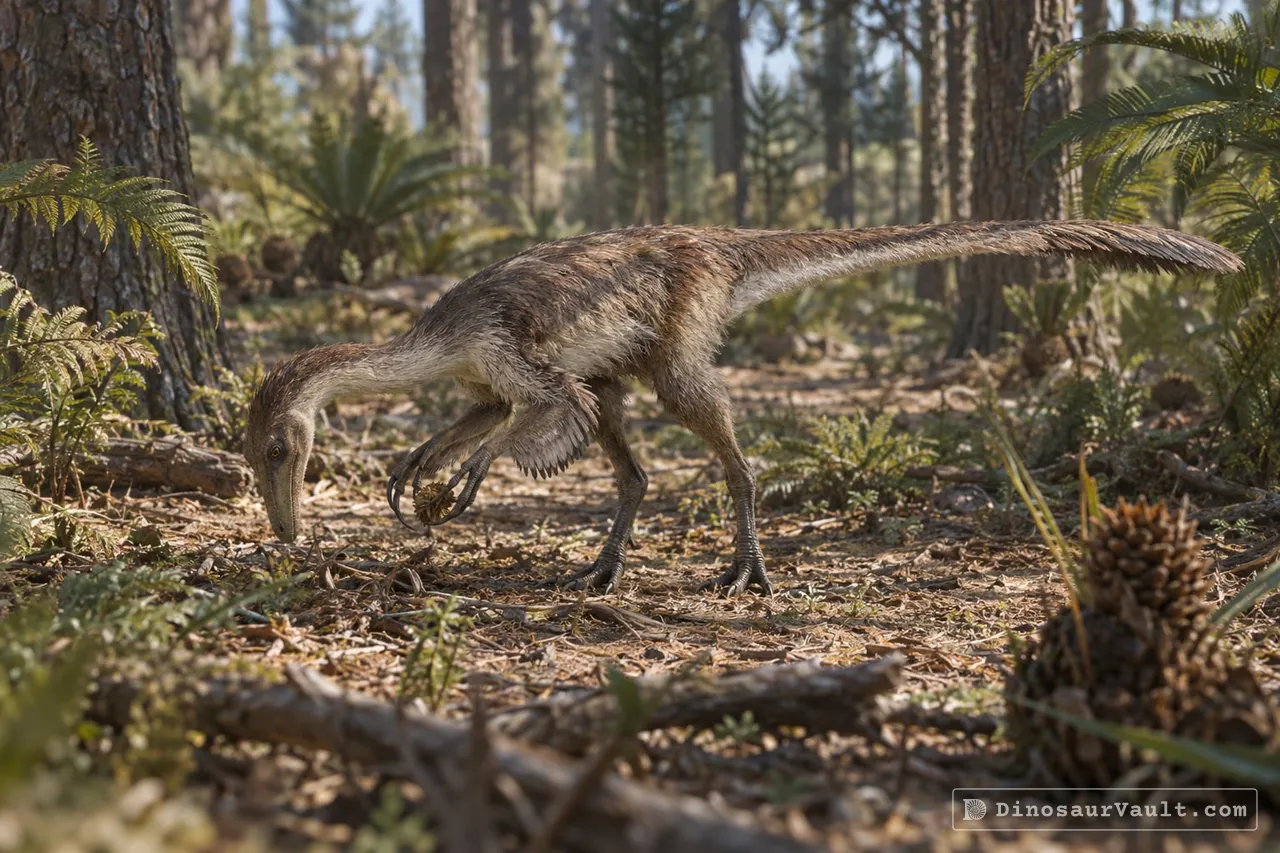
Bannykus was an alvarezsaur, a bird-like dinosaur. Its arms were shorter than those of early members of its group but longer than later ones, and its thumb was large, a halfway stage toward the single-clawed hands of later species.
Its world
It lived in the Early Cretaceous in what is now northern China. Its bones come from the Bayangobi Formation, where the early therizinosaur Alxasaurus and the small horned Psittacosaurus also lived.
How it was found
Xu and colleagues named it in 2018.
Field gallery
More views of Bannykus
Scenes reconstructed from the available fossil evidence.
1 of 3
Lived alongside
Found in the same rock formations


A rock formation can hold fossils laid down millions of years apart, so not every animal here met Bannykus.
The evidence
The science behind Bannykus
Which parts of the picture come from its own bones, and which come from its relatives.
From its own fossils
- A partial skeleton preserves parts of the head, backbone, shoulders, arms and legs.
- Its strong arms were less shortened than those of Mononykus, and its hands had an enlarged main finger and smaller side fingers.
- Bone-derived material in the type specimen's intestinal contents supports a meat-eating diet.
Borrowed from relatives
- Haplocheirus offers a comparison for the missing front of the snout and lower jaw.
- Its shoulders and hands show a stage between the less specialized limbs of Haplocheirus and the short, powerful arms of later alvarezsaurs.
Still unknown
- Which animals it ate and exactly how it used its hands.
- Its feather covering and color.
- What a hatchling looked like.
Discovery timeline
- 2018Named itXu et al.
- 2018Family treeHoltz
- 2021Growing upQin et al.
- 2025How it fedWang et al.
- 2026Family treeLeedham et al.
Key papers
The research behind what we know of Bannykus
Named it
Named Bannykus and Xiyunykus, whose arms and hands fill a gap between early alvarezsaurs and their later, strongly specialized relatives.
Two Early Cretaceous Fossils Document Transitional Stages in Alvarezsaurian Dinosaur Evolution. Current Biology 28: 2853-2860.e3
Read the paper : Two Early Cretaceous Fossils Document Transitional Stages in Alvarezsaurian Dinosaur Evolution (opens in a new tab)Family tree
Explained how Bannykus and Xiyunykus reveal intermediate stages in the evolution of the unusual arms and hands of later alvarezsaurs.
Evolution: New Branches on the Alvarezsaur Tree. Current Biology 28: R941-R943
Read the paper : Evolution: New Branches on the Alvarezsaur Tree (opens in a new tab)Growing up
Identified the known Bannykus as still growing and linked the later shrinking of alvarezsaurs to possible changes in feeding habits.
Growth and miniaturization among alvarezsauroid dinosaurs. Current Biology 31: 3687-3693.e5
Read the paper : Growth and miniaturization among alvarezsauroid dinosaurs (opens in a new tab)How it fed
Found bone-derived material in the intestinal contents of the type specimen, supporting a meat-eating diet.
Direct evidence of carnivory in the early-diverging Alvarezsaurian <i>Bannykus</i>. The Innovation Geoscience 3: 100143
Read the paper : Direct evidence of carnivory in the early-diverging Alvarezsaurian <i>Bannykus</i> (opens in a new tab)Family tree
Models of the type specimen's arm bones suggest a flexible limb capable of scratching and hooking, less specialized for digging than Mononykus.
Range of motion and myology support a digging function for the forelimbs of alvarezsauroid dinosaurs. Proceedings of the Royal Society B: Biological Sciences 293
Read the paper : Range of motion and myology support a digging function for the forelimbs of alvarezsauroid dinosaurs (opens in a new tab)
Close relatives
Other members of Alvarezsauroidea


Sources: Wikidata