Murusraptor
"wall thief"
- Lived
- 90 to 86 million years ago, Late Cretaceous
- Diet
- Carnivore
- Group
- Theropods, Megaraptoridae
- Found in
- Argentina
- Named by
- Coria and Currie 2016
Where its fossils were found
The evidence
Today

90 million years ago
Habitat
Rivers crossed the landscape recorded in the Sierra Barrosa Formation in Argentina. Other dinosaurs from these rocks include Mendozasaurus and Kaijutitan.
Field notes
About Murusraptor
What it was like
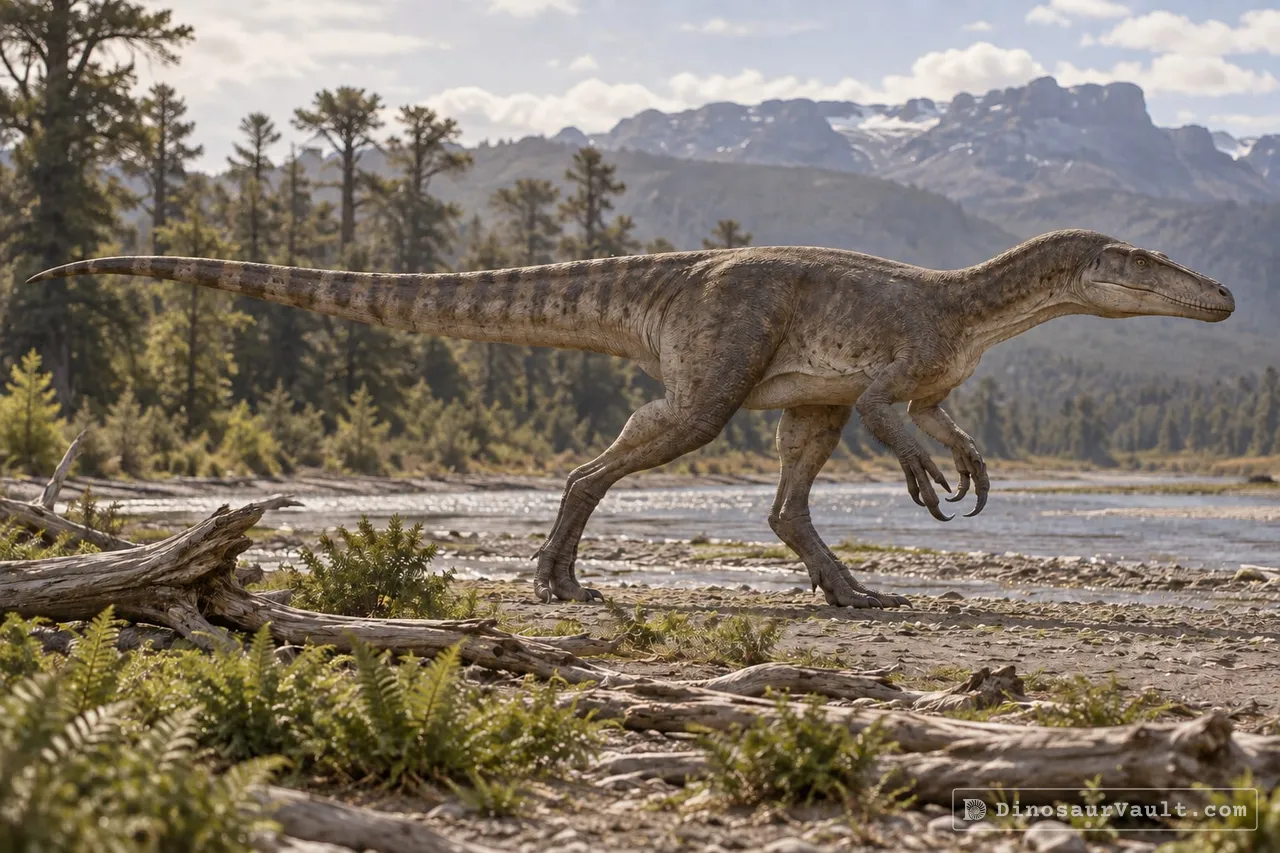
Murusraptor was a megaraptor, a lightly built predator with long arms and big hand claws. Its partial skull and skeleton helped show what megaraptors looked like, since most are known from fewer bones.
Its world
It lived in the Late Cretaceous, in what is now Argentina. It comes from the Sierra Barrosa Formation, where it shared the land with the titanosaurs Mendozasaurus and Kaijutitan.
How it was found
Coria and Currie named Murusraptor in 2016. The name refers to the canyon wall where it was found.
Field gallery
More views of Murusraptor
Scenes reconstructed from the available fossil evidence.
Lived alongside
Found in the same rock formations


A rock formation can hold fossils laid down millions of years apart, so not every animal here met Murusraptor.
The evidence
The science behind Murusraptor
Which parts of the picture come from its own bones, and which come from its relatives.
From its own fossils
- A closely associated partial skeleton preserves the back of the skull, teeth, vertebrae, ribs, hip bones, a shin bone, a heel bone and a small curved claw probably from the hand.
- Air spaces extend into bones of the skull and skeleton.
- The preserved braincase contains the spaces once occupied by the brain, nerves and inner ear.
Borrowed from relatives
- Its missing arms are compared with Australovenator, whose arm bones are known.
- The missing front of the snout and jaw is compared with a juvenile Megaraptor and with Australovenator.
Still unknown
- Its fully grown size. Its neck, shoulder bones, arms and most of its tail are unknown.
- Its skin covering and color, and whether its missing nasal bones carried a crest.
- Exactly where megaraptors fit in the theropod family tree.
Discovery timeline
- 2016Named itCoria & Currie
- 2017SkullPaulina-Carabajal & Currie
- 2019Family treeAranciaga Rolando, Novas & Agnolín
- 2025SkullsIbiricu et al.
Key papers
The research behind what we know of Murusraptor
Named it
Described a partial skeleton with an unusually complete braincase and placed Murusraptor among the megaraptors.
A New Megaraptoran Dinosaur (Dinosauria, Theropoda, Megaraptoridae) from the Late Cretaceous of Patagonia. PLOS ONE 11: e0157973
Read the paper : A New Megaraptoran Dinosaur (Dinosauria, Theropoda, Megaraptoridae) from the Late Cretaceous of Patagonia (opens in a new tab)Skull
Used scans of the braincase to reconstruct the spaces for the brain, cranial nerves and inner ear.
The Braincase of the Theropod Dinosaur Murusraptor: Osteology, Neuroanatomy and Comments on the Paleobiological Implications of Certain Endocranial Features. Ameghiniana 54: 617
Read the paper : The Braincase of the Theropod Dinosaur Murusraptor: Osteology, Neuroanatomy and Comments on the Paleobiological Implications of Certain Endocranial Features (opens in a new tab)Family tree
Reexamined Murusraptor and found features supporting a close relationship between megaraptors and tyrannosauroids.
A reanalysis of Murusraptor barrosaensis Coria & Currie (2016) affords new evidence about the phylogenetical relationships of Megaraptora. Cretaceous Research 99: 104-127
Read the paper : A reanalysis of Murusraptor barrosaensis Coria & Currie (2016) affords new evidence about the phylogenetical relationships of Megaraptora (opens in a new tab)Skulls
Compared Murusraptor with Joaquinraptor and suggested the downward slope of the frontal bones may be shared between them.
Latest Cretaceous megaraptorid theropod dinosaur sheds light on megaraptoran evolution and palaeobiology. Nature Communications 16
Read the paper : Latest Cretaceous megaraptorid theropod dinosaur sheds light on megaraptoran evolution and palaeobiology (opens in a new tab)
Close relatives
Other members of Megaraptoridae


Sources: Wikidata