Australovenator
"southern hunter"
Type species Australovenator wintonensis
- Lived
- 101 to 90 million years ago, Late Cretaceous
- Diet
- Carnivore
- Group
- Theropods, Megaraptoridae
- Found in
- Australia
- Named by
- Hocknull et al. 2009
Where its fossils were found
The evidence
Today

95 million years ago
Habitat
Rivers, lakes and wooded lowlands in the Winton Formation of Australia supported flowering plants and ferns. The sauropods Diamantinasaurus, Wintonotitan and Savannasaurus lived in this region.
Field notes
About Australovenator
What it was like
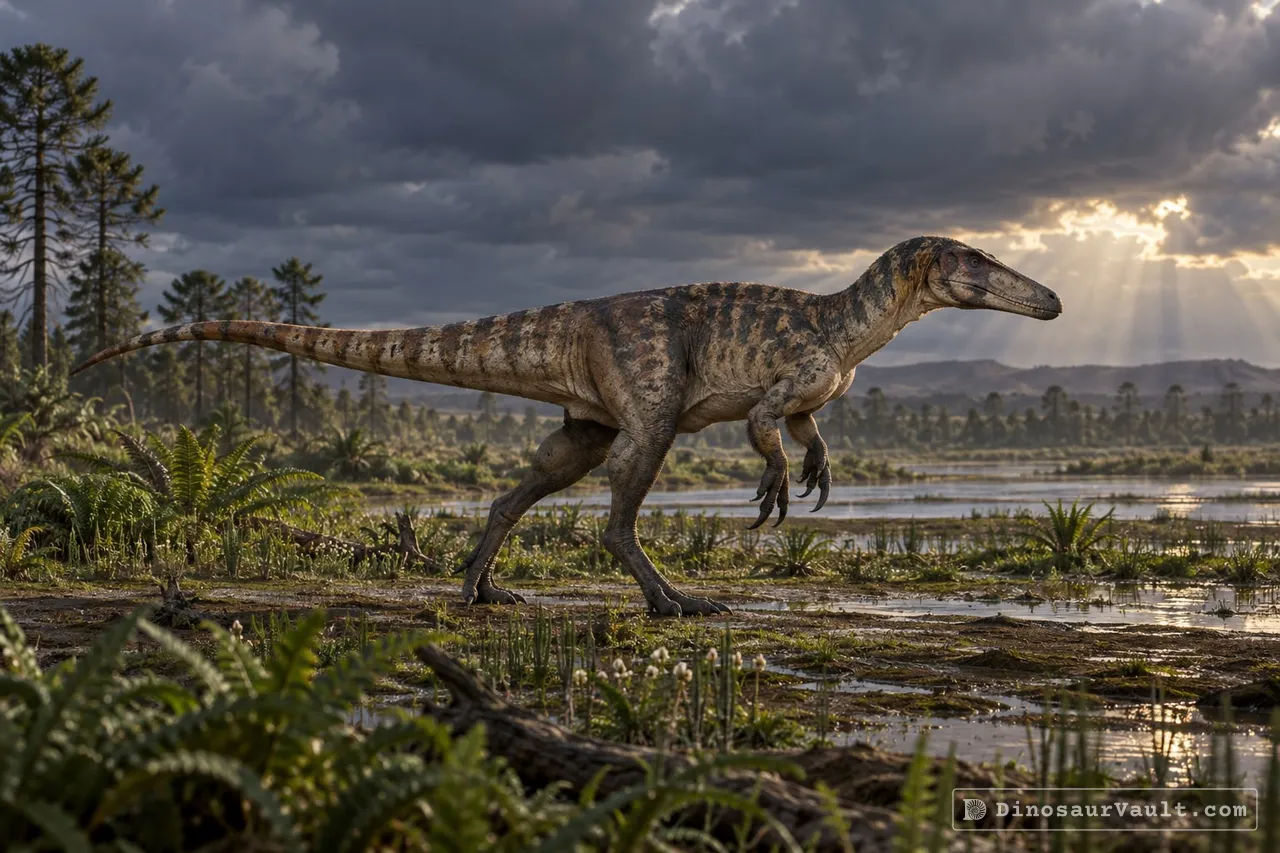
Australovenator was a megaraptor, a slender, fast meat eater with three large, curved claws on each hand. It is known from a partial skeleton with much of the arms and legs, one of the most complete meat-eating dinosaurs found in Australia.
Its long legs suggest it was a quick runner, and its big hand claws were probably its main weapons.
Its world
It lived in the Late Cretaceous in what is now Australia. Its bones come from the Winton Formation, where it shared the land with the titanosaurs Diamantinasaurus, Wintonotitan and Savannasaurus.
How it was found
Hocknull and colleagues named Australovenator in 2009. Its bones were found at the same site as Diamantinasaurus.
Field gallery
More views of Australovenator
Scenes reconstructed from the available fossil evidence.
1 of 3
Lived alongside
Found in the same rock formations


A rock formation can hold fossils laid down millions of years apart, so not every animal here met Australovenator.
The evidence
The science behind Australovenator
Which parts of the picture come from its own bones, and which come from its relatives.
From its own fossils
- A partial skeleton preserves the slender tooth-bearing bones of both lower jaws, teeth, ribs, part of the hip, much of the arms and hands, and the legs and feet.
- Its first two hand claws are big, curved and close in size, and the third is smaller. The thumb claw is narrow from side to side.
- Its arm joints allowed a wide reach and could fold the hands toward its chest.
Borrowed from relatives
- Missing parts of the head and trunk are restored using other megaraptors, such as Megaraptor and Murusraptor.
- An emu's foot has helped researchers restore the pads, tendons and claw coverings around its fossil foot bones.
Still unknown
- The complete shape of its skull.
- Where megaraptors fit in the meat-eater family tree. Experts still disagree.
- Its skin covering and color.
Discovery timeline
- 2009Named itHocknull et al.
- 2012New findWhite et al.
- 2013New findWhite et al.
- 2015SkullWhite et al.
- 2015How it fedWhite et al.
- 2016PostureWhite et al.
Key papers
The research behind what we know of Australovenator
Named it
Named Australovenator from a partial skeleton found at the same site as Diamantinasaurus, alongside the description of Wintonotitan.
New Mid-Cretaceous (Latest Albian) Dinosaurs from Winton, Queensland, Australia. PLoS ONE 4: e6190
Read the paper : New Mid-Cretaceous (Latest Albian) Dinosaurs from Winton, Queensland, Australia (opens in a new tab)New find
Described newly found forearm, wrist and hand bones of the original skeleton and corrected which finger some bones belong to.
New Forearm Elements Discovered of Holotype Specimen Australovenator wintonensis from Winton, Queensland, Australia. PLoS ONE 7: e39364
Read the paper : New Forearm Elements Discovered of Holotype Specimen Australovenator wintonensis from Winton, Queensland, Australia (opens in a new tab)New find
Added newly found leg and foot bones from the original skeleton, giving a slender lower leg and a revised layout of the toe bones.
New Australovenator Hind Limb Elements Pertaining to the Holotype Reveal the Most Complete Neovenatorid Leg. PLoS ONE 8: e68649
Read the paper : New Australovenator Hind Limb Elements Pertaining to the Holotype Reveal the Most Complete Neovenatorid Leg (opens in a new tab)Skull
Described the complete right lower jaw bone: long and slender, with a rounded tip and a gently wavy lower edge.
The dentary ofAustralovenator wintonensis(Theropoda, Megaraptoridae); implications for megaraptorid dentition. PeerJ 3: e1512
Read the paper : The dentary ofAustralovenator wintonensis(Theropoda, Megaraptoridae); implications for megaraptorid dentition (opens in a new tab)How it fed
Moved digital models of the arm bones and suggested that folding the wrist inward helped draw captured food toward the chest.
Forearm Range of Motion in Australovenator wintonensis (Theropoda, Megaraptoridae). PLOS ONE 10: e0137709
Read the paper : Forearm Range of Motion in Australovenator wintonensis (Theropoda, Megaraptoridae) (opens in a new tab)Posture
Compared its foot with an emu's to restore soft parts and show how tendons and other tissues limited toe movement.
The pes ofAustralovenator wintonensis(Theropoda: Megaraptoridae): analysis of the pedal range of motion and biological restoration. PeerJ 4: e2312
Read the paper : The pes ofAustralovenator wintonensis(Theropoda: Megaraptoridae): analysis of the pedal range of motion and biological restoration (opens in a new tab)
Close relatives
Other members of Megaraptoridae


Sources: Wikidata