Oceanotitan
"ocean giant"
- Lived
- 152 to 149 million years ago, Late Jurassic
- Diet
- Herbivore
- Group
- Sauropods
- Found in
- Portugal
- Named by
- Mocho et al. 2019
Where its fossils were found
The evidence
Today

150 million years ago
Habitat
Coastal land in what is now Portugal, near the Atlantic. Its wider world included Dacentrurus, Zby and Lusovenator.
Field notes
About Oceanotitan
What it was like
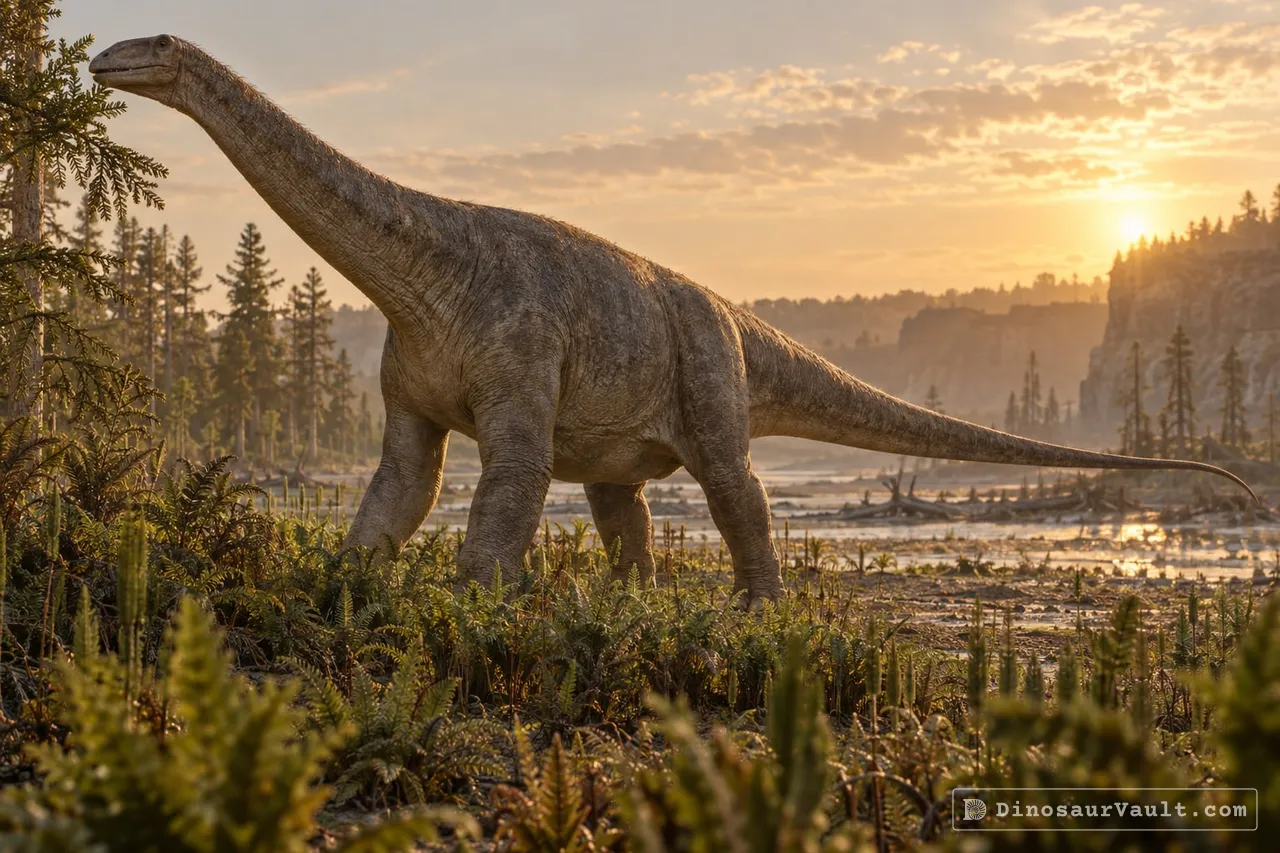
Oceanotitan was a long-necked, four-legged plant eater, an early relative of the titanosaurs. It is known from tail bones and parts of the hips and legs.
Its world
It lived in the Late Jurassic in what is now Portugal, in coastal land near the Atlantic. It shared its world with the stegosaur Dacentrurus, the long-necked Zby and the hunter Lusovenator.
How it was found
Mocho and colleagues named Oceanotitan in 2019, from a single find. Its name refers to the ocean near the cliffs where it was found.
Field gallery
More views of Oceanotitan
Scenes reconstructed from the available fossil evidence.
Lived alongside
Found in the same rock formations


A rock formation can hold fossils laid down millions of years apart, so not every animal here met Oceanotitan.
The evidence
The science behind Oceanotitan
Which parts of the picture come from its own bones, and which come from its relatives.
From its own fossils
- The associated partial skeleton preserves tail vertebrae, parts of the shoulder and hip girdles, and a right hind leg with straight thigh and shin bones.
- The shoulder blade has a rough rounded bump on its inner surface and an oval hollow on its underside.
- The thighbone has a strong muscle attachment along the middle of its back surface.
Borrowed from relatives
- Europasaurus provides a comparison for the missing skull.
- Camarasaurus provides broader comparisons for the missing neck, body proportions, hands and feet.
Still unknown
- Its closest relatives; studies disagree on whether it belonged to the titanosauriform group.
- The length and proportions of its neck.
- Its skin covering and color.
Discovery timeline
- 2019Named itMocho, Royo-Torres & Ortega
- 2020Same rocksMalafaia et al.
- 2023Family treeMocho et al.
Key papers
The research behind what we know of Oceanotitan
Named it
Described the partial skeleton and proposed that Oceanotitan was a macronarian sauropod, possibly an early relative of the titanosaurs.
A new macronarian sauropod from the Upper Jurassic of Portugal. Journal of Vertebrate Paleontology 39: e1578782
Read the paper : A new macronarian sauropod from the Upper Jurassic of Portugal (opens in a new tab)Same rocks
Named Lusovenator, a carcharodontosaurian predator from the Late Jurassic of Portugal.
A new carcharodontosaurian theropod from the Lusitanian Basin: evidence of allosauroid sympatry in the European Late Jurassic. Journal of Vertebrate Paleontology 40
Read the paper : A new carcharodontosaurian theropod from the Lusitanian Basin: evidence of allosauroid sympatry in the European Late Jurassic (opens in a new tab)Family tree
A broader analysis of Iberian sauropods; a later study reports that it placed Oceanotitan outside the titanosauriform group suggested in its original description.
New sauropod dinosaur from the Lower Cretaceous of Morella (Spain) provides new insights on the evolutionary history of Iberian somphospondylan titanosauriforms. Zoological Journal of the Linnean Society 201: 214-268
Read the paper : New sauropod dinosaur from the Lower Cretaceous of Morella (Spain) provides new insights on the evolutionary history of Iberian somphospondylan titanosauriforms (opens in a new tab)
Close relatives
Other members of Titanosauriformes


Sources: Wikidata