Duriatitan
"Dorset titan"
- Lived
- 155 to 137 million years ago, Late Jurassic to Early Cretaceous
- Diet
- Herbivore
- Group
- Sauropods
- Found in
- United Kingdom and France
- Named by
- Barrett et al. 2010
Where its fossils were found
The evidence
Today

145 million years ago
Habitat
Duriatitan lived on land near a shallow sea in what is now England. The Kimmeridge Clay formed offshore; other dinosaurs recorded from these rocks include Dacentrurus, Cumnoria and Juratyrant.
Field notes
About Duriatitan
What it was like
Duriatitan was a long-necked sauropod known from an upper arm bone. It may be related to the brachiosaurs and titanosaurs.
Its world
It lived in the Late Jurassic in what is now England. Its bone comes from the Kimmeridge Clay, which formed on the floor of a shallow sea. Other dinosaurs from these rocks include the stegosaur Dacentrurus.
How it was found
Barrett and colleagues named Duriatitan in 2010. Its bone had been placed in another genus for more than a century.
Field gallery
More views of Duriatitan
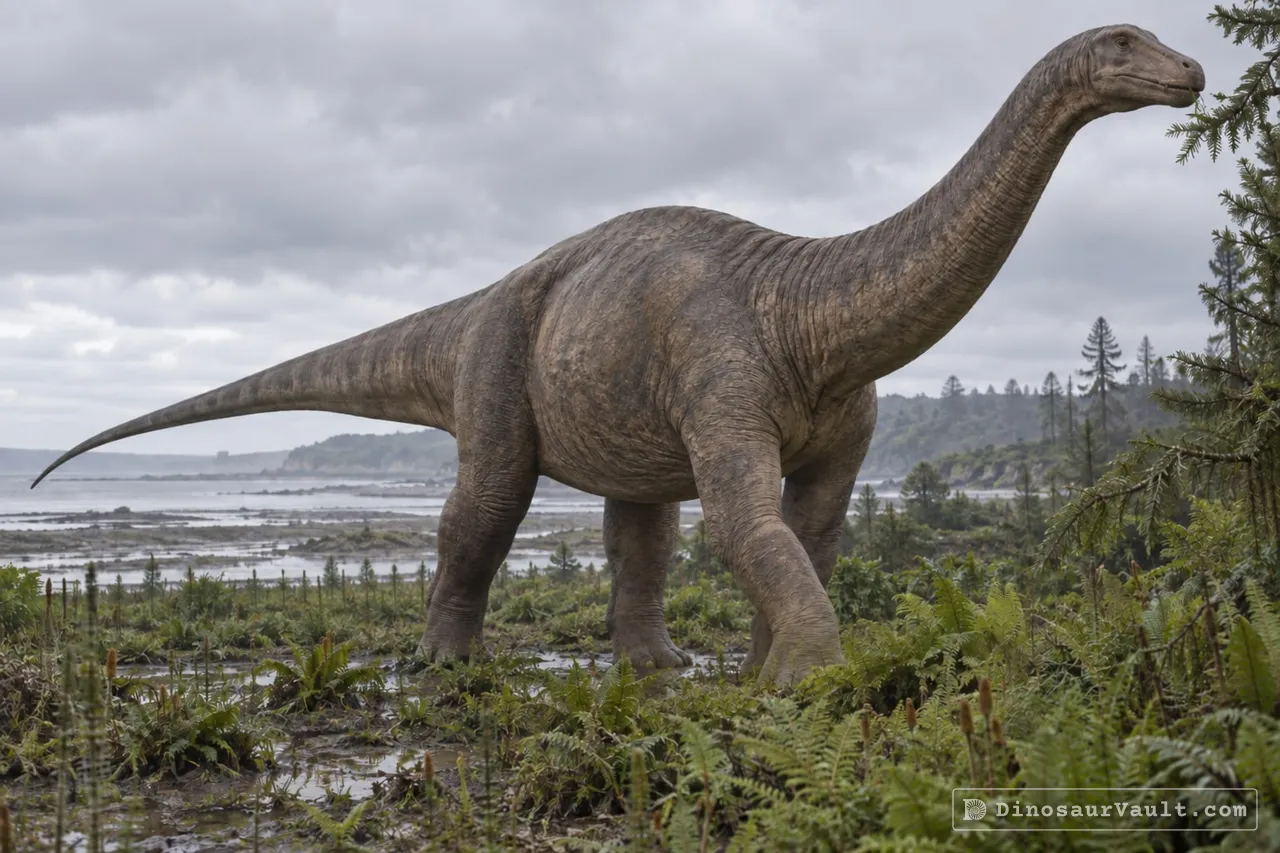
Scenes reconstructed from the available fossil evidence.
Lived alongside
Found in the same rock formations


A rock formation can hold fossils laid down millions of years apart, so not every animal here met Duriatitan.
The evidence
The science behind Duriatitan
Which parts of the picture come from its own bones, and which come from its relatives.
From its own fossils
- A partial left upper arm bone from the Kimmeridge Clay.
- The upper arm bone has a slender shaft and a crest at the back of its upper end. Part of the ridge for the shoulder muscles is damaged.
- Upper arm bones from other sites have been compared with it, but none has been firmly assigned to it.
Borrowed from relatives
- The head is restored by comparison with Europasaurus, a sauropod known from skull bones.
- The neck, trunk, legs, feet and tail are restored by comparison with Camarasaurus.
Still unknown
- Its full length and body proportions.
- Where it belongs in the sauropod family tree. One study tentatively placed it among titanosauriforms, another only as a sauropod of uncertain position, and a later one among macronarians without a precise position.
- Its skin texture and color.
Discovery timeline
- 1874Full descriptionHulke
- 2010Named itBarrett, Benson & Upchurch
- 2013Family treeMannion et al.
- 2020New findTorcida Fernández-Baldor, Canudo & Huerta
Key papers
The research behind what we know of Duriatitan
Full description
First described the large upper arm bone that later became the basis for Duriatitan.
Note on a very Large Saurian Limb-bone adapted for Progression upon Land, from the Kimmeridge Clay of Weymouth, Dorset. Quarterly Journal of the Geological Society of London 30: 16-17
Read the paper : Note on a very Large Saurian Limb-bone adapted for Progression upon Land, from the Kimmeridge Clay of Weymouth, Dorset (opens in a new tab)Named it
Reexamined an upper arm bone previously assigned to Cetiosaurus and gave it the new genus name Duriatitan.
Dinosaurs of Dorset: Part II, the sauropod dinosaurs (Saurischia, Sauropoda) with additional comments of the theropods. Proceedings of the Dorset Natural History and Archaeological Society 131: 113-126
No link available
Family tree
Reviewed early titanosauriforms and retained Duriatitan in that group without assigning it firmly to the brachiosaurs.
Osteology of the Late Jurassic Portuguese sauropod dinosaurLusotitan atalaiensis(Macronaria) and the evolutionary history of basal titanosauriforms. Zoological Journal of the Linnean Society 168: 98-206
Read the paper : Osteology of the Late Jurassic Portuguese sauropod dinosaurLusotitan atalaiensis(Macronaria) and the evolutionary history of basal titanosauriforms (opens in a new tab)New find
Described an upper arm bone from Spain that resembles Duriatitan and suggested it may come from an early brachiosaur.
New data on sauropod palaeobiodiversity at the Jurassic-Cretaceous transition of Spain (Burgos). Journal of Iberian Geology 46: 351-362
Read the paper : New data on sauropod palaeobiodiversity at the Jurassic-Cretaceous transition of Spain (Burgos) (opens in a new tab)
Close relatives
Other members of Titanosauriformes


Sources: Wikidata