Fusuisaurus
"Fusui lizard"
- Lived
- 121 to 113 million years ago, Early Cretaceous
- Diet
- Herbivore
- Group
- Sauropods
- Found in
- China
- Named by
- Mo et al. 2006
Where its fossils were found
The evidence
Today

115 million years ago
Habitat
It lived around rivers in southern China. Liubangosaurus, Datanglong and Napaisaurus are also recorded from the Xinlong Formation.
Field notes
About Fusuisaurus
What it was like
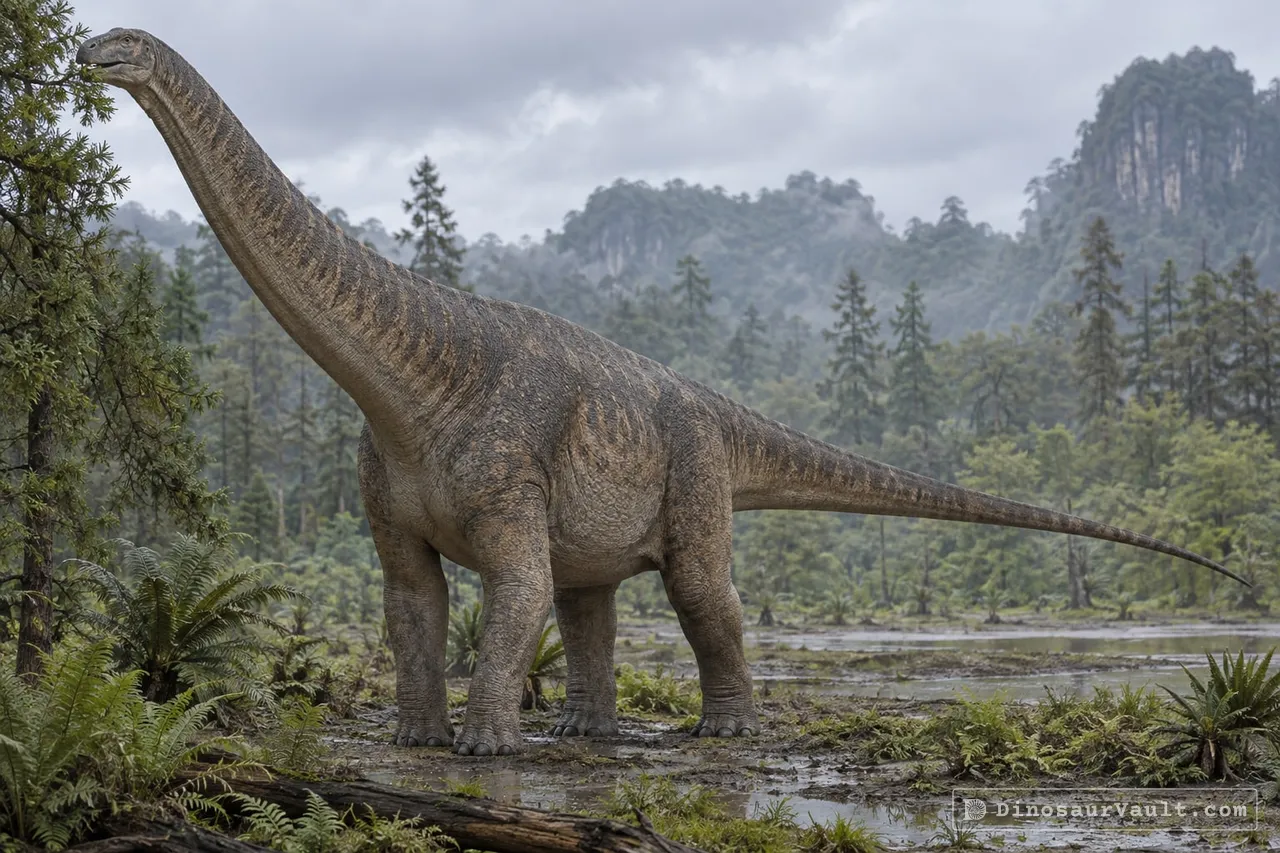
Fusuisaurus was a large long-necked sauropod, a relative of the titanosaurs. It is known from a hip bone, ribs and a thigh bone.
Its world
It lived in the Early Cretaceous in what is now southern China. Its bones come from the Xinlong Formation, where the sauropod Liubangosaurus also lived.
How it was found
Mo and colleagues named it in 2006. It is named after the county where it was found.
Field gallery
More views of Fusuisaurus
Scenes reconstructed from the available fossil evidence.
Lived alongside
Found in the same rock formations


A rock formation can hold fossils laid down millions of years apart, so not every animal here met Fusuisaurus.
The evidence
The science behind Fusuisaurus
Which parts of the picture come from its own bones, and which come from its relatives.
From its own fossils
- Its partial skeleton includes two left hip bones, the ilium and pubis, three front tail vertebrae still joined together, most of the back ribs and the lower end of the left thigh bone.
- Its back ribs show no signs of air spaces inside, and the lower end of its pubis is a flat plate.
- A large upper arm bone from the same quarry has been tentatively assigned to Fusuisaurus because of its size and where it was found.
Borrowed from relatives
- The missing skull is restored by comparison with Euhelopus, a relative known from a skull.
- The neck, body and legs follow Mnyamawamtuka, a titanosaur from Tanzania.
Still unknown
- Its teeth. Isolated teeth from the quarry cannot be matched to it or to Liubangosaurus, whose bones lie in the same place.
- Its exact place in the family tree. Two studies suggest it was probably a somphospondylan, but it shifts around in their analyses because so little of it is known.
- Whether the large upper arm bone belongs to Fusuisaurus, and its complete length and weight.
Discovery timeline
- 2006Named itMo et al.
- 2013Close relativePoropat & Kear
- 2015Its worldMO et al.
- 2020New findMo et al.
Key papers
The research behind what we know of Fusuisaurus
Named it
Named Fusuisaurus from a partial skeleton and identified it as an early member of the titanosauriform branch.
A basal titanosauriform from the Early Cretaceous of Guangxi, China. Acta Geologica Sinica 80: 486-489
Read the paper : A basal titanosauriform from the Early Cretaceous of Guangxi, China (opens in a new tab)Close relative
Photographed and rebuilt in three dimensions the skull of Euhelopus, a long-necked plant eater from China, and described more of its skull bones.
Photographic Atlas and Three-Dimensional Reconstruction of the Holotype Skull of Euhelopus zdanskyi with Description of Additional Cranial Elements. PLoS ONE 8: e79932
Read the paper : Photographic Atlas and Three-Dimensional Reconstruction of the Holotype Skull of Euhelopus zdanskyi with Description of Additional Cranial Elements (opens in a new tab)Its world
Reviewed the animals from the river deposits of the Xinlong Formation and showed that the quarry holds at least two different sauropods.
Early Cretaceous vertebrates from the Xinlong Formation of Guangxi (southern China): a review. Geological Magazine 153: 143-159
Read the paper : Early Cretaceous vertebrates from the Xinlong Formation of Guangxi (southern China): a review (opens in a new tab)New find
Described a giant upper arm bone from the original quarry and tentatively assigned it to Fusuisaurus.
New fossil remains of Fusuisaurus zhaoi (Sauropoda: Titanosauriformes) from the Lower Cretaceous of Guangxi, southern China. Cretaceous Research 109: 104379
Read the paper : New fossil remains of Fusuisaurus zhaoi (Sauropoda: Titanosauriformes) from the Lower Cretaceous of Guangxi, southern China (opens in a new tab)
Close relatives
Other members of Titanosauriformes


Sources: Wikidata