Metriacanthosaurus8.2 m (27 ft)Human1.8 m (6 ft)School bus12 m (40 ft)
05101520
Metriacanthosaurus 8.2 m (27 ft)Human 1.8 m (6 ft)School bus 12 m (40 ft)
Scale in metersOutline: typical theropod shape
Where its fossils were found
The evidence
Today
1,000 km (621 mi)
1 find
160 million years ago
Map: C. R. Scotese, PALEOMAP
Habitat
It probably hunted on land near the shallow sea that laid down the Oxford Clay. Dinosaurs from these rocks include Eustreptospondylus, Cetiosauriscus and Loricatosaurus.
Field notes
About Metriacanthosaurus
What it was like
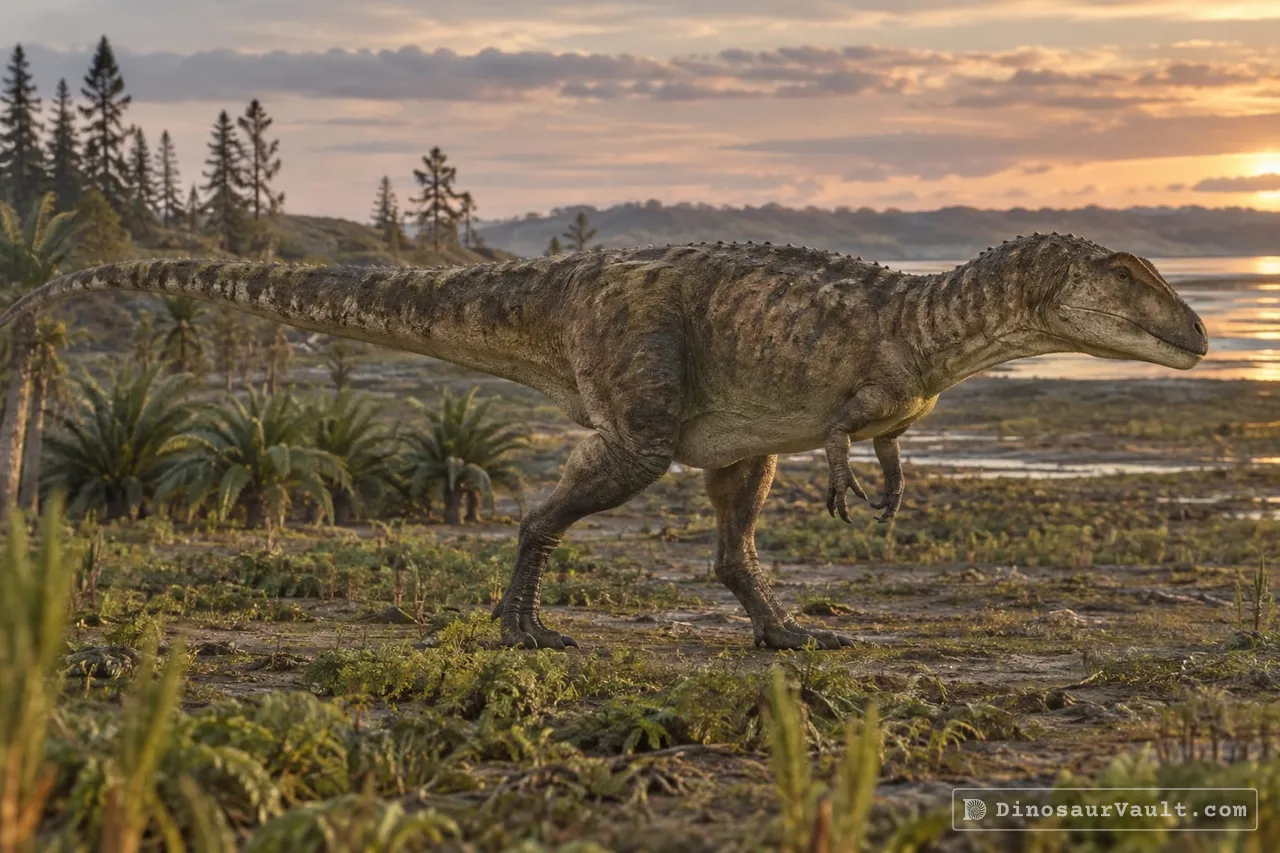
Metriacanthosaurus was a large two-legged predator estimated at about 8.2 meters (27 feet) long. It is known from an incomplete skeleton, so its total length is a reconstruction rather than a measurement of a complete animal. Its name refers to the spines on its backbones; these were not unusually tall compared with many other theropods.
Its world
It lived in the Late Jurassic in what is now England. Its bones come from the Oxford Clay.
How it was found
Its bones were first placed in Megalosaurus. Walker gave it its own genus in 1964. It gave its name to the metriacanthosaurids, a family that also includes Sinraptor and Yangchuanosaurus.
From the specimen
What was actually found?
The name Metriacanthosaurus parkeri is anchored to a holotype, the reference specimen for the species. The partial skeleton, OUMNH J.12144, is held at Oxford University Museum of Natural History. It includes vertebrae, pelvic bones and hindlimb bones, rather than a complete skeleton with a skull. Oxford specimen record
The Oxford specimen record places a tail vertebra from that skeleton at Jordan Cliff, Overcombe, near Weymouth in Dorset. Research identifies the rocks as the Weymouth Member of the Oxford Clay. The bones were first assigned to Megalosaurus; Walker established Metriacanthosaurus as a separate genus in 1964. That is a naming date, not a discovery date. Research review, pp. 495, 502
How does it compare?
All three were large meat-eating theropods. Family relationships and the completeness of their fossils are more useful comparisons than a precise size ranking.
An allosaurid from the Late Jurassic, especially well known from North America. Its skull preserves distinctive horns above the eyes. Metriacanthosaurus belongs to a different family, Metriacanthosauridae, and its missing skull cannot show whether it had similar ornaments.
A fellow metriacanthosaurid from China. Nearly complete specimens of Yangchuanosaurus shangyouensis give a much fuller picture of its anatomy. These fossils help with comparisons, but do not establish the exact shape of the missing parts of Metriacanthosaurus.
A rock formation can hold fossils laid down millions of years apart, so not every animal here met Metriacanthosaurus.
The evidence
The science behind Metriacanthosaurus
Which parts of the picture come from its own bones, and which come from its relatives.
From its own fossils
The known skeleton preserves vertebrae and parts of the hips and hindlimbs.
The spines on its backbones were not unusually tall compared with many other theropods.
Borrowed from relatives
The missing head, arms and much of the tail are restored using better-known relatives such as Sinraptor and Yangchuanosaurus.
Still unknown
The shape of its skull and hands.
Its skin covering and color.
How its body changed as it grew.
Discovery timeline
1964Named itWalker
2012Family treeCarrano, Benson & Sampson
2025Close relativeZou et al.
Key papers
The research behind what we know of Metriacanthosaurus
Named it
Walker, 1964
Separated the partial skeleton from Megalosaurus and established Metriacanthosaurus as its own genus.
Triassic reptiles from the Elgin area: Ornithosuchus and the origin of carnosaurs. Philosophical Transactions of the Royal Society of London. Series B, Biological Sciences 248: 53-134