Siamotyrannus
"Siamese tyrant"
Type species Siamotyrannus isanensis
- Lived
- 126 to 121 million years ago, Early Cretaceous
- Diet
- Carnivore
- Group
- Theropods, Metriacanthosauridae
- Found in
- Thailand
- Named by
- Buffetaut et al. 1996
Where its fossils were found
The evidence
Today

125 million years ago
Habitat
Its home was a broad floodplain crossed by winding rivers, with freshwater lakes between the channels. Dinosaurs from the Sao Khua Formation include Phuwiangosaurus, Phuwiangvenator and Kinnareemimus.
Field notes
About Siamotyrannus
What it was like
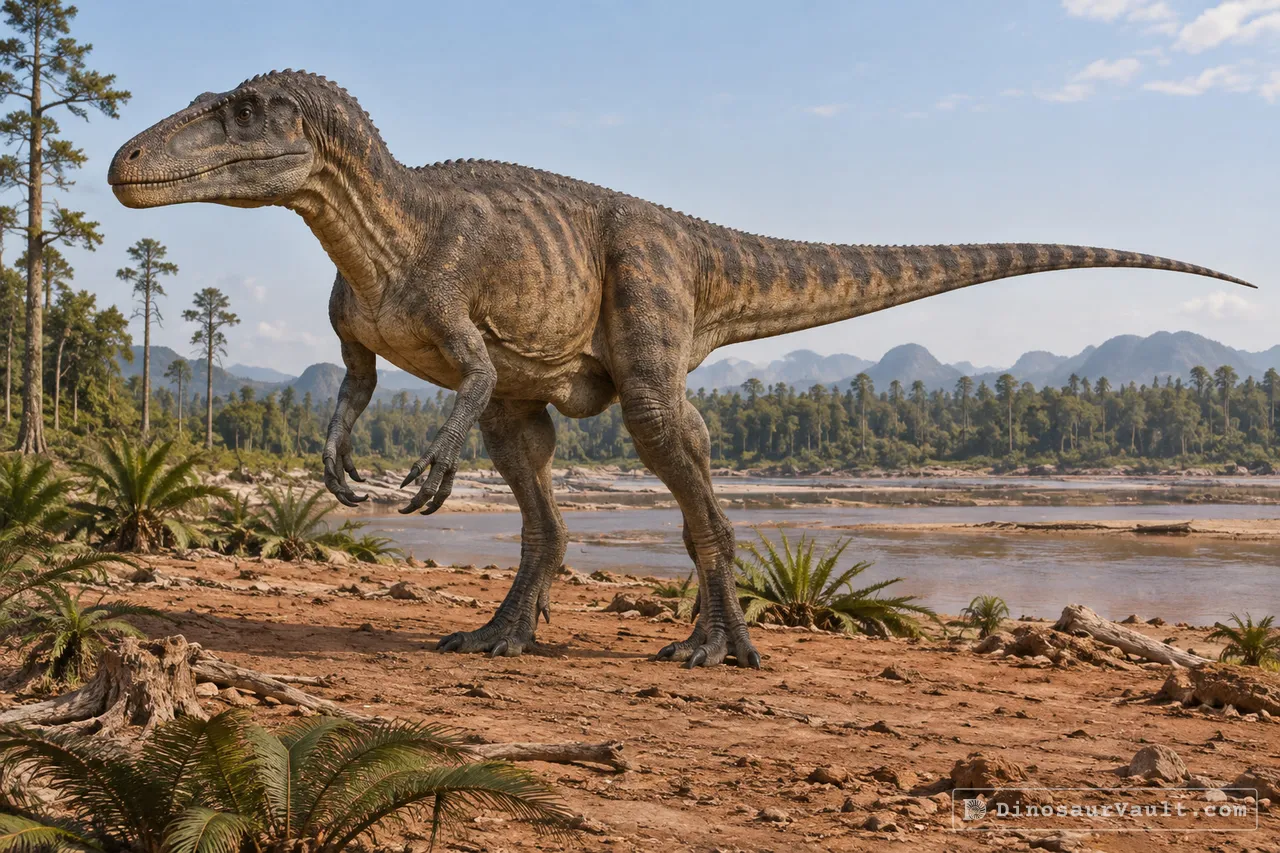
Siamotyrannus was a large theropod known only from a hip and part of the backbone and tail. It was first thought to be an early tyrannosaur, but most scientists now place it with the metriacanthosaurids, relatives of Allosaurus.
Its world
It lived in the Early Cretaceous, in what is now Thailand. It shared the Sao Khua Formation with the sauropod Phuwiangosaurus and the smaller theropods Phuwiangvenator, Vayuraptor and Kinnareemimus.
How it was found
Buffetaut and colleagues named Siamotyrannus in 1996. The type species is Siamotyrannus isanensis.
Field gallery
More views of Siamotyrannus
Scenes reconstructed from the available fossil evidence.
1 of 3
Lived alongside
Found in the same rock formations


A rock formation can hold fossils laid down millions of years apart, so not every animal here met Siamotyrannus.
The evidence
The science behind Siamotyrannus
Which parts of the picture come from its own bones, and which come from its relatives.
From its own fossils
- The original skeleton preserves part of the hip, the backbone above it and the front of the tail.
- Features of the hip resemble those of Sinraptor and Yangchuanosaurus.
Borrowed from relatives
- Sinraptor guides the missing head and much of the body.
- Substantial arms with inward-facing hands follow comparisons with other early members of the broader theropod group.
Still unknown
- Its skull shape and tooth arrangement.
- The exact proportions of its arms and feet.
- Where it belongs in the theropod family tree; studies favor different positions.
Often drawn wrong
- A huge tyrannosaur head and tiny arms with reduced fingers repeat its original classification rather than the later comparisons.
- The horn above the eye of Alpkarakush should not be copied onto Siamotyrannus.
Discovery timeline
- 1996Named itBuffetaut, Suteethorn & Tong
- 2012Family treeCarrano, Benson & Sampson
- 2019RedescriptionSamathi, Chanthasit & Sander
Key papers
The research behind what we know of Siamotyrannus
Named it
Named Siamotyrannus from an incomplete skeleton and interpreted it as an early tyrannosaur.
The earliest known tyrannosaur from the Lower Cretaceous of Thailand. Nature 381: 689-691
Read the paper : The earliest known tyrannosaur from the Lower Cretaceous of Thailand (opens in a new tab)Family tree
Compared its pelvic bones with other theropods and placed Siamotyrannus among the relatives of Sinraptor.
The phylogeny of Tetanurae (Dinosauria: Theropoda). Journal of Systematic Palaeontology 10: 211-300
Read the paper : The phylogeny of Tetanurae (Dinosauria: Theropoda) (opens in a new tab)Redescription
Reviewed its known bones and competing classifications, and questioned whether previously assigned shin and hip bones belonged to Siamotyrannus.
A review of theropod dinosaurs from the Late Jurassic to mid-Cretaceous of Southeast Asia. Annales de Paléontologie 105: 201-215
Read the paper : A review of theropod dinosaurs from the Late Jurassic to mid-Cretaceous of Southeast Asia (opens in a new tab)
Close relatives
Other members of Metriacanthosauridae


Sources: Wikidata