Alpkarakush
Type species Alpkarakush kyrgyzicus
- Lived
- 165 to 162 million years ago, Middle Jurassic
- Diet
- Carnivore
- Group
- Theropods, Metriacanthosauridae
- Found in
- Kyrgyzstan
- Named by
- Rauhut et al. 2024
Where its fossils were found
The evidence
Today

165 million years ago
Habitat
It lived in an inland basin in what is now Kyrgyzstan, during a shift toward a drier climate. Ferganasaurus and Ferganocephale are named from the same formation, which also contains turtles and fish.
Field notes
About Alpkarakush
What it was like
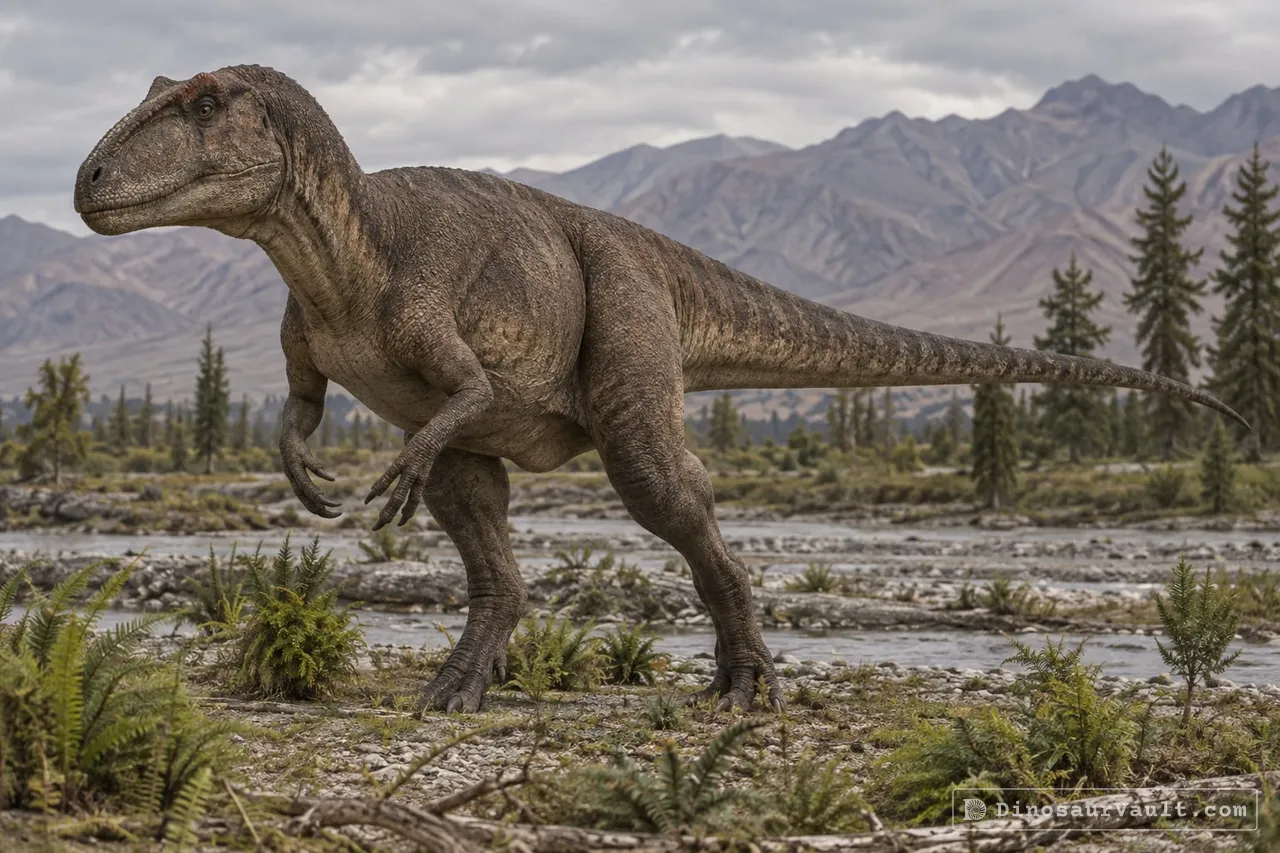
Alpkarakush was a large two-legged predator from the metriacanthosaurid family, a group of Jurassic meat eaters that includes Sinraptor and Yangchuanosaurus. It is known from a partial skeleton, including skull bones with a ridge above the eye.
Its world
It lived about 165 to 162 million years ago, in the Middle Jurassic, in what is now Kyrgyzstan. Its bones come from the Balabansai Formation, where the sauropod Ferganasaurus also lived.
How it was found
Rauhut and colleagues named it in 2024 from one find. The type species is Alpkarakush kyrgyzicus. Its name comes from a giant bird of local legend.
Field gallery
More views of Alpkarakush
Scenes reconstructed from the available fossil evidence.
1 of 2
Lived alongside
Found in the same rock formations


A rock formation can hold fossils laid down millions of years apart, so not every animal here met Alpkarakush.
The evidence
The science behind Alpkarakush
Which parts of the picture come from its own bones, and which come from its relatives.
From its own fossils
- The type specimen preserves bones from above the eye and the rear cheek, including an unusually prominent, rough brow.
- The partial type skeleton preserves most of the hips and hind legs, back bones and fragments of the hands. Its stout shin bones are shorter than its thigh bones.
- Its back vertebrae contain cavities reached through openings in the bone.
Borrowed from relatives
- The missing snout and jaws are restored by comparison with Sinraptor.
- Missing arm and wrist bones are restored by comparison with Allosaurus.
- Dubreuillosaurus supplies comparisons for the missing neck and tail bones, and Torvosaurus for gaps in the fingers and toes.
Still unknown
- The size and shape of the covering over its bony brow.
- Its skin texture and color.
- Whether the larger individual cared for the youngster found nearby.
Discovery timeline
- 2003Same rocksAlifanov & Averianov
- 2020SkullHendrickx et al.
- 2024Named itRauhut et al.
Key papers
The research behind what we know of Alpkarakush
Same rocks
Described Ferganasaurus, a large sauropod from the same formation as Alpkarakush, using its backbone, hips and limb bones.
Ferganasaurus verzilini, gen. et sp. nov., a new neosauropod (Dinosauria, Saurischia, Sauropoda) from the Middle Jurassic of Fergana Valley, Kirghizia. Journal of Vertebrate Paleontology 23: 358-372
Read the paper : Ferganasaurus verzilini, gen. et sp. nov., a new neosauropod (Dinosauria, Saurischia, Sauropoda) from the Middle Jurassic of Fergana Valley, Kirghizia (opens in a new tab)Skull
Detailed the teeth and jaws of Sinraptor, the relative used for Alpkarakush's missing snout.
Dental anatomy of the apex predator Sinraptor dongi (Theropoda: Allosauroidea) from the Late Jurassic of China. Canadian Journal of Earth Sciences 57: 1127-1147
Read the paper : Dental anatomy of the apex predator Sinraptor dongi (Theropoda: Allosauroidea) from the Late Jurassic of China (opens in a new tab)Named it
Described a predator with a prominent brow and a smaller juvenile, placing Alpkarakush among the relatives of Sinraptor.
A new theropod dinosaur from the Callovian Balabansai Formation of Kyrgyzstan. Zoological Journal of the Linnean Society 201
Read the paper : A new theropod dinosaur from the Callovian Balabansai Formation of Kyrgyzstan (opens in a new tab)
Close relatives
Other members of Metriacanthosauridae


Sources: Wikidata