Ligabueino
- Lived
- 126 to 120 million years ago, Early Cretaceous
- Diet
- Carnivore
- Group
- Theropods, Noasauridae
- Found in
- Argentina
- Named by
- Bonaparte 1996
Where its fossils were found
The evidence
Today

125 million years ago
Habitat
River channels and swamps crossed the lowlands of the La Amarga Formation. Amargasaurus, Amargatitanis and Zapalasaurus are known from this formation.
Field notes
About Ligabueino
What it was like
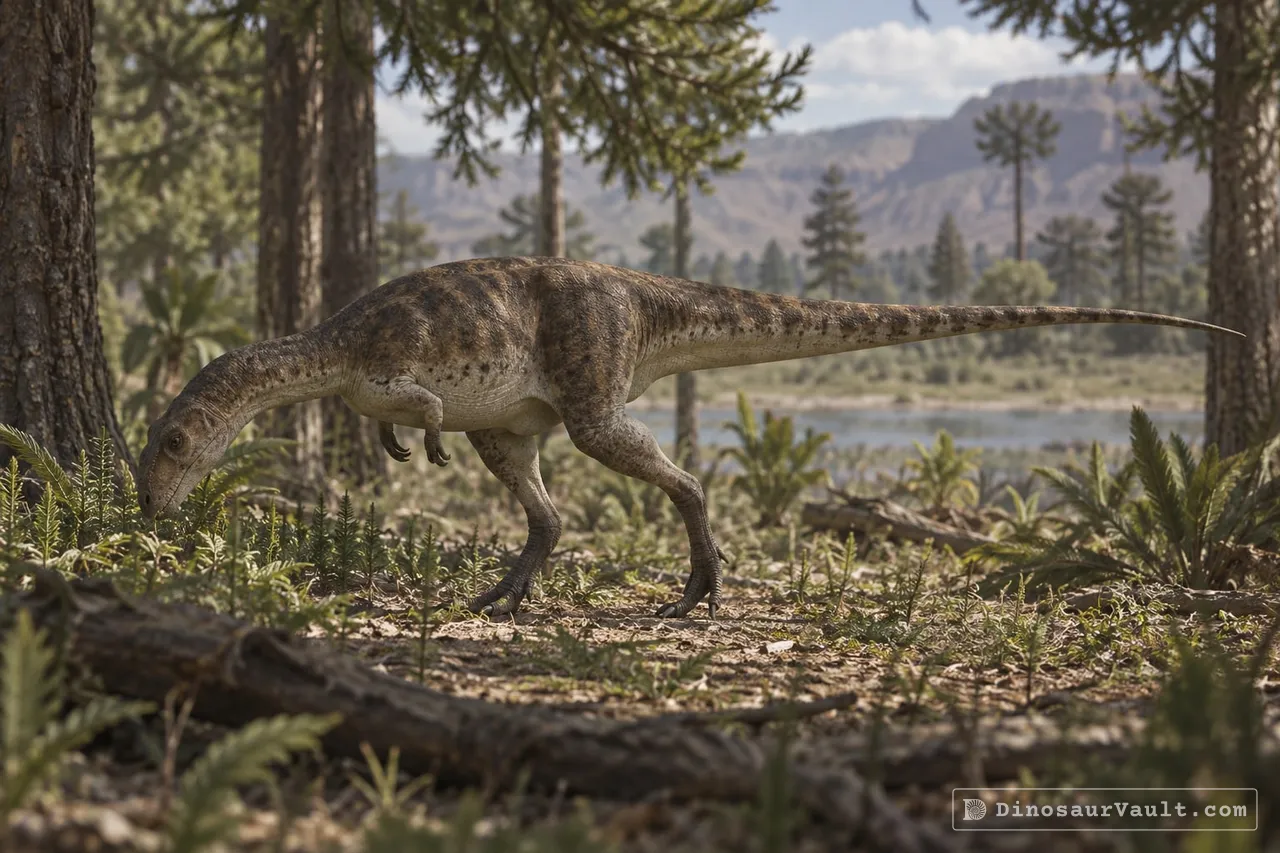
Ligabueino was a tiny noasaurid, a lightly built predator. It is known from a few bones of a young animal, so its adult size is unknown.
Its world
It lived in the Early Cretaceous, in what is now Argentina. It comes from the La Amarga Formation, where it shared the land with the spiny-necked sauropod Amargasaurus.
How it was found
Bonaparte named Ligabueino in 1996, after the man who funded the expedition.
Field gallery
More views of Ligabueino
Scenes reconstructed from the available fossil evidence.
Lived alongside
Found in the same rock formations


A rock formation can hold fossils laid down millions of years apart, so not every animal here met Ligabueino.
The evidence
The science behind Ligabueino
Which parts of the picture come from its own bones, and which come from its relatives.
From its own fossils
- A handful of bones preserves parts of the backbone, hip, thigh and digits of a tiny animal.
- A bone once identified as a toe bone has the shape of a finger bone.
Borrowed from relatives
- Reconstructions of the missing head and limbs draw on small theropods such as Noasaurus and Masiakasaurus.
Still unknown
- Its adult size and skull shape.
- Its exact place among small ceratosaurs.
- Its skin covering and color.
Discovery timeline
- 1996Named itBonaparte
- 2008Family treeCarrano & Sampson
- 2011Growing upCarrano, Loewen & Sertich
Key papers
The research behind what we know of Ligabueino
Named it
Named Ligabueino from a tiny, incomplete skeleton from Argentina.
Cretaceous tetrapods of Argentina. Münchner Geowissenschaften Abhandlungen 30: 73-130
No link available
Family tree
Compared Ligabueino with other ceratosaurs and examined the features linking its fragmentary bones to the abelisauroid branch.
The Phylogeny of Ceratosauria (Dinosauria: Theropoda). Journal of Systematic Palaeontology 6: 183-236
Read the paper : The Phylogeny of Ceratosauria (Dinosauria: Theropoda) (opens in a new tab)Growing up
Recognized the Ligabueino specimen as a juvenile and reassessed its finger bone and family relationships.
New materials of Masiakasaurus knopfleri Sampson, Carrano, and Forster, 2001, and implications for the morphology of the Noasauridae (Theropoda:Ceratosauria). Smithsonian Contributions to Paleobiology: 1-53
Read the paper : New materials of Masiakasaurus knopfleri Sampson, Carrano, and Forster, 2001, and implications for the morphology of the Noasauridae (Theropoda:Ceratosauria) (opens in a new tab)
Close relatives
Other members of Noasauridae


Sources: Wikidata