Amargasaurus
ah-MAR-ga-SORE-us
"La Amarga lizard"
- Lived
- 126 to 121 million years ago, Early Cretaceous
- Diet
- Herbivore
- Length
- estimates range from 10 to 12 m (33 to 39 ft)
- Group
- Sauropods, Dicraeosauridae
- Found in
- Argentina
- Named by
- Bonaparte 1984
Where its fossils were found
The evidence
Today

125 million years ago
Habitat
Rivers and lakes shaped the La Amarga landscape. Other dinosaurs from these rocks include Amargatitanis, Zapalasaurus and Ligabueino.
Field notes
About Amargasaurus
What it was like
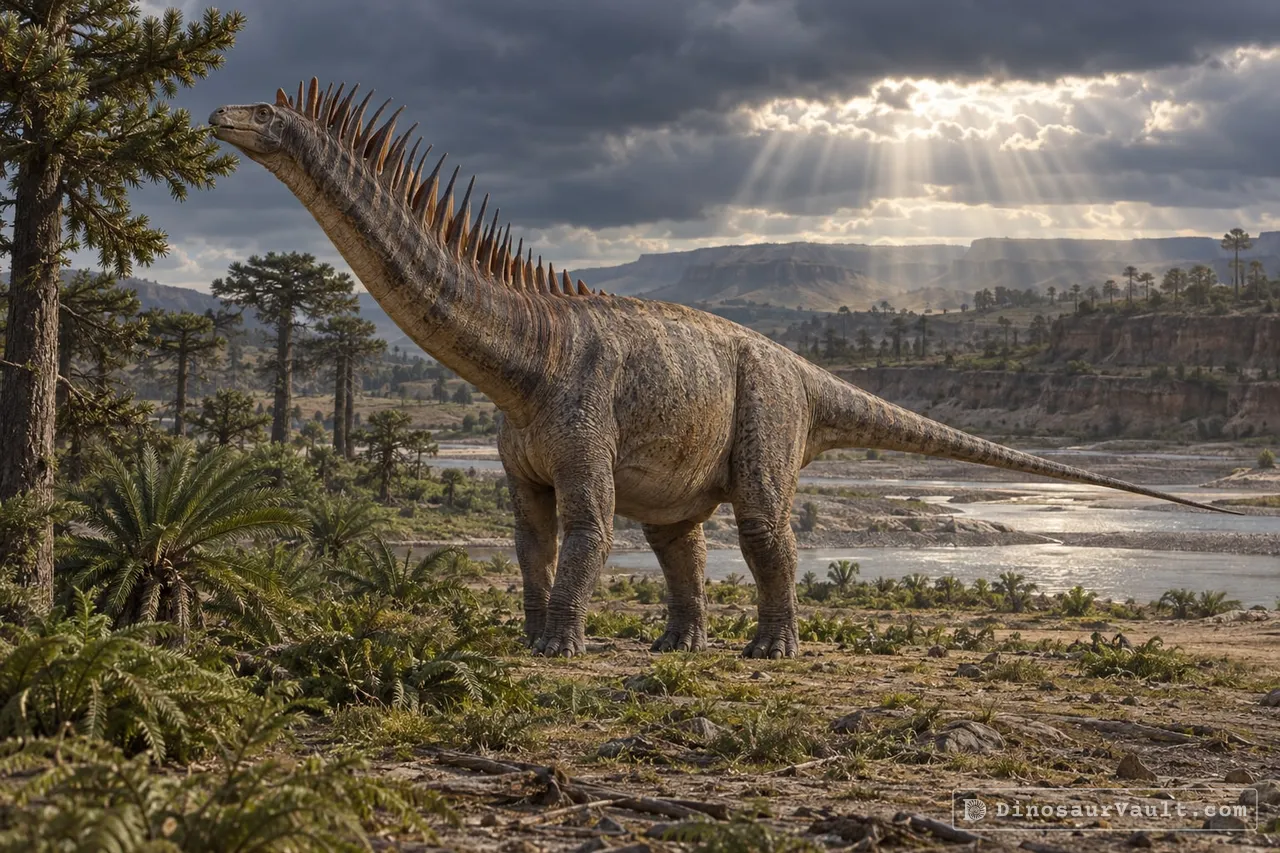
Amargasaurus was a sauropod, but a small one by sauropod standards, reaching roughly 10 to 12 meters (33 to 39 feet) long. Its most striking feature was two parallel rows of tall, narrow spines running from its neck down its back.
Paleontologists debate exactly what the spines looked like in life. Some think they stuck up as bare, horn-covered points, while others think they were joined by skin to form a sail along the neck. Either way, they were probably used for display, and possibly for defense.
Its world
Amargasaurus lived from about 126 to 121 million years ago, in the Early Cretaceous, in what is now Argentina. Its bones come from the La Amarga Formation.
It shared its habitat with other sauropods, including Amargatitanis and Zapalasaurus, and with the small carnivore Ligabueino. As a herbivore living alongside other large plant eaters, it probably fed at a different height than its neighbors to avoid competing for the same food.
How it was found
Bonaparte named Amargasaurus in 1984, from a skeleton that is still one of the most complete of any dicraeosaurid sauropod. Only two fossil finds of the genus are known, but the skeleton's completeness has made it one of the best studied members of its family, alongside relatives like Dicraeosaurus and Suuwassea.
Field gallery
More views of Amargasaurus
Scenes reconstructed from the available fossil evidence.
1 of 7
Lived alongside
Found in the same rock formations


A rock formation can hold fossils laid down millions of years apart, so not every animal here met Amargasaurus.
The evidence
The science behind Amargasaurus
Which parts of the picture come from its own bones, and which come from its relatives.
From its own fossils
- A largely complete skeleton preserves a relatively short neck and a body carried on four legs.
- Neck and front back vertebrae bear paired, exceptionally long bony spines.
- Fine structure inside the neck spines supports a covering of soft tissue joining neighboring spines.
Borrowed from relatives
- Much of the body is known from its own skeleton; missing skull parts are restored using Dicraeosaurus and other close relatives.
Still unknown
- The exact outer shape and covering of the neck spines.
- Whether the spines served mainly for display, defense or another purpose.
- Its color and the appearance of its young.
Often drawn wrong
- A neck as long as Diplodocus's misses its shorter-necked build.
- Huge exposed horn sheaths on every neck spine are a disputed reconstruction.
Discovery timeline
- 1984Named itBonaparte
- 2014PosturePaulina Carabajal, Carballido & Currie
- 2021New findWindholz et al.
- 2021Growing upWindholz & Cerda
- 2022SkinCerda et al.
Key papers
The research behind what we know of Amargasaurus
Named it
Introduced the sauropod known for its paired rows of elongated neck spines.
I dinosauri dell’Argentina [. Sulle Orme dei Dinosauri.
No link available
Posture
Scans of the braincase and inner ear suggest a downward-pointing muzzle and a neck suited to feeding below the treetops.
Braincase, neuroanatomy, and neck posture ofAmargasaurus cazaui(Sauropoda, Dicraeosauridae) and its implications for understanding head posture in sauropods. Journal of Vertebrate Paleontology 34: 870-882
Read the paper : Braincase, neuroanatomy, and neck posture ofAmargasaurus cazaui(Sauropoda, Dicraeosauridae) and its implications for understanding head posture in sauropods (opens in a new tab)New find
Described additional back vertebrae, referring one to Amargasaurus and another to an unidentified relative.
New Dicraeosauridae (Sauropoda, Diplodocoidea) remains from the La Amarga Formation (Barremian–Aptian, Lower Cretaceous), Neuquén Basin, Patagonia, Argentina. Cretaceous Research 117: 104629
Read the paper : New Dicraeosauridae (Sauropoda, Diplodocoidea) remains from the La Amarga Formation (Barremian–Aptian, Lower Cretaceous), Neuquén Basin, Patagonia, Argentina (opens in a new tab)Growing up
Examined microscopic bone structure in Amargasaurus and Amargatitanis to study growth and bone remodeling.
Paleohistology of two dicraeosaurid dinosaurs (Sauropoda; Diplodocoidea) from La Amarga Formation (Barremian–Aptian, Lower Cretaceous), Neuquén Basin, Argentina: Paleobiological implications. Cretaceous Research 128: 104965
Read the paper : Paleohistology of two dicraeosaurid dinosaurs (Sauropoda; Diplodocoidea) from La Amarga Formation (Barremian–Aptian, Lower Cretaceous), Neuquén Basin, Argentina: Paleobiological implications (opens in a new tab)Skin
Microscopic spine structure supports soft tissue between neighboring spines rather than separate horn sheaths.
Osteohistology of the hyperelongate hemispinous processes of Amargasaurus cazaui (Dinosauria: Sauropoda): Implications for soft tissue reconstruction and functional significance. Journal of Anatomy 240: 1005-1019
Read the paper : Osteohistology of the hyperelongate hemispinous processes of Amargasaurus cazaui (Dinosauria: Sauropoda): Implications for soft tissue reconstruction and functional significance (opens in a new tab)
Close relatives
Other members of Dicraeosauridae


Sources: Wikidata