Amargatitanis
"Amarga titan"
- Lived
- 126 to 121 million years ago, Early Cretaceous
- Diet
- Herbivore
- Group
- Sauropods, Dicraeosauridae
- Found in
- Argentina
- Named by
- Apesteguía 2007
Where its fossils were found
The evidence
Today

125 million years ago
Habitat
River channels crossed a floodplain with swamps in what is now Argentina. Amargasaurus, Zapalasaurus and Ligabueino are also known from the La Amarga Formation.
Field notes
About Amargatitanis
What it was like
Amargatitanis was a long-necked plant eater, probably a dicraeosaurid, a sauropod with a fairly short neck for its kind. It is known from part of a hind leg, a hip bone and a few tail bones.
Its world
It lived about 126 to 121 million years ago, in the Early Cretaceous, in what is now Argentina. Its bones come from the La Amarga Formation, where it shared the land with its spiny relative Amargasaurus and the sauropod Zapalasaurus.
How it was found
Apesteguía named it in 2007 from one find.
Field gallery
More views of Amargatitanis
Scenes reconstructed from the available fossil evidence.
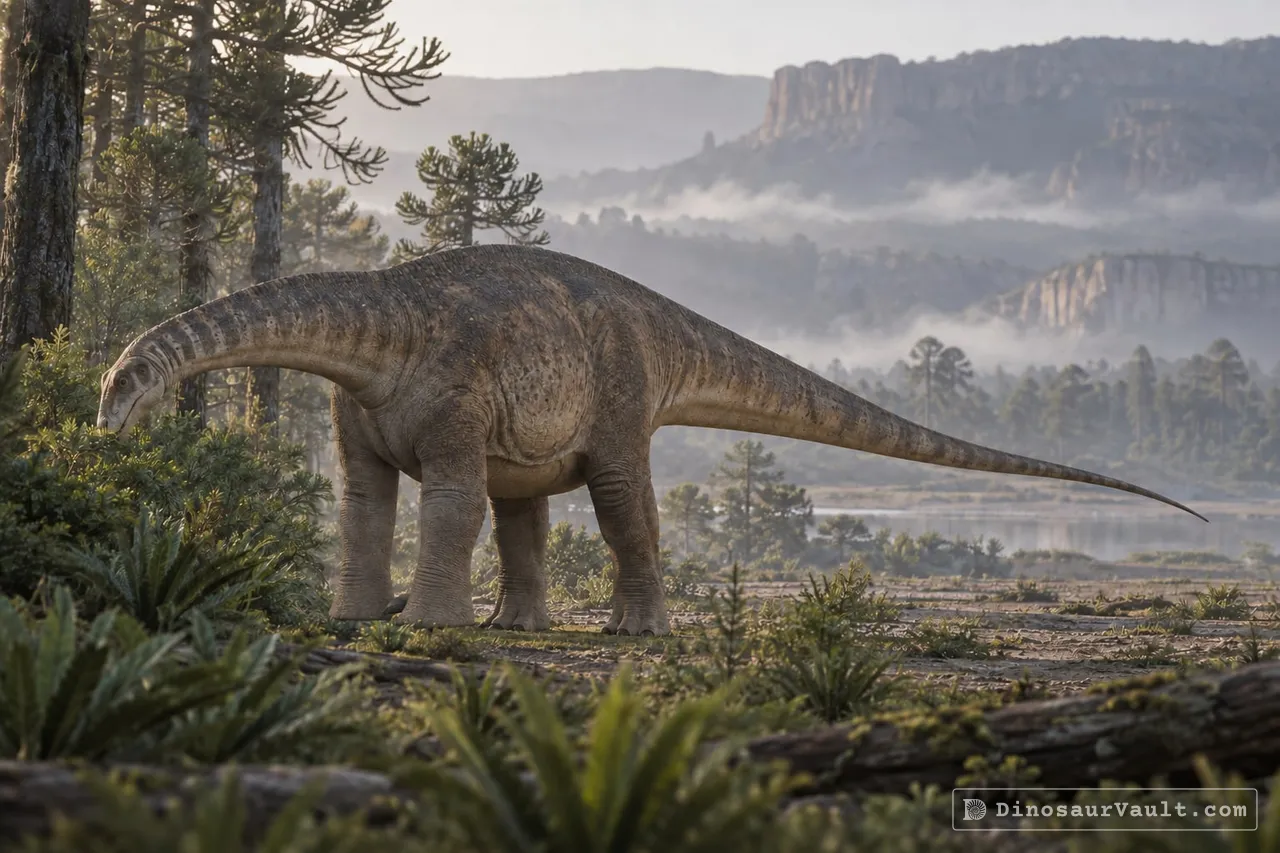
1 of 3
Lived alongside
Found in the same rock formations


A rock formation can hold fossils laid down millions of years apart, so not every animal here met Amargatitanis.
The evidence
The science behind Amargatitanis
Which parts of the picture come from its own bones, and which come from its relatives.
From its own fossils
- Part of a hind leg, a hip bone and tail vertebrae belong to a single incomplete skeleton.
- The thigh bone has growth marks and an outer layer showing that the animal had reached its adult size.
- A reexamination separated bones from different finds that had originally been grouped together under this name.
Borrowed from relatives
- Its missing head and neck are restored by comparison with dicraeosaurids such as Amargasaurus.
- It probably had a relatively short neck for a sauropod, like Amargasaurus and Dicraeosaurus.
Still unknown
- The shape of its skull and the length of its neck.
- Whether its neck carried tall spines like those of Amargasaurus.
- Its skin texture and color.
Discovery timeline
- 2007Named itApesteguía
- 2016RedescriptionGallina
- 2021Growing upWindholz & Cerda
Key papers
The research behind what we know of Amargatitanis
Named it
Named Amargatitanis while describing the variety of sauropods in the La Amarga Formation.
The sauropod diversity of the La Amarga Formation (Barremian), Neuquén (Argentina). Gondwana Research 12: 533-546
Read the paper : The sauropod diversity of the La Amarga Formation (Barremian), Neuquén (Argentina) (opens in a new tab)Redescription
Revised which bones belong to Amargatitanis and placed it among the dicraeosaurids rather than the titanosaurs.
Reappraisal of the Early Cretaceous sauropod dinosaur Amargatitanis macni (Apesteguía, 2007), from northwestern Patagonia, Argentina. Cretaceous Research 64: 79-87
Read the paper : Reappraisal of the Early Cretaceous sauropod dinosaur Amargatitanis macni (Apesteguía, 2007), from northwestern Patagonia, Argentina (opens in a new tab)Growing up
Studied bone tissue in Amargatitanis and Amargasaurus, finding that the Amargatitanis individual had reached adult size.
Paleohistology of two dicraeosaurid dinosaurs (Sauropoda; Diplodocoidea) from La Amarga Formation (Barremian–Aptian, Lower Cretaceous), Neuquén Basin, Argentina: Paleobiological implications. Cretaceous Research 128: 104965
Read the paper : Paleohistology of two dicraeosaurid dinosaurs (Sauropoda; Diplodocoidea) from La Amarga Formation (Barremian–Aptian, Lower Cretaceous), Neuquén Basin, Argentina: Paleobiological implications (opens in a new tab)
Close relatives
Other members of Dicraeosauridae


Sources: Wikidata